

On this page
A faculty review committee sees two strong performers.
One teaches a heavy course load, advises students, coordinates a programme, and supports accreditation.
Another carries a lighter teaching load but leads funded research and postgraduate supervision.
Both contribute significantly.
The problem begins when the review process cannot show that context clearly.
For Provosts, Deans, and Faculty Affairs leaders, that is where performance reviews become difficult to defend. The disagreement is often not about the final rating. It is about whether the institution can explain how it got there.
Quick answer
Faculty performance becomes more transparent when evaluation criteria, workload context, and supporting evidence are visible together. Instead of comparing faculty through isolated metrics or annual summaries, Provosts, Deans, and review committees can evaluate contribution in context, explain decisions more clearly, and use performance discussions to support development, workload planning, and academic governance.
Article summary
| Problem | Faculty are evaluated without enough visibility into the workload and context behind their contribution. |
| Who this is for | Provosts, Deans, Faculty Affairs, Performance Committees, HR, and Institutional Effectiveness leaders. |
| What changes | Workload, evidence, criteria, and review decisions become part of the same performance picture. |
| Why it matters | Reviews are harder to trust when faculty and leaders cannot see how decisions were reached. |
| Outcome | Fairer conversations, stronger development decisions, and more defensible faculty governance. |
Key takeaways
- Performance numbers mean little without workload context.
- Different faculty roles should not be forced into identical comparisons.
- Transparent evidence strengthens rather than replaces academic judgement.
- Faculty reviews should inform development and planning, not simply produce a score.
- Workload and performance become more useful when leaders can see them together.
Why This Matters
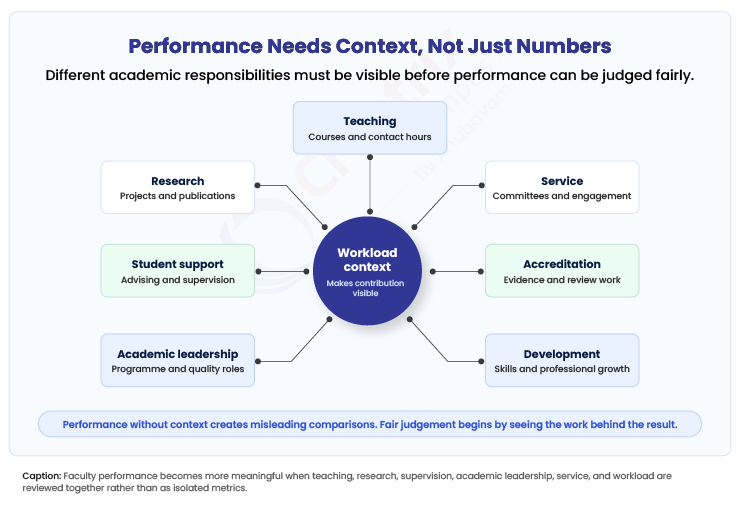
Provosts and Deans are often asked to make consequential decisions about promotion, development, workload, and academic capacity using evidence collected through different processes. When teaching, research, supervision, service, leadership, and accreditation work are not visible in the same context, even a carefully made review can feel unfair. Transparency is not about making every faculty role identical. It is about making different contributions understandable.
Performance Data Without Workload Context Can Mislead
The question in a performance review should not be only:
“What did this faculty member achieve?”
It should also be:
“What responsibilities did they carry while achieving it?”
Consider how differently contribution can appear when context is missing:
| What the review sees | What workload context may reveal |
| Lower research output | Heavy teaching and advising responsibility |
| Fewer courses taught | Postgraduate supervision or funded research |
| Limited committee activity | Programme leadership or accreditation workload |
| Similar teaching scores | Very different class sizes or course demands |
The numbers may all be accurate.
The interpretation can still be unfair.
That is why workload visibility belongs inside the performance conversation. Faculty Workload Management can help institutions make teaching, research, service, supervision, and administrative responsibilities more visible across the academic year.
A Fair Review Must Explain How the Decision Was Reached
Transparency does not mean everyone receives the same outcome.
It means the institution can explain why the outcomes differ.
Faculty should understand what criteria apply, what evidence has been considered, how responsibilities are weighted, and where academic judgement enters the process.
That matters for the review committee too.
When evidence is scattered across annual forms, spreadsheets, CVs, department records, and individual memory, reviewers spend time reconstructing contribution before they can evaluate it.
A more structured approach allows the committee to begin with the evidence already in context.
The AAUP 2024–25 Faculty Compensation Survey in the original research covers more than 800 institutions and illustrates just how varied faculty appointments can be across higher education. That diversity is precisely why one universal performance lens is difficult to defend.
For institutions looking to bring review criteria, evidence, and appraisal workflows closer together, Faculty Performance Management supports a more structured approach to faculty evaluation.
The goal is not to remove professional judgement.
It is to give judgement evidence strong enough to stand behind.
Better Evidence Leads to Better Academic Conversations
The useful outcome of a review is not the score at the bottom of the form.
It is what leaders can decide because of it.
A Dean may discover that one faculty member is carrying disproportionate service work. A department may identify a mentoring need. A Provost may see that workload distribution is limiting research capacity. Faculty Affairs may identify where development opportunities should be directed.
The EDUCAUSE 2024 Teaching and Learning Workforce study cited in the original draft found that only 37% of respondents believed their institutions could create new positions to meet emerging needs.
That makes visibility into existing academic capacity even more important.
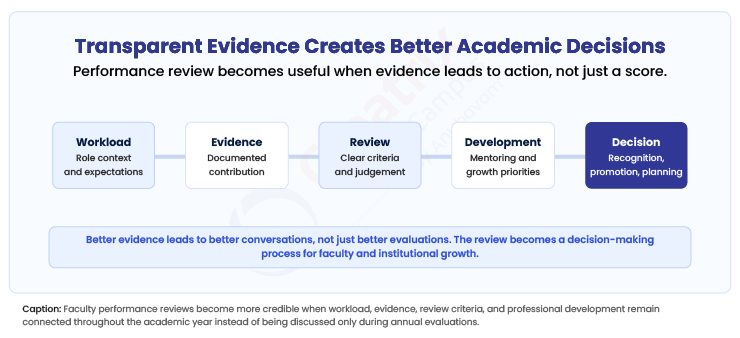
When workload planning, performance evidence, appraisal, and development remain separate, university leaders see snapshots.
When they remain connected, leaders can see a faculty lifecycle.
Faculty Management can support that broader view by bringing faculty contribution, performance, workload, and development into a more connected academic process.
Conclusion
Faculty performance becomes credible when a Provost, Dean, committee, and faculty member can all see the evidence and understand the context behind the decision. The goal is not more monitoring. It is making academic judgement easier to explain and easier to trust.
Could your review committee explain not only who performed well, but why the comparison was fair? See how Creatrix Campus connects faculty workload, performance, and development across the faculty lifecycle.
Quick recap
Transparent faculty evaluation starts by connecting what faculty achieved with what they were asked to carry. When workload, evidence, criteria, and development stay visible together, performance reviews become less about defending a rating and more about making better academic decisions.
Frequently asked questions
What is faculty performance transparency?
Why is workload important in faculty performance reviews?
Does transparent evaluation remove academic judgement?
How does evidence-based evaluation improve fairness?
Why should faculty workload and performance be connected?
Join the conversation
Want to contribute?
We welcome thought leaders to share ideas and write for our blog.
Become a guest author