
On this page
A faculty member asks why her teaching was rated satisfactory while a colleague’s was not. The committee has the scores, but not the reasoning.
Higher education institutions now analyse faculty performance for promotion, tenure and remuneration decisions. Subjective elements such as teaching style and mentorship matter as much as objective metrics such as publications, so institutions want appraisal that is fair, consistent and explainable. This guide covers what a faculty performance appraisal and development system includes, the challenges it has to solve, what accreditors expect, and what an effective system does. It builds on our guide to faculty management solutions.
Quick answer
A faculty performance appraisal and development system evaluates faculty against defined criteria across teaching, research, service and scholarly contribution, gives feedback, and links the results to development, promotion and recognition. It works when criteria are applied consistently, evidence sits in one record, and appraisal leads to development, not just a rating.
Article summary
This guide explains what faculty appraisal covers, nine challenges that make it hard, what accreditation frameworks expect, and what an effective appraisal and development system does.
Key takeaways
- Appraisal covers tenure and promotion, awards and annual reviews, and its results shape both career advancement and faculty growth.
- Subjective elements such as teaching style and mentorship matter alongside objective metrics such as publications, which makes consistency the central challenge.
- Fair appraisal depends on mitigating bias, handling disciplinary differences and compiling complete faculty data.
- Accreditors typically expect clear, merit-based recognition criteria, documented appraisal and development policies, and periodic evaluation of teaching.
- Appraisal should lead to development: feedback, training and mentoring tied to the result.
What Faculty Appraisal and Development Covers
Peers and students are among the stakeholders who provide comments during a multi-stage assessment of faculty. The process covers tenure and promotion decisions, awards and recognition, and annual reviews, and its results influence career advancement and faculty growth.
A faculty performance appraisal and development system has two halves. Appraisal judges performance against defined criteria. Development acts on the result, with feedback, training, mentoring and recognition. A system that does only the first produces ratings. A system that does both produces better teaching and research.
Nine Challenges in Faculty Performance Appraisal
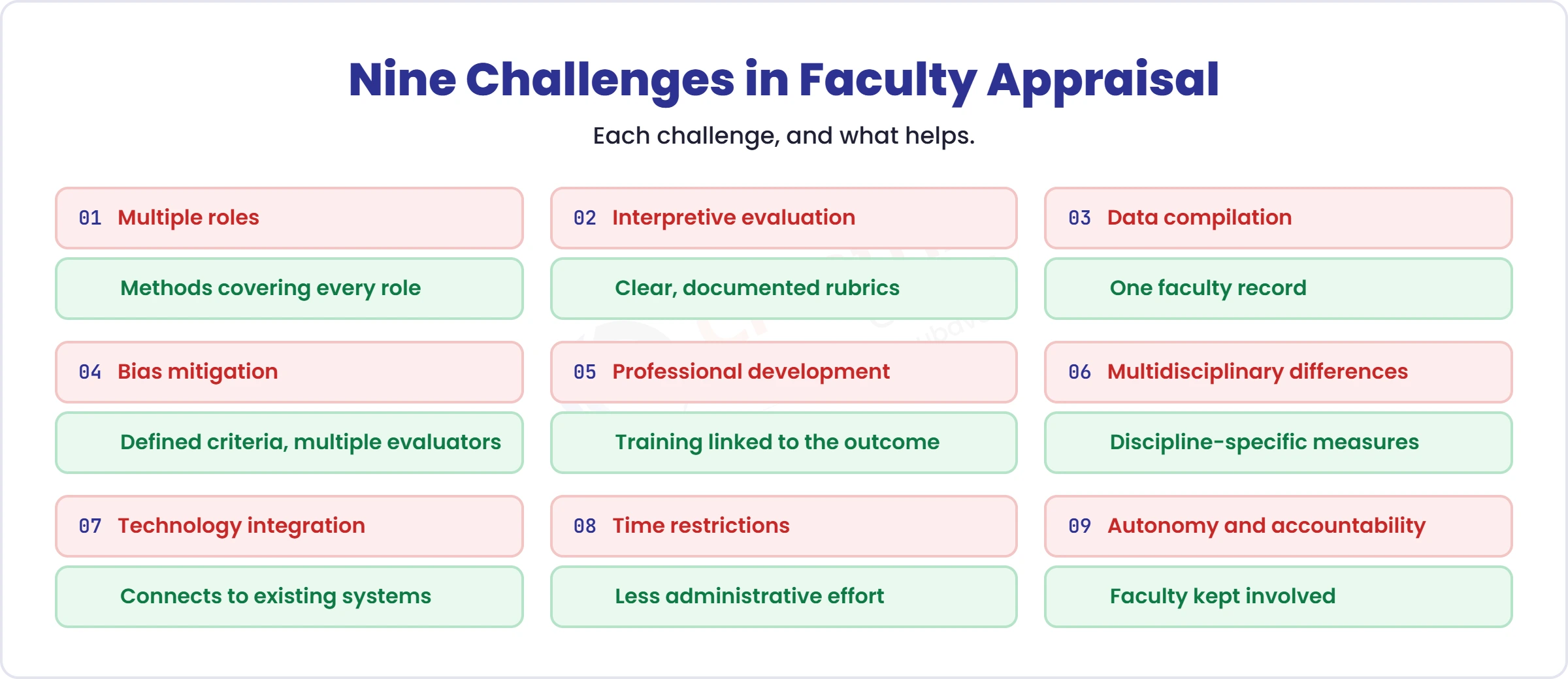
| Challenge | What it looks like | What helps |
| Multiple roles | Faculty teach, research, supervise and serve at once | Evaluation methods that cover every role |
| Interpretive evaluation | Qualitative traits such as teaching style judged inconsistently | Clear rubrics and nuanced, documented judgement |
| Data compilation | Teaching, research, publications, service and scholarly input scattered | One faculty record, compiled across all sources |
| Bias mitigation | Implicit bias shapes ratings | Defined criteria and multiple evaluators |
| Professional development | Appraisal with no route to improvement | Training and support linked to the outcome |
| Multidisciplinary differences | Disciplines use different performance measures | A framework that accommodates discipline-specific measures |
| Technology integration | A tool that does not fit existing systems | A platform that connects to the systems you already run |
| Time restrictions | Reviews limited by faculty and administrator time | Workflows that reduce administrative effort |
| Autonomy and accountability | Oversight that erodes faculty morale | A balance that keeps faculty involved |
What Accreditors Typically Expect
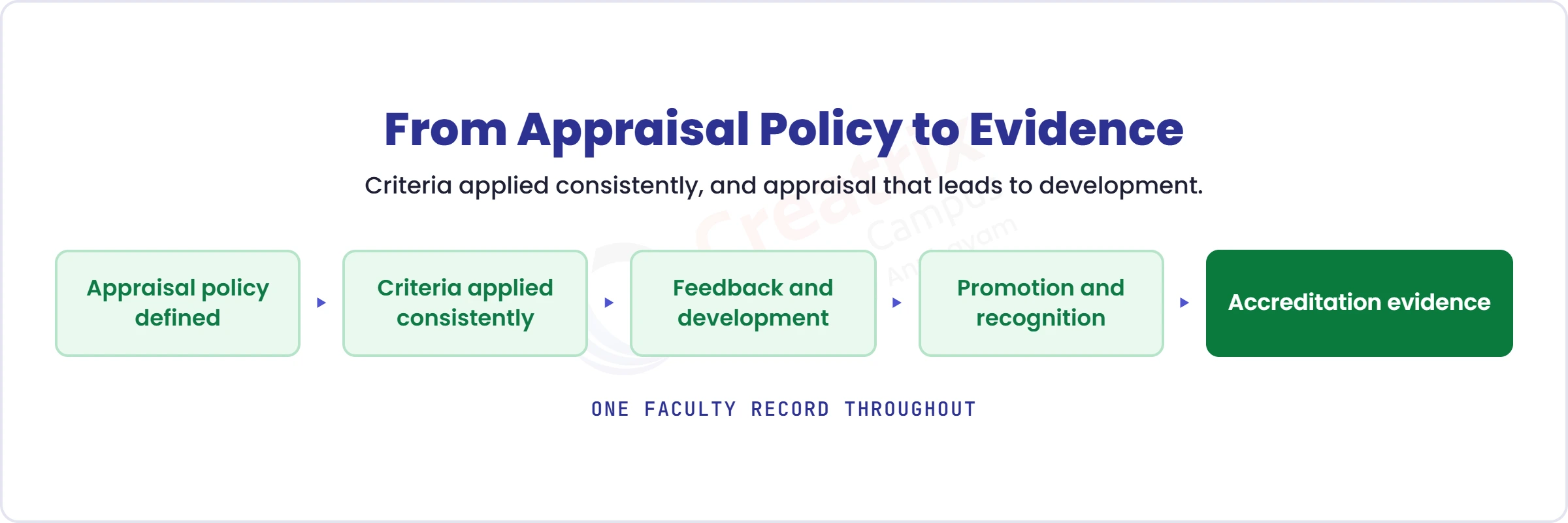
Accreditation frameworks differ by region and level, but they converge on the same questions about faculty. Typically, an institution has to show that:
- Recognition through promotion, pay and awards follows criteria that are clear, transparent and based on merit.
- There are documented policies for appraisal, service and professional development.
- Teaching is evaluated periodically, including student feedback, for quality improvement.
- New and existing faculty have access to development programmes.
The common thread is evidence. An institution has to show that criteria exist, that they were applied consistently, and that appraisal led to development. A system that keeps this in one record makes the evidence a by-product of appraisal, not a project before each review.
What an Effective System Does
An effective system does five things.
- Keeps one faculty record. Teaching, research and publications, service and scholarly contributions are compiled in one place, so reviewers see the full picture.
- Applies criteria consistently. Appraisal follows defined policy, with room for discipline-specific measures, which reduces bias and subjective drift.
- Opens the dialogue. Workflow channels between faculty and assessors keep feedback ongoing, and faculty can see their own performance information.
- Links appraisal to development. Feedback, training, mentoring and recognition follow from the result.
- Supports decisions with analytics. Patterns in the data inform development and resource allocation.
The benefits follow: stronger teaching quality, increased research productivity, better faculty satisfaction and retention, more strategic resource allocation, easier accreditation, and a culture of continuous improvement aligned to institutional goals.
Where Creatrix Campus Fits
In Creatrix Campus, Faculty Lifecycle covers Faculty Performance & Development: performance appraisal, promotion and tenure, reappointment, professional development, training and certifications, mentoring, and awards and recognition. Appraisal and promotion policies are defined in Academic Governance and applied by Faculty Lifecycle, so criteria stay consistent across departments.
Quality Assurance & Accreditation consumes faculty qualifications, professional development and research achievements as evidence. Payroll, leave and attendance stay with the HR system, which Faculty Lifecycle connects to through a governed handoff.
Conclusion
Fair appraisal is not about a better form. It is about criteria that are applied consistently, evidence that is complete, and results that lead to development. Institutions that get this right give faculty transparency and give accreditors proof.
If you want to see how appraisal, development and evidence connect on one faculty record, talk to us about a Tailored Proof Session.
Quick recap
Appraise against clear criteria, keep one faculty record, and link results to development and recognition. That is what faculty want to see and what accreditors want to see evidenced.
Frequently asked questions
What is a faculty performance appraisal system?
What is the difference between appraisal and development?
How do you reduce bias in faculty evaluation?
What do accreditors expect from faculty appraisal?
How does Creatrix Campus support faculty appraisal?
Join the conversation
Want to contribute?
We welcome thought leaders to share ideas and write for our blog.
Become a guest author