

On this page
A faculty member asks where her promotion stands. The Dean opens a spreadsheet, then the HR file, then an email thread, and still cannot give a straight answer. The same Dean is also asked to show that teaching, supervision and committee work are shared fairly across the department. That takes another week.
Nothing about this is unusual. Faculty are among the most important stakeholders in any institution, yet their records are often the most scattered: qualifications in one place, workload in another, appraisal in a third, research somewhere else. Faculty feel it as unfairness and repeated data entry. Provosts feel it when accreditation asks for faculty evidence.
A faculty management solution exists to close that gap: one continuous record of the academic career, from recruitment to promotion, that faculty, deans and quality teams can all rely on.
Quick answer
An effective faculty management solution keeps one governed record of each faculty member’s academic career: recruitment, qualifications, workload, appraisal, promotion, development and research. It applies the institution’s policies consistently, makes workload equity visible, and supplies faculty evidence for accreditation. Payroll, leave and attendance stay with the HR system it connects to.
Article summary
The case for a faculty management solution rests on three things: what the system should own and what it should leave to HR, which parts of the academic career need a continuous record, and what to check before buying so the claims hold up beyond the screens shown in a product tour.
Key takeaways
- Faculty records are often the most scattered in an institution, with qualifications, workload, appraisal and research held in separate files.
- A faculty management solution owns the academic career. Payroll, leave and attendance belong to the HR system it connects to.
- Workload equity and promotion transparency are what faculty most want to see, and what spreadsheets make hardest to prove.
- Faculty qualifications, workload, development and research are accreditation evidence, so a continuous record saves preparation time later.
- Ask to see one faculty record traced from appointment to promotion before trusting a feature list.
What a Faculty Management Solution Should Own
Many institutions first meet faculty management as a payroll or HR project. Salaries, attendance, leave and benefits matter, but they describe the employee, not the academic. The academic career raises different questions. What is this person qualified to teach? How much of the institution’s teaching, supervision and committee work do they carry? Where do they stand for reappointment or promotion?
That is the line worth drawing. An enterprise HR or HCM platform owns the employee lifecycle. A faculty management solution owns the academic one, applying the policies that academic governance defines: appointment criteria, workload rules and promotion standards.
Where an HR system is mandated, the two connect through a governed handoff, so faculty data is entered once and neither system tries to do the other’s job.
The Academic Career, Tracked Continuously
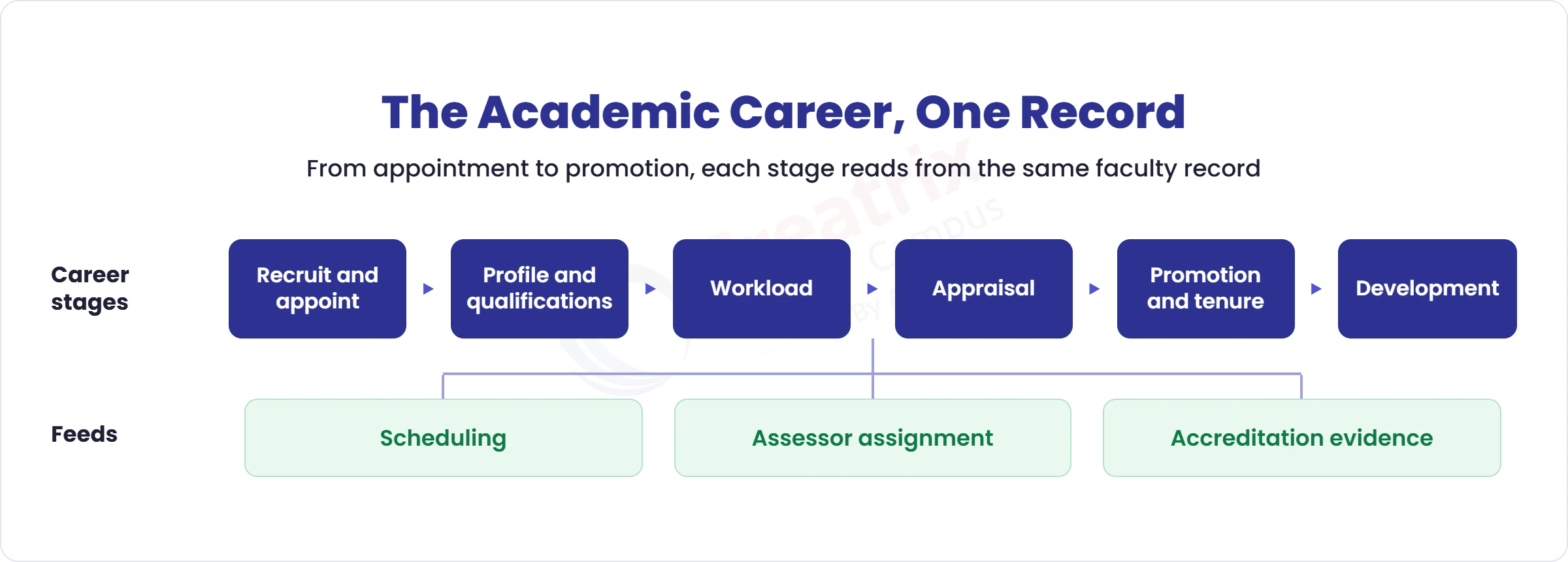
Faculty records usually fail at the joins. A qualification is verified in one file and never reaches the system that assigns teaching. A promotion case is assembled from scratch because publications, teaching and service were never kept together.
A continuous record connects the stages:
- Recruitment and appointment: positions, search committees, candidate evaluation, contracts and onboarding.
- Academic profile: verified qualifications, certifications, portfolios, memberships and availability.
- Workload: allocation against credit limits, hours and points, so the distribution can be seen and defended.
- Appraisal and promotion: weighted parameters such as teaching and publications, reappointment, and promotion and tenure, with the evidence already attached.
- Development and recognition: training, mentoring and awards.
Regulation is moving the same way. In the UAE, for example, the Commission for Academic Accreditation (CAA) now expects terminal degrees for most bachelor’s faculty, caps part-time faculty at 25 percent and requires Ministry of Education attestation of qualifications within a month of hire. Tracked qualifications are becoming a compliance question, not a filing habit.
What to Check Before Investing in Faculty Management Software
| Claim | What it might actually cover | What to ask instead |
| “Faculty management” | A faculty directory or HR file with contact details and contract dates | Ask to see qualifications, workload, appraisal and promotion in one record, not just a profile page |
| “Workload management” | An allocation sheet that does not feed scheduling and that faculty cannot see | Ask whether allocation follows credit limits, hours and points, and whether faculty and deans see the same numbers |
| “Accreditation-ready” | Reports exported to Word, PDF or Excel and assembled by hand | Ask which faculty evidence comes from the live record, and what happens when the record changes |
Ask the plain questions too: how it connects to your existing HR system, whether role-based access lets people see only what they should, what training and support are included, and how pricing behaves in later years. The most reliable test is one faculty member’s record, traced from appointment to promotion, with nobody retyping anything.
Where Creatrix Campus Fits
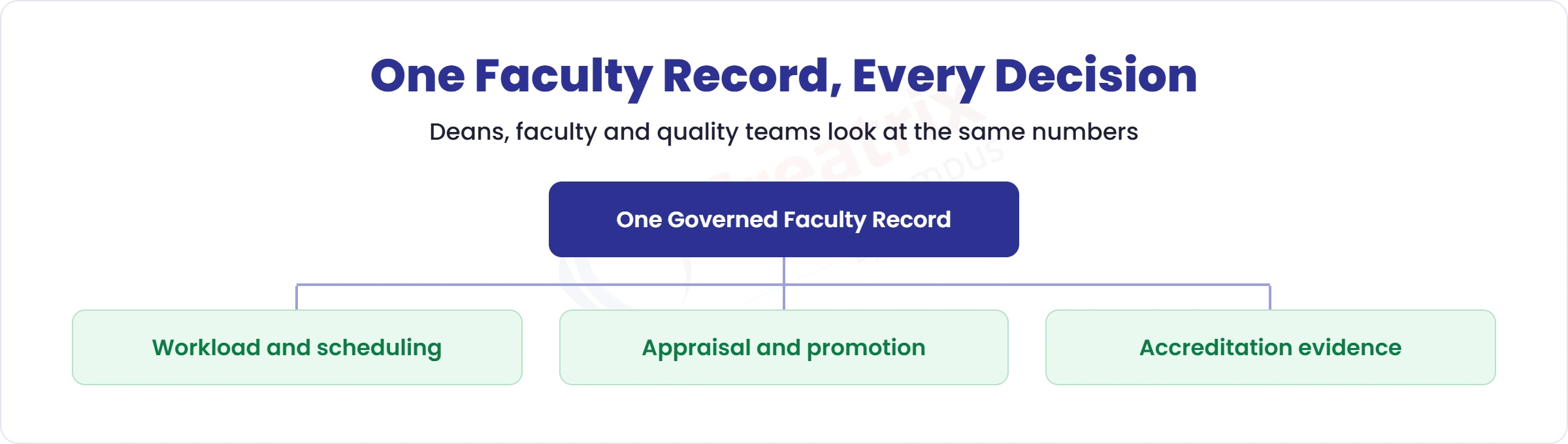
Creatrix Campus Faculty Lifecycle is the academic workforce layer of the Academic Operating System. It keeps one record of the faculty career, from recruitment and appointment through workload, appraisal, promotion and development, and applies the policies set in Academic Governance. Faculty availability and workload feed scheduling, qualifications and expertise feed assessor assignment, and qualifications, staffing, development and research feed accreditation evidence. Research Management is an optional extension for research-intensive institutions.
Where an HR or HCM platform is mandated. Faculty Lifecycle integrates through a governed handoff, and Creatrix Connect brings in data from non-Creatrix HR systems so it does not need replacing.
Conclusion
An institution can hire excellent faculty and still be unable to show that workload is fair, that qualifications are current, or where a promotion case stands, if each answer lives in a different file. Institutions that keep one continuous record give faculty transparency, give deans decisions they can defend, and give quality teams evidence without a scramble. The rest keep assembling the same story from spreadsheets.
Quick recap
An effective faculty management solution keeps one continuous record of the academic career, makes workload and promotion transparent, and feeds accreditation evidence, while leaving payroll and attendance to HR. Test it with one faculty record, not a feature list.
Frequently asked questions
What is a faculty management solution?
How is a faculty management system different from HR software?
What does faculty workload management include?
How does a faculty management solution support accreditation?
How does Creatrix Campus handle faculty management?
Faculty Lifecycle keeps one faculty record connected to governance, scheduling, assessment and accreditation, and integrates with your HR system where one is mandated.
Join the conversation
Want to contribute?
We welcome thought leaders to share ideas and write for our blog.
Become a guest author