
On this page
Ask most academic affairs offices where faculty workload actually lives, and the honest answer is a spreadsheet somewhere, maintained by whoever inherited the job last. One tab for teaching load. Another for committee assignments. A separate file entirely for appraisal cycles, usually built fresh every year because nobody trusts last year's version enough to reuse it.
None of this is because the people running it are careless. It's because faculty management touches too many moving parts, teaching load, research output, service commitments, recruitment, professional development, appraisal, for a spreadsheet to hold reliably once a department grows past a handful of people.
Faculty management software needs to do more than file paperwork. Why the spreadsheet approach quietly fails departments as they scale, and what to look for when evaluating a platform meant to actually support faculty, is where the real gap shows up.
Quick answer
Faculty management software centralizes faculty records, workload allocation, recruitment, appraisal, and professional development in one system, so a dean or provost can see accurate, current data instead of reconciling separate spreadsheets built by different people at different times. The genuinely useful version of this software makes workload allocation visible and defensible, automates the appraisal cycle instead of rebuilding it from scratch every year, and tracks professional development in a way that actually informs retention decisions.
Article summary
The practical case for faculty management software rests on three things: what the category should deliver beyond a basic HR directory, why workload and appraisal data commonly ends up scattered across untrusted spreadsheets, and how to evaluate a platform against what faculty affairs offices actually need day to day.
Key takeaways
- Workload spreadsheets that nobody fully trusts create real disputes, not just administrative friction, because allocation looks uneven and nobody can easily prove otherwise.
- Faculty management touches too many moving parts, teaching load, research, service, recruitment, appraisal, for a spreadsheet to hold reliably once a department scales past a handful of people.
- AAUP, the American Association of University Professors, has defined professional standards for higher education faculty since 1915, including shared governance and workload expectations, reflecting how long institutions have needed structured ways to manage exactly this.
- Appraisal cycles rebuilt from scratch every year waste time and produce inconsistent records that don't hold up well against a retention or promotion decision later.
- The institutions that get real value from faculty management software evaluate it for workload transparency and appraisal consistency, not just for whether it stores an HR record.
What Is Faculty Management Software?
Faculty management software centralizes the full range of information a department, dean's office, or provost needs about faculty: records and qualifications, teaching workload and committee assignments, recruitment and onboarding, appraisal and performance history, and professional development activity. Done well, it answers questions that matter in the moment they're asked, not two weeks later after someone reconstructs a spreadsheet: is this faculty member's workload comparable to their peers, when is their next appraisal due, and what development activity have they completed since their last review.
The category is different from a basic HR system in one specific way: HR systems track employment status and pay. Faculty management software tracks the academic-specific dimensions, teaching load balanced against research and service commitments, appraisal cycles tied to academic calendars, and professional development that maps to promotion and tenure decisions, that a generic HR platform was never built to hold.
Recruitment is part of the same picture. A faculty search that tracks candidates, qualifications, and interview stages in the same system that later manages that person's workload and appraisal avoids the handoff gap where recruitment data gets lost the moment someone is hired.
Why Faculty Data Ends Up Scattered Across Spreadsheets
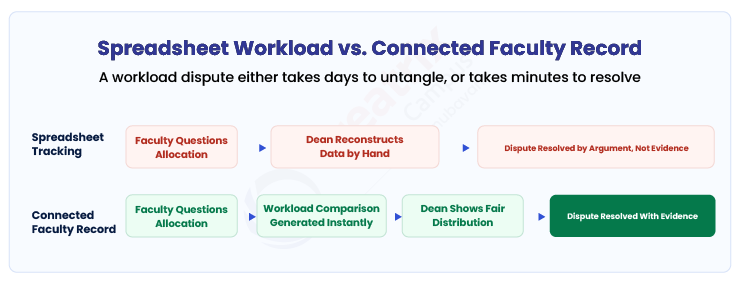
Here's the test that reveals whether faculty workload data is genuinely reliable: if a dean is asked to show that teaching load is distributed fairly across a department, can they produce that comparison in minutes, or does someone have to reconstruct it from several different files first?
In most institutions relying on spreadsheets, the honest answer is reconstruction. Workload data lives with whoever built the original tracking sheet. Appraisal records live somewhere else, often rebuilt each cycle because the previous year's format doesn't quite fit this year's process. Professional development activity, conferences attended, courses completed, gets tracked inconsistently or not at all, which makes it nearly useless when a promotion or retention decision needs that history.
AAUP, the American Association of University Professors, describes itself as a union and membership association of faculty and academic professionals whose mission includes advancing academic freedom and shared governance and defining professional standards for higher education, per AAUP's own site, an organization that has existed since 1915 specifically because faculty employment, workload, and governance in higher education are complicated enough to require structured, ongoing attention. That same complexity is exactly what a department-level spreadsheet was never designed to hold as a program grows.
The honest cost shows up whenever workload gets disputed or an appraisal cycle starts late. Both situations cost the dean's office real time reconstructing data that should have already been current and easy to pull up.
What to Look For When Evaluating Faculty Management Software
Every vendor selling into this category can point to a faculty directory or a basic profile page. That's table stakes. It doesn't tell you whether workload, appraisal, and development data actually connect to each other or just sit in separate tabs of the same product.
| Approach | What implementation looks like | What it costs the institution later |
| Departmental spreadsheets maintained independently | Each department tracks workload and appraisal its own way | Data isn't comparable across departments; disputes get resolved without solid evidence |
| Basic HR system with a faculty module added | Employment and pay tracked reliably, academic-specific data bolted on loosely | Workload, appraisal, and development still require manual reconciliation outside the system |
| Faculty management software built around the academic-specific record | Workload, appraisal, recruitment, and development connected in one place | Requires more upfront setup to migrate existing records, but stays current and comparable afterward |
If the goal is only to store faculty contact and employment records, a basic HR system can do that already. If the goal is to actually make workload defensible and appraisal consistent, the evaluation needs a harder question: can a dean pull a workload comparison across the whole department in minutes, and does an appraisal cycle carry forward last year's record automatically rather than starting from a blank template.
| Capability | Why it matters | What to ask a vendor |
| Workload visibility across a department | Deans need to show allocation is fair, not just assert it | Ask how a workload comparison across all faculty in a department is generated |
| Appraisal cycle automation | Rebuilding the appraisal process from scratch each year wastes time and produces inconsistent records | Ask whether appraisal cycles carry forward prior history automatically |
| Recruitment-to-onboarding continuity | A new hire's search record shouldn't disappear the moment they're hired | Ask whether recruitment data flows into the faculty's ongoing record after onboarding |
| Professional development tracking tied to review | Development activity is only useful if it actually informs promotion or retention decisions | Ask how development records surface during an appraisal or promotion review |
Where Creatrix Campus Fits
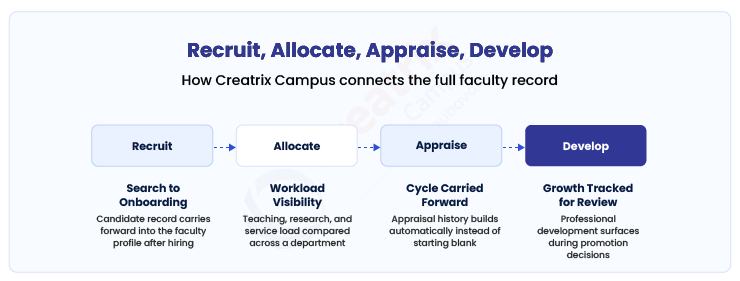
Creatrix Campus centralizes faculty records, workload, recruitment, appraisal, and professional development in one connected system, not a faculty directory with a few extra fields.
Workload allocation is visible across a department, so a dean can show, rather than assert, that teaching load is distributed fairly. Appraisal cycles carry forward prior history automatically instead of being rebuilt from a blank template every year. Recruitment data flows directly into a hired faculty member's ongoing record, so nothing gets lost in the handoff from search to onboarding. Professional development activity is tracked in a way that actually surfaces during appraisal and promotion review, instead of living in a separate, disconnected file.
The practical effect is that faculty affairs offices spend less time reconstructing data under deadline pressure and more time actually using it, for workload planning, for appraisal cycles, and for the retention conversations that depend on an accurate record.
Conclusion
Most institutions manage faculty workload and appraisal in spreadsheets that nobody fully trusts, rebuilt every cycle by whoever currently owns the job. That works, barely, right up until a workload dispute or a promotion review needs a record that should have been reliable all along.
The harder, more useful question when evaluating faculty management software isn't whether it stores a faculty directory. It's whether workload, appraisal, recruitment, and development data actually connect to each other, so a dean can produce a fair comparison in minutes and an appraisal cycle doesn't start from a blank page every year. Institutions that evaluate for that get a system faculty affairs offices can actually rely on.
If you want to see how Creatrix Campus connects faculty workload, appraisal, recruitment, and development in one system, talk to us about faculty management software.
Quick recap
Faculty management software should centralize faculty records, workload allocation, recruitment, appraisal, and professional development in one connected system, so a dean or provost can see accurate, current data instead of reconciling separate spreadsheets. That requires workload transparency across a department, appraisal cycles that carry forward automatically, and development records that actually inform retention and promotion decisions, not just a faculty directory with a few extra fields.
Frequently asked questions
What is faculty management software?
How is faculty management software different from a basic HR system?
Why does faculty workload and appraisal data end up scattered across spreadsheets?
What should institutions look for when evaluating faculty management software beyond a directory?
How does Creatrix Campus handle faculty management?
Join the conversation
Want to contribute?
We welcome thought leaders to share ideas and write for our blog.
Become a guest author