

On this page
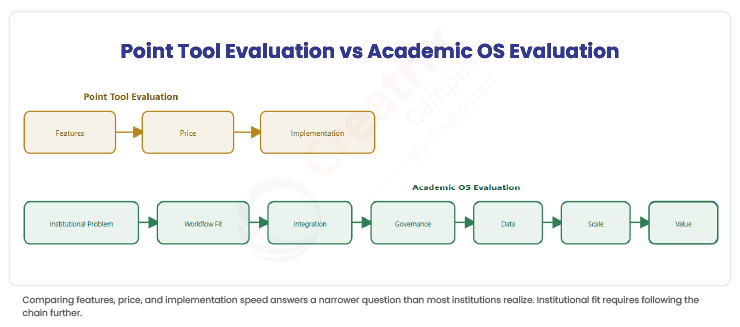
Every higher education software evaluation eventually turns into a features and pricing comparison, because that's the easiest thing to compare on a spreadsheet. It's also the comparison least likely to tell you whether the platform will connect your institution's academic operations or simply become one more system your teams have to work around.
Quick answer
Universities should evaluate higher education management software by asking whether it fits the institution's actual operating model, connecting curriculum, assessment, faculty, and student data, rather than judging it only on feature lists, price, and implementation speed. A platform that scores well on those three but adds another disconnected system to the stack solves less than it appears to.
Article summary
This article keeps the practical, buyer oriented structure of a ten point evaluation framework, because at this stage of a decision, a checklist is genuinely useful. What changes is the substance behind each question. Instead of asking whether a vendor has the features you want, each question asks whether the software can actually operate as part of the institution, connecting workflows, data, and governance, rather than becoming another system to integrate around later.
Key takeaways
- Feature lists and pricing comparisons rarely reveal whether software will reduce or add to institutional fragmentation.
- Many implementation problems, unclear ownership, poor data mapping, workflow mismatches, actually started as unasked evaluation questions.
- Integration should be judged by whether it connects the systems you're keeping, not by whether APIs exist on paper.
- Total cost includes integration, implementation, and support, not just the license price.
- The strongest evaluation question isn't about features at all. It's whether the software strengthens how the institution operates as one system.
The 10 Questions That Actually Reveal Institutional Fit
A ten point checklist is still the right tool at this stage of a decision. What matters is which ten questions you're actually asking, since the standard version, priorities, customization, security, scalability, reliability, pricing, time to market, integration, support, can be answered well by a system that still leaves your institution fragmented.
1. What institutional problem are we actually solving?
Before comparing vendors, define the actual academic or operational problem the software needs to solve, and which stakeholders, students, faculty, staff, are affected. A vendor selected to fix a narrow pain point often gets stretched to cover problems it was never designed for.
2. Does the platform connect the academic workflows that matter?
Ask whether curriculum, assessment, scheduling, and student records can actually inform each other inside the platform, not just sit in the same login. A system that houses everything but connects nothing still leaves your teams reconciling data by hand.
3. How well does it integrate with the systems we are keeping?
Few institutions replace everything at once. The real question is whether the new platform can exchange data cleanly with the SIS, LMS, or finance system staying in place, and what that integration actually requires from your IT team, not just whether an API exists.
4. Can governance, roles, and approvals be configured without creating workarounds?
If the platform's approval workflows don't match how your curriculum committee or registrar's office actually operates, staff will build workarounds within weeks. Ask to see the governance and permission model configured for a process like yours, not a generic demo.
5. What happens to data quality and ownership across systems?
Every additional system is another place data can drift out of sync. Ask specifically who owns the authoritative record for a student, a course, or a faculty assignment once this platform is in place, and how conflicts between systems get resolved.
6. Can the platform scale across lifecycles, programmes, campuses, or future requirements?
Scalability isn't only about concurrent users. Ask whether the platform can support additional programmes, campuses, or lifecycle stages you don't need yet without a re-architecture, and what licensing changes when you add them.
7. What will implementation actually require from our teams?
Every implementation timeline promise depends on how much of your institution's data mapping, workflow configuration, and change management work happens before go live. Ask for a realistic breakdown of what your staff, not the vendor's team, will need to do.
8. How should we evaluate total cost, not just license price?
The license fee is rarely the full cost. Ask for a total cost picture that includes integration work, implementation services, training, ongoing support, and what happens to pricing as you add modules, users, or campuses over time.
9. What evidence exists for reliability, security, and support?
Rather than taking a vendor's security claims at face value, ask for their responses to a recognized higher education vendor assessment framework. The Higher Education Community Vendor Assessment Toolkit, developed by EDUCAUSE, Internet2, and REN-ISAC, gives institutions a standardized way to evaluate a vendor's cybersecurity, privacy, and compliance practices instead of relying on a sales conversation alone.
10. Will this reduce fragmentation or add another layer to it?
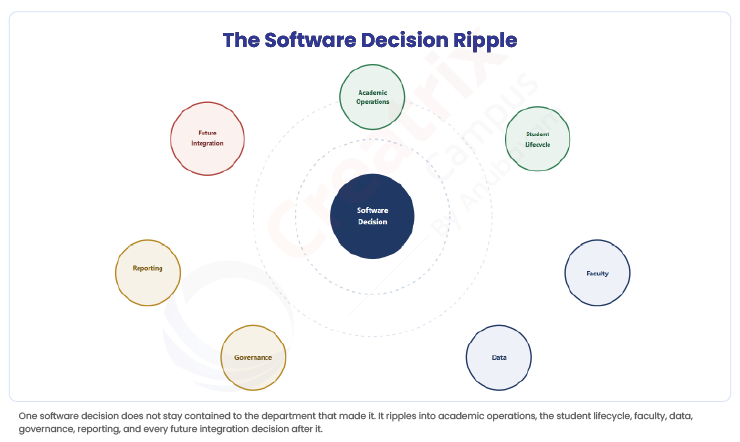
This is the question the other nine build toward. A platform that answers every prior question well but still operates as a separate silo from your academic data and workflows hasn't solved the underlying problem, it has just added a better looking layer on top of it.
| Evaluation Area | Weak Buying Question | Stronger Institutional Question |
| Integration | Does it have APIs? | Can it connect the systems and workflows we are actually keeping? |
| Scalability | Can it handle more users? | Can it support more lifecycles, programmes, campuses, and governance complexity? |
| Implementation | How fast can we go live? | What data, workflow, ownership, and change dependencies must be resolved first? |
| Cost | What is the annual license? | What is the total cost of integration, implementation, support, and future expansion? |
| Reporting | Does it have dashboards? | Can leadership see connected context across academic operations? |
Read the left column as the questions a features comparison naturally produces, and the right column as the ones that actually predict whether implementation goes smoothly. Most procurement processes only ever ask the left column out loud.
Where Creatrix Campus Fits
Creatrix Campus is built as the Academic Operating System that connects academic lifecycles, curriculum, assessment, faculty, and student data, along with the governance and evidence trail that runs across them, rather than functioning as one more standalone application. Because policy and workflow rules are configured rather than hardcoded, the platform can be adapted to an institution's existing governance model instead of forcing a generic workflow onto it.
Creatrix Campus does not replace every SIS, ERP, LMS, or finance system an institution already runs, and integration effort, implementation timelines, and scalability still depend on the specific systems and complexity involved. What it's built to do is reduce the number of disconnected systems academic decisions have to pass through, which is the question worth testing directly against your own environment rather than taking on faith.
Institutions evaluating where a connected platform fits their broader technology environment can review how Platform, Data and AI connects across existing systems, and what the Academic Operating System actually means as an evaluation category, distinct from a single application.
Conclusion
The right software decision isn't the one with the longest feature list or the fastest quoted implementation. It's the one that reduces fragmentation while fitting the way your institution actually operates, governance, workflows, and data included. Before your next vendor conversation, it's worth asking a version of question ten directly: if we implement this exactly as proposed, will our teams be connecting systems, or still stitching them together themselves. If you want to see how Creatrix Campus approaches that evaluation for your institution specifically, request a demo.
Quick recap
Feature lists, pricing, and implementation speed are the easiest things to compare, and the least likely to reveal whether software will reduce institutional fragmentation. The stronger evaluation asks whether the platform fits your workflows, governance, and data, connects the systems you're keeping, and whether the total cost and implementation effort are realistic once integration is accounted for.
Frequently asked questions
How should universities evaluate higher education management software?
What is the biggest mistake institutions make when comparing vendors?
Why does integration matter more than the presence of an API?
How can institutions evaluate a vendor's security and compliance claims objectively?
Join the conversation
Want to contribute?
We welcome thought leaders to share ideas and write for our blog.
Become a guest author