

On this page
EQUIS accreditation asks a harder question than whether a business school has good programmes, capable faculty, or an international student body. It asks whether those strengths add up to one coherent institution operating on a clear strategy, and whether the school can prove that connection with evidence rather than assertion.
Quick answer
The EQUIS accreditation process for business schools runs through eligibility, a self-assessment report against ten standard areas, peer review by an international team, a site visit, and a final decision by EFMD's Accreditation Board resulting in a 3-year or 5-year award. The process typically takes 2 to 3 years, and in the most favourable circumstances can be completed in around 15 months. EQUIS is an international accreditation, not one limited to Europe.
Article summary
Business schools often prepare for EQUIS by building strong documentation for each individual criterion, from governance to faculty to internationalisation, without being able to show how those areas connect back to one institutional strategy. That gap matters because EQUIS panels are trained to look across the institution, not at ten separate files. Schools whose evidence stays connected to daily academic and administrative work are far better positioned than those that reconstruct their story from scratch before every review.
Key takeaways
- EQUIS assesses ten standard areas, not a checklist of isolated strengths.
- The accreditation process typically takes 2 to 3 years and results in a 3-year or 5-year award.
- EQUIS is an international accreditation open to business schools worldwide, not a Europe-only standard.
- Evidence built continuously through normal operations holds up better than evidence assembled for a single self-assessment report.
What EQUIS Is Really Looking Across
EQUIS evaluates a business school across ten standard areas: governance and strategy, programmes, students, faculty, research, executive education where offered, resources and administration, internationalisation, ethics and responsibility, and connections with practice. Each area has its own documentation requirements, and it is entirely possible for a school to build a strong file for every single one.
That is not the same as passing review comfortably. EQUIS panels are trained to look at how these areas reinforce each other, not just whether each independently clears a bar. A school that names strategic internationalisation as a priority should be able to show that priority reflected in faculty recruitment and activity, in programme design, in student mobility, and in its partnerships with practice, not only in a governance document.
| EQUIS Area | What the School Needs to Demonstrate | Evidence That Makes It Visible |
| Governance & Strategy | A clear institutional strategy with real operational follow-through | Strategic plans linked to programme, faculty, and partnership decisions |
| Programmes | Coherent design and learning outcomes across the portfolio | Curriculum records connected to outcome data, not standalone syllabi |
| Faculty | Qualified faculty active in both research and teaching | Faculty activity and research output tracked against strategic priorities |
| Research | Demonstrated academic, applied, and pedagogical impact | Assessment and outcomes data connected back to research and teaching activity |
| Internationalisation | A genuine international footprint, not isolated exchange numbers | Student mobility, faculty international activity, and partnerships shown together |
| Connections with Practice | Real engagement with employers, policy, and industry | Corporate and advisory relationships traceable to programme and research decisions |
EQUIS asks a school to demonstrate more than individual areas of strength. The harder question is whether those strengths add up to a coherent institution.
The Hard Part Is Connecting Strategy to Evidence
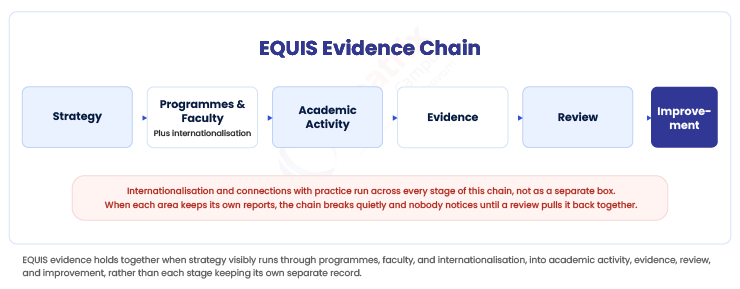
This is where most EQUIS preparation gets difficult. A school's strategy usually looks clear on paper: internationalise the student body, deepen corporate partnerships, strengthen research output, or reposition a flagship programme. The harder task is showing that the strategy actually runs through programmes, faculty deployment, research priorities, internationalisation activity, corporate connections, student experience, and governance decisions, rather than sitting separately from all of them.
The operating chain looks like this: strategy shapes academic activity, academic activity produces evidence, evidence gets reviewed, review leads to a decision, and the decision feeds back into improvement. When each area, faculty, programmes, internationalisation, corporate engagement, keeps its own reports and its own data, that chain breaks quietly. Nobody notices until a self-assessment report tries to pull it all back together and finds the pieces no longer tell one story.
This is also where accreditation periods create risk. A school accredited for 5 years may see a change in dean, market conditions, or strategic focus well before its next review. Evidence built for the earlier strategy does not automatically update itself, and governance records, programme documentation, or faculty activity can quietly continue reflecting a priority the school has already moved past.
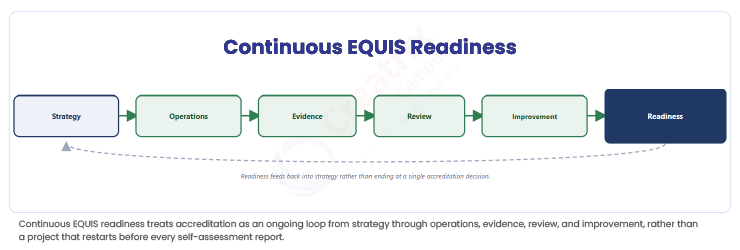
From EQUIS Preparation to Continuous Readiness
Self-assessment should describe how a business school works. In practice, it often becomes the point where the school first tries to understand itself, reconciling different departments' records, chasing internationalisation numbers, and asking faculty to reconstruct activity from memory. That is a difficult way to write an accurate document under a deadline.
| Periodic EQUIS Preparation | Continuous EQUIS Readiness |
| Evidence gathered for self-assessment | Evidence maintained through normal operations |
| Strategy explained retrospectively | Strategy remains connected to execution |
| International activity counted | Internationalisation remains visible across the school |
| Corporate engagement compiled | Relationships and impact remain traceable |
| Improvement reconstructed | Findings, decisions and actions stay connected |
This is an institutional operating comparison, not an official EFMD model. The self-assessment should describe how the school works. It should not be where the school first reconstructs how everything fits together.
Where Creatrix Campus Fits
Creatrix Campus connects the academic and administrative activity that EQUIS evidence depends on: curriculum and programme decisions, faculty activity, assessment and outcomes data, and accreditation evidence, so a change in strategy stays visible across the records that support it. That gives quality and accreditation teams a current view of how governance, programmes, and faculty work line up with institutional strategy throughout the cycle, not only in the months before a self-assessment report is due. It does not replace academic judgement, EFMD's process, or peer review. It supports the evidence discipline those processes depend on.
Conclusion
EQUIS panels are ultimately testing whether a business school's strategy is something the institution runs on, not something written into a plan. That test gets harder the longer strategy and evidence are allowed to drift apart between reviews. See how Creatrix Campus can help you keep accreditation evidence connected across your institution.
Quick recap
EQUIS accreditation rewards business schools that can show one strategy running through governance, programmes, faculty, internationalisation, and corporate connections, not ten separately strong files. The real risk is not missing documentation. It is evidence that quietly falls behind once strategy shifts. Keeping records connected as priorities change makes the self-assessment report a much smaller lift than rebuilding the story from scratch.
Frequently asked questions
What is EQUIS accreditation?
Who can apply for EQUIS accreditation?
What is the EQUIS accreditation process?
What does EQUIS assess in a business school?
How should a business school prepare for EQUIS accreditation?
Join the conversation
Want to contribute?
We welcome thought leaders to share ideas and write for our blog.
Become a guest author