

On this page
A common assumption trips up engineering programmes preparing for accreditation in the UK: that an application goes to the Engineering Council, and the Engineering Council reviews it directly. That is not how the system works. Programmes are accredited by licensed professional engineering institutions against a standard the Engineering Council sets, and confusing the two leads institutions to prepare for the wrong process entirely.
Quick answer
Engineering Council programme accreditation in the UK is carried out by professional engineering institutions that the Engineering Council has licensed to accredit degrees, evaluated against the Accreditation of Higher Education Programmes standard, currently in its fourth edition, AHEP 4. The Engineering Council sets the standard and oversees the system, but the accreditation visit, review, and decision are conducted by the relevant licensed institution, not the Engineering Council directly.
Key takeaways
- Engineering degree accreditation in the UK is conducted by licensed professional engineering institutions, not by the Engineering Council itself.
- AHEP, currently in its fourth edition, is the standard institutions accredit against, set by the Engineering Council in line with UK-SPEC.
- An accredited degree supports the educational requirements for professional registration but does not automatically confer Chartered Engineer or Incorporated Engineer status.
- Accreditation evidence is strongest when learning outcomes stay traceable through curriculum, assessment, review, and improvement, not assembled only when an accreditation visit approaches.
How Engineering Programme Accreditation Actually Works in the UK
The Engineering Council does not accredit individual degree programmes. It sets the overall standard, the Accreditation of Higher Education Programmes framework, in line with UK-SPEC, the Standard for Professional Engineering Competence and Commitment. Actual accreditation is carried out by professional engineering institutions that the Engineering Council has licensed for this purpose. A university sends its accreditation application to one or more of these licensed institutions, and that institution conducts the review, including an accreditation visit, and makes the accreditation decision.
AHEP is currently in its fourth edition. According to the Engineering Council's guidance for higher education providers, accredited status typically runs for five years from the first-year student intake date of the programme, and institutions are expected to reapply for re-accreditation well before that period ends, ideally at least twelve months ahead. Accreditation can apply at bachelor, honours, integrated master's, and other postgraduate levels.
It matters just as much to be precise about what accreditation does not do. An accredited programme supports some or all of the underpinning knowledge, understanding, and skills a graduate needs to pursue professional registration, such as Chartered Engineer or Incorporated Engineer status. It does not automatically grant that status. Registration still requires the individual to apply separately and meet the relevant competence requirements under UK-SPEC.
| Part of the UK System | Role | What It Means for Universities |
| Engineering Council | Sets the AHEP standard and oversees the overall system | Programmes are ultimately judged against AHEP, not an internal Engineering Council checklist |
| Licensed Professional Engineering Institution | Reviews and accredits individual degree programmes | The application, visit, and decision are handled by the relevant licensed institution, not the Engineering Council directly |
| AHEP | The standard programmes are accredited against, currently fourth edition | Programme learning outcomes and evidence must map to AHEP's requirements |
| UK-SPEC | The competence standard AHEP aligns with, underlying professional registration | Accreditation supports, but does not replace, an individual's own registration application |
The Hard Part Is Connecting Learning Outcomes to Evidence
Once a programme understands who it is actually being reviewed by, the harder problem comes into view. AHEP accreditation rests on whether a programme can show that its intended learning outcomes are genuinely taught, assessed, and achieved, not simply listed in a validation document.
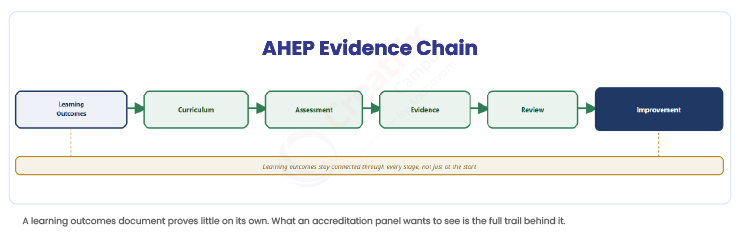
The chain that matters runs from programme learning outcomes through curriculum design, into teaching, into assessment, into evidence of student achievement, into academic review of that evidence, and into whatever improvement action follows. Programmes run into trouble when these pieces live apart from each other. Learning outcomes sit in a curriculum document that was last touched at validation. Assessment evidence sits in module-level records that nobody has mapped back to those outcomes. Programme committee minutes record that an issue was discussed, but there is no link showing what changed in the curriculum or assessment as a result.
An accreditation visit tends to surface exactly this kind of disconnection, because a reviewing panel will typically ask not just what the learning outcomes are, but how a programme knows students are achieving them and what happens when they are not. A programme that can only produce the learning outcomes document, without the assessment and review trail behind it, has a much harder case to make than one that can show the full path.
Accreditation evidence becomes stronger when a programme can trace how its intended learning outcomes are taught, assessed, reviewed, and improved.
From Accreditation Preparation to Continuous Programme Readiness
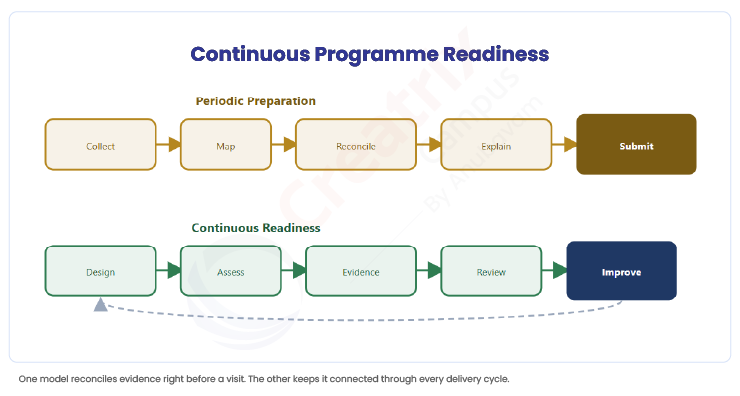
Many programmes only test whether this evidence chain actually holds together when an accreditation visit is approaching. That timing works against them. A gap between what the curriculum says and what assessment actually measures is far easier to fix a year in advance than during the weeks before a panel visit.
A steadier approach keeps this evidence connected as part of normal programme delivery. Learning outcome mapping stays attached to live curriculum design rather than a frozen validation record. Assessment results get tied back to specific outcomes as they are marked, not reconstructed afterward. Programme review decisions get logged with a clear link to the evidence that prompted them, so a panel, or the programme team itself, can trace a finding through to whatever action followed.
This is an institutional operating comparison, not an official Engineering Council or AHEP model, and it does not change what any specific licensed institution requires for its own review.
| Periodic Accreditation Preparation | Continuous Programme Readiness |
| Outcome evidence assembled later | Evidence maintained through delivery |
| Curriculum mapping reconciled for review | Mapping remains connected to programme design |
| Assessment records gathered separately | Assessment remains tied to learning outcomes |
| Improvement actions reconstructed | Decisions and actions remain traceable |
| Accreditation triggers evidence work | Accreditation draws from existing programme evidence |
Accreditation preparation becomes lighter when the evidence trail already exists.
Where Creatrix Campus Fits
Creatrix Campus helps engineering programmes keep curriculum mapping, learning outcomes, assessment evidence, and programme review connected to the workflows that produce them. Outcome attainment data stays linked to the assessments and curriculum decisions behind it, and improvement actions remain traceable to the review findings that prompted them, reducing the need to reconstruct those relationships when accreditation evidence is required. This does not guarantee Engineering Council accreditation, AHEP approval, or professional registration outcomes, all of which rest with the relevant licensed institution and the Engineering Council.
Conclusion
AHEP readiness is strongest when accreditation evidence already exists as a traceable result of how the engineering programme is designed, assessed, reviewed, and improved, not as a document set built for a single visit. Understanding that a licensed institution, not the Engineering Council itself, conducts that review is the first step toward preparing for the right process.
If your engineering programme's accreditation preparation still means reconstructing learning outcome evidence from scratch before each review, talk to Creatrix Campus about connecting curriculum, assessment, and accreditation evidence to everyday programme delivery.
Quick recap
UK engineering degree accreditation is carried out by licensed professional engineering institutions against the AHEP standard, currently in its fourth edition, not by the Engineering Council directly. Accredited programmes support, but do not guarantee, professional registration. Readiness improves most when learning outcomes stay traceable through curriculum, assessment, and review throughout normal delivery.
Frequently asked questions
What is AHEP accreditation?
Who accredits engineering degrees in the UK?
What is the Engineering Council's role in programme accreditation?
What are AHEP learning outcomes?
Does an Engineering Council accredited degree automatically make a graduate a Chartered Engineer?
Join the conversation
Want to contribute?
We welcome thought leaders to share ideas and write for our blog.
Become a guest author