
On this page
A university can adopt adaptive learning software, launch flexible pathways, and redesign a few courses around skills, and still not be any closer to Education 4.0 if curriculum, assessment, and student progression data don't move together behind the scenes. The technology is rarely the hard part.
Quick answer
Education 4.0 is reshaping higher education by shifting the goal from delivering content to developing demonstrable, personalized, and transferable skills. That shift is straightforward to describe and difficult to operate, because it requires curriculum, assessment, faculty capacity, and student progression data to work as one coordinated system rather than as separate processes.
Article summary
This article moves past the usual list of Education 4.0 trends, personalized learning, remote access, digital tools, project based work, to ask a more useful question for leadership. Universities already understand what these ambitions look like from the outside. What's harder to see is what has to change inside the institution, in curriculum design, assessment, faculty workload, and data, for those ambitions to actually function rather than remain aspirational.
Key takeaways
- Education 4.0 is a shift in what universities want learning to look like, not a shopping list of technologies.
- Personalized learning, flexible pathways, and skills based education all create real coordination demands behind the scenes.
- Buying digital tools does not by itself make an institution ready for these ambitions.
- Curriculum, assessment, faculty capacity, and student progression data need to move together, not separately.
- The Academic Operating System is the coordination layer that makes these ambitions workable, not another piece of classroom technology.
Education 4.0 Changes More Than the Classroom
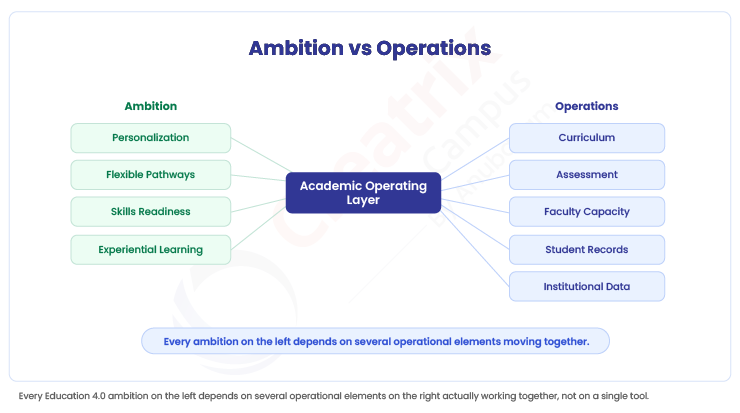
Let's be honest about what Education 4.0 actually asks for. Personalized learning means different students can follow different paths through the same programme. Skills based education means an outcome has to be demonstrated, not just covered. Experiential and continuous assessment mean evidence has to be gathered throughout a course, not only at the end. None of that is a classroom feature. Each one is an operating requirement.
Take personalization as an example. Offering a student a different pathway only works if the curriculum can actually represent multiple valid routes to the same outcome, if course availability and prerequisites support that flexibility, and if someone is tracking whether the alternate path still meets the requirement. A learning management tool can present the options. It can't resolve the underlying curriculum and scheduling logic that makes those options real.
The same is true for skills readiness. The World Economic Forum's Future of Jobs Report 2025, which surveyed more than a thousand employers across 55 economies, identifies skills gaps as the biggest barrier to workforce transformation that employers currently face. That's a demand side signal. Meeting it on the supply side requires a curriculum that can actually track competency development, not just course completion, which is a structural change, not a tool purchase.
The Hard Part Is Connecting the Institution Behind the Learning Experience
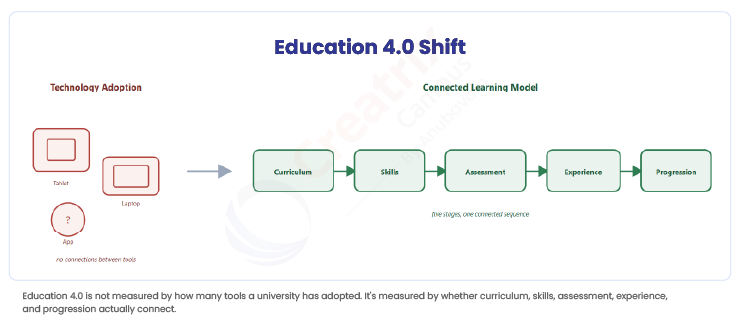
Here's the real problem underneath most Education 4.0 initiatives. Curriculum design happens in one committee cycle. Assessment gets built separately, often by individual faculty. Student progression data lives in the student records system. Faculty workload planning happens somewhere else entirely. Education 4.0 asks all four of these to be aware of each other, and most institutions don't currently have a structure that makes that possible.
Consider what happens when a programme tries to introduce a genuinely flexible pathway. The curriculum has to support more than one valid route. Assessment has to verify the same competency regardless of which route a student took. Faculty need enough workload flexibility to support students on different paces. And someone needs visibility into whether students on the alternate pathway are actually progressing as intended. Miss any one of these, and the flexible pathway becomes a paperwork exception rather than a real option.
| Education 4.0 Ambition | What Students Experience | What the Institution Must Coordinate |
| Personalized learning | Different pathways based on individual pace or need | Curriculum flexibility, assessment consistency, progression data |
| Flexible pathways | More choice in how and when learning is completed | Course availability, prerequisites, academic records |
| Skills based learning | Visible development of specific competencies | Learning outcomes, assessment design, evidence of mastery |
| Experiential learning | Learning through projects, placements, and applied work | Assessment criteria that can evaluate applied work fairly |
| Continuous assessment | Feedback and evaluation throughout a course, not just at the end | Formative assessment tracking, faculty workload capacity |
| Lifelong learning | Credentials and pathways that extend beyond a single programme | Stackable records, competency mapping, portable evidence |
Look at the right column as a whole rather than row by row. Every single coordination requirement touches curriculum, assessment, or student data, usually more than one at once. That's not a coincidence. It's the actual shape of the problem Education 4.0 creates for an institution that wants to deliver on these ambitions rather than just describe them.
Where Creatrix Campus Fits
Creatrix Campus connects the operational pieces that Education 4.0 ambitions depend on: curriculum design, assessment, and student records, within one governed system, so a flexible pathway or a skills based outcome can be tracked consistently rather than reconciled across separate tools. Because a curriculum decisio shares the same underlying data model as assessment and progression tracking, changes made in one area can be reflected in the others instead of surfacing as a mismatch later.
Creatrix Campus does not deliver Education 4.0 on its own, and no single platform can. What it provides is the coordination layer that makes flexible, outcomes oriented, and data informed learning models operationally possible, while decisions about curriculum design, pedagogy, and skills priorities stay with academic leadership and faculty.
Conclusion
Education 4.0 is not a technology upgrade. It's an operating model question for the university, one that asks whether curriculum, assessment, faculty capacity, and student data can actually move together behind a more personalized, flexible, and skills oriented learning experience. Most institutions already own more than enough technology to attempt this. The harder, more useful question for the next leadership meeting is whether the academic operating model behind that technology can actually coordinate what Education 4.0 requires. If you want to see how curriculum, assessment, and student progression can stay connected as one coordinated system, request a demo of Creatrix Campus.
Quick recap
Education 4.0 asks for personalized, flexible, skills based, and experiential learning, and each of those ambitions creates real coordination demands across curriculum, assessment, faculty capacity, and student data. Technology alone does not resolve that coordination problem, and neither does any single platform.
Frequently asked questions
How is Education 4.0 reshaping higher education?
Is Education 4.0 mainly about adopting new technology?
Why do flexible learning pathways create operational challenges?
Can a single software platform deliver Education 4.0 for a university?
Join the conversation
Want to contribute?
We welcome thought leaders to share ideas and write for our blog.
Become a guest author