
On this page
A student reaches the final question in a course evaluation.
They know exactly what they want to say about unclear assessment expectations, delayed feedback, or something that affected their learning.
Then another question takes over.
“Will my lecturer know this came from me?”
And even if the answer is no, there is another doubt:
“Will anything actually change?”
For Academic Quality and Student Experience leaders, that is the harder problem. A university can collect thousands of responses and still learn very little if students do not trust the process enough to be honest.
Quick answer
Students trust feedback when they know their identity is protected, understand how responses will be reviewed, and can see that the institution does something meaningful with what it learns. For Quality and Institutional Effectiveness leaders, the goal is therefore not simply higher response rates. It is a feedback process that produces credible student voice, connects that evidence to academic improvement, and closes the loop visibly enough for students to believe participation matters.
Article summary
| Problem | Students may respond without saying what they really think, or stop participating altogether. |
| Who this is for | Academic Quality, Institutional Effectiveness, Student Experience, Provosts, Deans, and Faculty Development leaders. |
| What changes | Feedback moves from survey collection to a trusted cycle of protection, review, action, and communication. |
| Why it matters | Weak trust produces weaker evidence for academic and quality decisions. |
| Outcome | More credible student voice and a clearer path from feedback to improvement. |
Key takeaways
- A high response rate does not automatically mean students are being honest.
- Anonymity works only when students understand and trust it.
- Quality leaders need to show who owns the response after feedback is collected.
- Student comments become stronger evidence when considered alongside wider academic information.
- Closing the loop is not a communications extra. It is part of earning trust for the next feedback cycle.
Why This Matters
For Academic Quality and Institutional Effectiveness leaders, the problem is not simply getting students to complete another survey. It is knowing whether the responses are candid enough to support a real decision and whether the institution can demonstrate what happened afterward. Students are effectively asking two questions every time they respond: “Can I be honest?” and “Will this matter?” If either answer is unclear, the university may be collecting feedback without capturing the student experience accurately.
Anonymity Is Not the Same as Trust
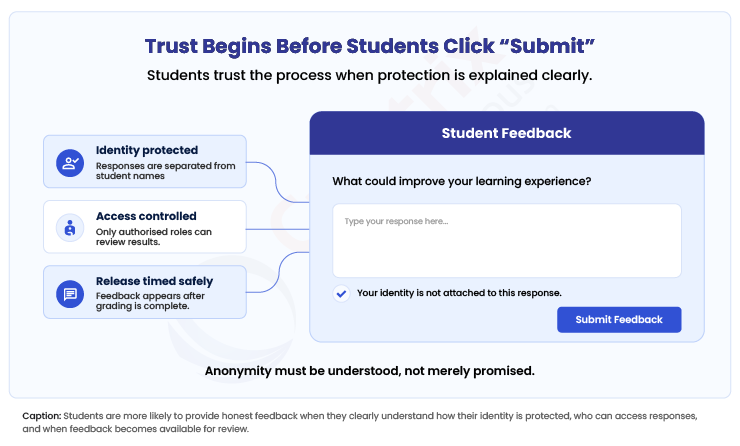
A survey can be technically anonymous and still feel unsafe to a student.
Students may wonder whether comments can be traced through a small class, whether lecturers see individual responses, or whether criticism could affect future interactions.
That uncertainty changes what gets written.
A concern becomes softer. A specific example becomes vague. A comment disappears entirely.
For a Quality leader, this creates an uncomfortable problem: the institution may have data, but not necessarily the truth students originally intended to share.
Trust therefore begins before the survey opens.
Students need a clear understanding of how feedback is handled, who sees it, and what protections surround the process.
Accountability Must Apply to the Institution Too
Universities ask students to be honest and constructive.
Once they respond, the responsibility changes hands.
Quality and Student Experience leaders then need answers to a different set of questions:
| After feedback closes | What leadership needs to know |
| Responses are collected | Who reviews them? |
| A concern appears repeatedly | Who owns the follow-up? |
| Action is agreed | How is progress tracked? |
| No action is possible | How is the decision explained? |
| Improvement is made | How will students know? |
Without that ownership, feedback can disappear into reports, committees, or departmental conversations.
The institution may have listened.
The student has no way of knowing that it did.
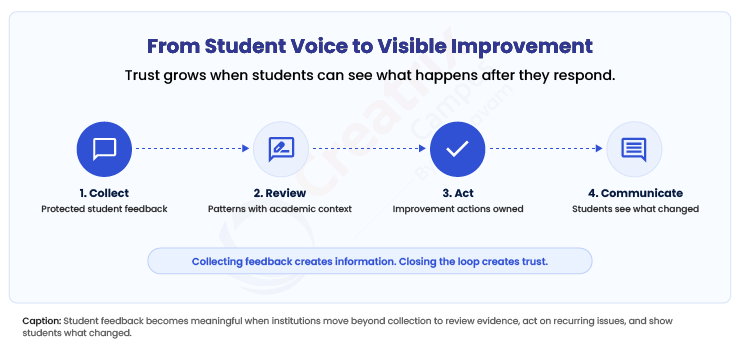
That gap matters because trust is not created when the survey closes. It is created by what happens next.
Good Decisions Need Connected Evidence
Student comments are valuable, but they rarely explain an academic problem by themselves.
If students repeatedly say assessment expectations are unclear, an Academic Quality leader still needs to ask whether the issue sits in teaching practice, assessment design, curriculum structure, or programme-level policy.
That requires more than survey data.
The Higher Learning Commission’s Criteria for Accreditation emphasise the use of evidence to evaluate and improve educational quality. Student voice becomes far more useful when it can contribute to that wider evidence picture rather than remaining isolated in a course-evaluation report.
This is also where Curriculum Management becomes relevant. Connecting feedback with curriculum review and academic quality processes helps leaders move from “Students raised this concern” to the more useful question: “What does the wider evidence tell us needs to change?”
That is a much stronger foundation for continuous improvement.
Students Trust Feedback They Can See Working
Students do not expect every suggestion to become policy.
They do expect evidence that somebody listened.
A timetable changes. Assessment instructions become clearer. A support process improves. A recurring course issue receives attention.
Small improvements matter when the institution connects them back to student voice.
“You told us. We reviewed it. Here is what changed.”
That simple loop does something another reminder email cannot.
It gives students a reason to take the next survey seriously.
For Quality and Institutional Effectiveness teams, it also turns feedback from a recurring collection exercise into a visible improvement cycle. Course Evaluation can support that broader approach by connecting course feedback with academic quality and improvement processes rather than treating evaluation as an isolated survey activity.
Conclusion
The most useful student feedback is not the feedback a university manages to collect. It is the feedback students were willing to give honestly because they trusted what would happen next. For Quality leaders, anonymity protects the voice, but accountability gives that voice institutional value.
If students submitted the same feedback next semester, would they be able to see what your institution did with it the first time? See how Creatrix Campus can connect student feedback with continuous academic improvement.
Quick recap
Student feedback becomes credible evidence when students trust the protection around their voice and the institution accepts responsibility for what follows. When feedback can move from collection to review, wider academic evidence, action, and visible follow-through, universities gain more than better surveys. They gain a student voice that Quality and Institutional Effectiveness leaders can actually use.
Frequently asked questions
Why is student trust important in course evaluations?
Is anonymous student feedback enough?
Why should student feedback connect with academic quality processes?
How can universities close the student feedback loop?
Who should be accountable for acting on student feedback?
Join the conversation
Want to contribute?
We welcome thought leaders to share ideas and write for our blog.
Become a guest author