
On this page
Ask a registrar, a provost, and a QA director the same question: Has this student completed what they say they've completed? And you may not get the same answer. Not because one of them is careless. Because each is reading from a different system, and each system was built to answer a narrower question than the one being asked.
That gap used to be rare. A degree took four years, credit accumulated in one direction, and by the time anyone checked, the three systems mostly agreed. Micro-credentials, stackable certificates, and modular pathways removed that comfortable delay. Students now complete recognizable units of learning constantly, not just at graduation, and every one of those moments asks planning, audit, and credentialing to agree on something in real time.
Quick answer
Degree audit, academic planning, and credentialing must integrate because non-degree credentials, badges, certificates, and stackable modules now outnumber traditional degrees by roughly six to one in the United States alone, according to Credential Engine's 2025 count. When a student earns one of these credentials, planning, audit, and credentialing each apply their own validation rules to the same event. If those rules aren't governed by one shared logic, the three systems can disagree about what happened, and the student, the registrar, and the accreditation reviewer each inherit a different version of the truth.
Article summary
| Problem | Academic planning, degree audit, and credentialing each validate student progress using their own rules, built for a linear degree that most students no longer follow exactly. |
| For | Registrars, Provosts, QA and Accreditation Directors, CIOs. |
| Shift | From three systems reconciling disagreements after the fact, to one governed rules layer that produces agreement by design. |
| Outcome | A single, defensible answer to what a student has completed, available the moment it's asked, not months later during manual reconciliation. |
Key takeaways
- Non-degree credentials now outnumber degrees nearly six to one in the US credential landscape, which means recognition logic gets tested constantly, not once at graduation.
- Planning, audit, and credentialing disagreeing isn't a bug. It's what happens when three systems each hold their own definition of "complete."
- The fix isn't a fourth system. It's one shared rules layer that planning, audit, and credentialing all read from.
- Accreditation reviewers increasingly ask institutions to prove their recognition logic is consistent, not just that a credential was awarded.
Why this matters
For decades, a university's three most important student-facing systems, academic planning, degree audit, and credentialing, rarely had to talk to each other in real time. Planning mapped the path. Audit checked it once a student was close to the end. Credentialing issued the outcome at graduation. Each ran on its own logic because each was answering its own question, and those questions rarely collided mid-journey.
They collide constantly now. A student can pause a programme, stack a short credential, transfer a module, and return, all before the traditional midpoint of a degree. Each of those moments asks a version of the same question: does this count, and toward what? If planning, audit, and credentialing answer that question differently, in different weeks, the university has three official but conflicting stories about one student's progress. That is not an integration inconvenience. It's a governance gap, and increasingly, it's one that shows up during an accreditation review, not just in a frustrated student's inbox.
When one achievement gets three answers
Here's a scenario a registrar will recognize immediately. Priya is midway through a business analytics degree. In week 9, she completes a short, verified data-analytics micro-credential through a partner programme, a real, documented achievement.
Academic planning sees it first and marks her on track for an embedded certificate; her advisor tells her so. Degree audit disagrees: its rules never mapped this micro-credential to the elective it replaces, so it still shows an unmet requirement when she pulls an audit before registering. Credentialing has a third answer again: nothing has been issued, because from its point of view no completed requirement set has triggered it yet.
Three systems. One achievement. Three different answers to what should be one question.
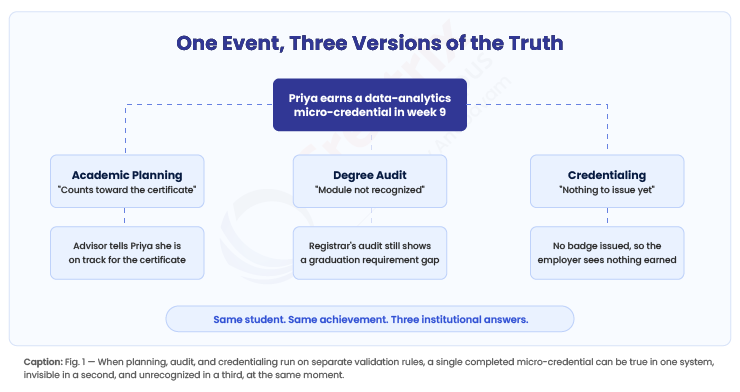
Multiply that by a student body earning modules, badges, and stackable credentials on overlapping timelines, and the registrar's office spends real hours each week resolving disagreements that shouldn't exist. The QA team inherits the same problem later, when a reviewer asks a plainer version of Priya's question: can you show your recognition logic is consistent across the institution? Too often, the honest answer involves a spreadsheet, a few emails, and a promise to follow up.
The governance question hiding inside the integration question
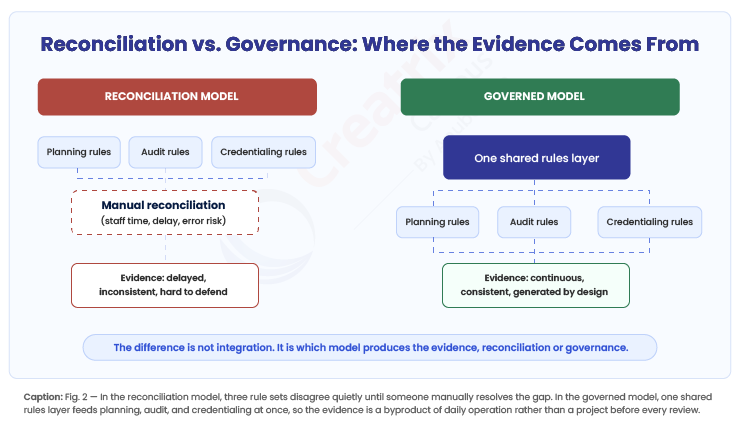
It's tempting to call this an integration problem: three systems that need a better connector. That framing undersells what's happening. Planning, audit, and credentialing disagree not because they lack a data pipe between them, but because each holds its own definition of what counts as complete.
Connecting the systems without aligning those rules just moves the disagreement faster. What's missing is a shared rules layer, not a fourth system bolted beside the other three, but one governing logic that planning, audit, and credentialing all read from when each answers the same question: has this been completed?
Scale makes this urgent, not theoretical. Credential Engine's 2025 count of the US credential landscape found 1.85 million unique credentials in circulation, degrees, certificates, certifications, licenses, and digital badges combined, with non-degree credentials making up roughly 85 percent of that total.
Recognition logic is no longer tested occasionally by the odd transfer student. It is tested by the majority of credentialing moments that never resemble a traditional degree at all.
Accreditation reviewers are catching up to this reality faster than most internal systems are. Increasingly, they want proof that an institution's recognition of any credential, not just its degrees, is governed by consistent rules they can trace, not reconstructed case by case when asked.
That is what a governed student lifecycle actually delivers: one record, one set of recognition rules, read the same way by every system that touches a student's progress, so a completed micro-credential means the same thing to the advisor, the registrar, and the reviewer, on the same day it happens. It is also what makes continuous accreditation evidence possible, evidence that is a byproduct of daily operation rather than a project that starts the month before a visit.
Conclusion
Priya's story isn't really about micro-credentials. It's about what happens when an institution's most important question doesn't have one owner: has this student completed what they say they've completed? Three systems answering separately isn't a temporary inconvenience while adoption catches up. It's the default outcome of building planning, audit, and credentialing as three independently governed tools.
The institutions that stop reconciling by hand are the ones that decided recognition logic belongs in one place, governed once, read consistently everywhere else.
Can your planning, audit, and credentialing systems currently agree on one student's progress without anyone checking by hand? See what a governed student lifecycle looks like.
Quick recap
Non-degree credentials now outnumber degrees by roughly six to one. Planning, audit, and credentialing each validate progress against their own rules, which means the same achievement can be true, invisible, and unrecognized all at once, in three different systems. The fix is one shared rules layer governing recognition everywhere, not a better connector between three separately governed tools.
Frequently asked questions
Why do degree audit and credentialing sometimes disagree about the same student?
Do micro-credentials cause this problem?
What does an accreditation reviewer actually want to see here?
Is integrating these systems mainly an IT project?
What does a governed student lifecycle actually change day to day?
Join the conversation
Want to contribute?
We welcome thought leaders to share ideas and write for our blog.
Become a guest author