
On this page
Most curriculum mapping still happens in a spreadsheet. Someone builds a grid, courses down one side, program learning outcomes across the top, and marks which course touches which outcome. It works, for a while. Then a program grows, a course gets revised, a new outcome gets added for an upcoming accreditation cycle, and the spreadsheet starts drifting quietly out of date.
Nobody notices the drift until an accreditation visit or a program review asks a direct question: show us where this outcome is actually taught, and where it's assessed. That is the moment a spreadsheet-based map usually fails, not because the mapping was wrong when it was built, but because nothing kept it current as the curriculum kept changing underneath it.
Curriculum mapping software needs to do more than produce a document once. Why the spreadsheet approach breaks down as programs scale, and what to look for when evaluating a platform meant to keep outcome alignment current, is where the real difference shows up.
Quick answer
Curriculum mapping software links program learning outcomes to the specific courses, assignments, and assessments that teach and evidence them, and keeps that link current as the curriculum changes. The genuinely useful version of this software surfaces gaps automatically, where an outcome has thin or no coverage, rather than requiring someone to manually re-check a static grid every time a course changes.
Article summary
Two related questions define curriculum mapping in higher education: what the software category should actually deliver, and why the benefits institutions expect from mapping, coherence, alignment, accreditation readiness, quietly erode when the map is maintained as a one-time spreadsheet exercise rather than a living record tied to the curriculum itself.
Key takeaways
- Curriculum mapping in a spreadsheet works at the moment it's built, then drifts out of date as courses change, outcomes get added, and nobody updates the grid.
- Gap analysis, finding an outcome with thin or missing coverage, is the actual value of curriculum mapping, not the map itself.
- AAC&U, the Association of American Colleges and Universities, operates the VALUE initiative specifically to help institutions assess learning outcomes consistently, reflecting how much sustained infrastructure genuine outcome alignment actually requires.
- Constructive alignment, making sure what's taught, what's assessed, and what's claimed as an outcome are the same thing, only holds if the mapping updates when any one of those three changes.
- Institutions that get real value from curriculum mapping treat it as a live link between outcomes and coursework, not a document produced once for an accreditation binder.
What Is Curriculum Mapping Software?
Curriculum mapping software links program learning outcomes, PLOs, and course learning outcomes, CLOs, to the specific courses, assignments, and assessments that teach and provide evidence for them. Done well, it answers three questions that matter to a program director, a quality assurance office, and an accreditation team at the same time: where is this outcome taught, where is it assessed, and where, if anywhere, is coverage thin or missing.
The category exists because constructive alignment, the principle that what's taught, what's assessed, and what's claimed as a learning outcome should all point to the same thing, is genuinely hard to maintain by hand once a program has more than a handful of courses. A curriculum with forty courses and fifteen program outcomes has hundreds of potential links to track, and every course revision, every new outcome, and every retired assessment changes some of them.
Good curriculum mapping software also supports visualization, seeing the whole map at once rather than reading a dense spreadsheet, and gap analysis, surfacing outcomes with weak coverage automatically instead of waiting for someone to notice during a review cycle.
Why the Spreadsheet Approach Breaks Down
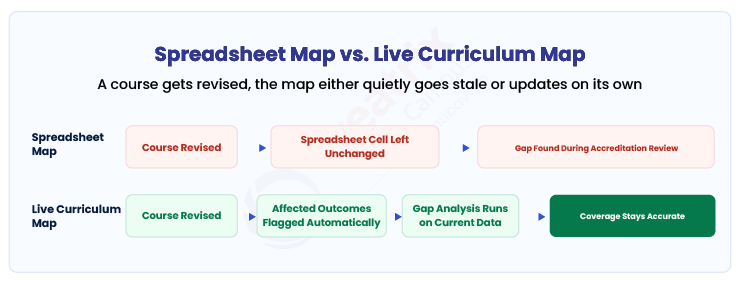
Here is the test that reveals whether a curriculum map is actually current or just historically accurate: if a course was substantially revised last term, does the map already reflect that, or does someone have to remember to go back and update a spreadsheet cell?
In most institutions relying on spreadsheets or static documents, the honest answer is that nobody goes back and updates it until they have to, usually right before a program review or accreditation visit. By then, the map may be describing a curriculum that no longer exists in the form it claims to.
AAC&U, the Association of American Colleges and Universities, describes its mission as advancing "the democratic purposes of higher education by promoting equity, innovation, and excellence in liberal education," and operates the VALUE, Valid Assessment of Learning in Undergraduate Education, initiative specifically to help institutions assess learning outcomes consistently across programs, per AAC&U's own site. An initiative built specifically around consistent outcome assessment exists because doing this reliably, at scale, across a real institution, is a genuinely sustained undertaking, not something a spreadsheet updated once a year can keep up with.
That is the real reason the benefits institutions expect from curriculum mapping, coherence across courses, faster gap analysis, smoother accreditation reviews, quietly erode over time. Not because the initial mapping exercise was done poorly, but because nothing kept it linked to a curriculum that kept changing.
What to Look For When Evaluating Curriculum Mapping Software
Every vendor selling into this category can show a mapping grid or a matrix view. That is table stakes, and it does not tell you whether the map will still be accurate a year from now.
| Approach | What it looks like in practice | What it costs the institution later |
| Static spreadsheet or document map | Built once, usually before an accreditation cycle, updated manually | Drifts out of date as courses change; gaps go unnoticed until a review forces a manual re-check |
| Mapping tool with manual re-entry per course change | Structured grid exists, but someone has to remember to update it every time a course is revised | Currency depends entirely on individual staff discipline, not the system itself |
| Software that links mapping directly to course and assessment records | Map updates as the underlying course or assessment data changes | Requires more upfront setup to connect course, assessment, and outcome data, but stays current afterward |
If the goal is only to produce a mapping document for an accreditation binder, a spreadsheet can do that once. If the goal is to actually keep outcome alignment current, the evaluation needs a harder question: does the map update when a course or assessment changes, or does someone have to remember to go back and edit it.
| Capability | Why it matters | What to ask a vendor |
| Direct link between outcomes, courses, and assessments | Without this link, the map is a snapshot, not a live record | Ask whether a course revision automatically flags which outcomes are affected |
| Automated gap analysis | Manually scanning a large grid for thin coverage is slow and error-prone | Ask how the system surfaces outcomes with weak or missing coverage |
| Visualization across the whole program | A dense spreadsheet is hard to read at a glance during a review | Ask to see the actual visual map, not just a description of it |
| Version history as the curriculum changes | Accreditation teams often need to see how coverage evolved, not just where it stands today | Ask whether the system retains a history of mapping changes over time |
Where Creatrix Campus Fits
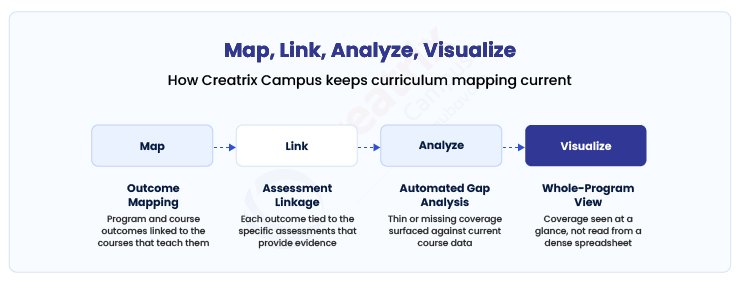
Creatrix Campus treats curriculum mapping as a live link into the academic record, not a document produced once and filed away.
Program and course learning outcomes map directly to the courses and assessments that teach and evidence them, so when a course is revised, the affected outcomes are visible immediately rather than discovered later. Gap analysis runs against current data, surfacing outcomes with thin or missing coverage automatically instead of requiring someone to manually scan a grid. The whole program's outcome coverage can be visualized at once, which matters as much during a routine program review as it does during an accreditation visit.
The practical effect is that an institution gets a curriculum map that describes the curriculum as it actually is right now, not as it was when someone last found time to update a spreadsheet.
Conclusion
Most institutions evaluate curriculum mapping tools on whether they can produce a matrix view for an accreditation binder. That is the easy check, and it is not the one that determines whether outcome alignment holds up between review cycles.
The harder, more useful question is whether the mapping stays linked to the actual curriculum as courses, assessments, and outcomes change, so that gap analysis reflects reality instead of a snapshot from the last time someone updated a spreadsheet. Institutions that evaluate for that get a curriculum map that's genuinely useful day to day, not just defensible once a year.
If you want to see how Creatrix Campus keeps curriculum mapping and outcome alignment current as your programs evolve, talk to us about curriculum mapping software.
Quick recap
Curriculum mapping software should link program and course learning outcomes to the specific courses and assessments that teach and evidence them, and keep that link current as the curriculum changes. That requires automated gap analysis, whole-program visualization, and a direct connection between outcomes, courses, and assessment data, not a spreadsheet built once and updated only when an accreditation cycle forces the question.
Frequently asked questions
What is curriculum mapping software?
Why do spreadsheet-based curriculum maps break down over time?
What is gap analysis in curriculum mapping, and why does it matter?
What should institutions look for when evaluating curriculum mapping software beyond a matrix view?
How does Creatrix Campus handle curriculum mapping?
Join the conversation
Want to contribute?
We welcome thought leaders to share ideas and write for our blog.
Become a guest author