
On this page
A registrar builds a timetable to fit rooms, faculty, and terms. A student experiences that same timetable as whether they can take the course they actually need, when they need it. Those two views of the same decision rarely get compared, and the gap between them is where student success problems quietly start.
Quick answer
Course scheduling affects student success by determining whether required courses are available without conflicts, whether enough seats exist to meet demand, and whether faculty capacity can support the sections students need. When scheduling is disconnected from curriculum requirements and student demand data, it can create real barriers to progression. Scheduling alone does not cause or fix retention, but it shapes the conditions retention efforts have to work within.
Article summary
This article moves past the idea that scheduling software is simply an administrative convenience. It looks at how ordinary scheduling decisions, a course conflict, a capacity limit, a poorly sequenced offering, can quietly become student success problems long before an advising or retention team ever sees them. It then looks at what changes when scheduling is treated as connected academic intelligence rather than an isolated timetable, and where that connection genuinely helps versus where institutions should be careful about overstating what it can do.
Key takeaways
- A course conflict, a capacity limit, or a sequencing gap can restrict a student's options before any advisor is involved.
- Scheduling is an academic operations decision with consequences for progression, access, and workload, not just a timetable generation task.
- Connecting scheduling to curriculum requirements and demand data can help institutions see these risks earlier.
- Scheduling can contribute to student success problems. It does not alone cause or solve retention.
- Student success teams often respond to problems after they surface. Better academic operations can help prevent some of them from forming in the first place.
The Timetable Is Already Making Student Success Decisions
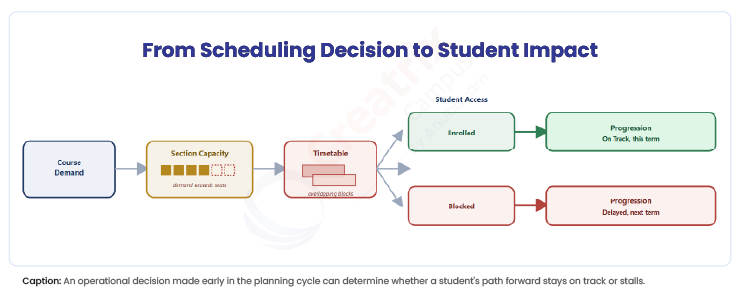
Consider a student who needs two required courses in the same term, and they are scheduled at the same time. Nobody designed that conflict to hurt the student. It's simply what happens when a timetable is built around rooms and faculty availability rather than the sequence a curriculum actually requires. The student now has to delay one course, and depending on prerequisites, that delay can push their graduation date back by a full term.
The same thing happens with capacity. A required course with thirty seats and forty students who need it isn't a scheduling inconvenience for those extra ten students. It's a decision, made somewhere in the planning process, about which students get to progress on time and which don't. Multiply that across a few high demand courses each term, and an institution has effectively decided, without meaning to, which students face avoidable delay.
Sequencing works the same way in a quieter, longer term sense. If a foundational course is offered only once a year and a student misses the window, their entire course pathway for that year can shift. None of these examples involve a student making a poor choice or an advisor missing a warning sign. They involve a scheduling decision that had already narrowed the student's options before anyone in student success even looked at the case.
| Scheduling Decision | What Students Experience | Institutional Signal |
| Course conflict | Student must choose between required courses | Progression risk |
| Insufficient seats | Student cannot enroll in a needed course | Capacity bottleneck |
| Poor course sequencing | Required learning is delayed | Curriculum pathway issue |
| Faculty overload | Reduced flexibility or course availability | Delivery capacity pressure |
| Uneven timetable | Difficult student schedule | Engagement or access concern |
| Cancelled or underfilled sections | Disrupted plans or wasted capacity | Demand planning mismatch |
Read down the right column and a pattern emerges. Almost none of these are grading, teaching, or advising problems. They are planning signals, generated well before a student ever falls behind, that most institutions currently have no structured way to see until the outcome has already occurred.
Research from the Community College Research Center at Teachers College, Columbia University, on structural barriers to student progression has found that inflexible scheduling and limited course availability can extend time to degree and make it harder for students to complete a programme on the timeline they planned for. That's a careful way to state the relationship: scheduling can contribute to delay, not that scheduling alone determines whether a student persists.
What Changes When Scheduling Becomes Connected Academic Intelligence?
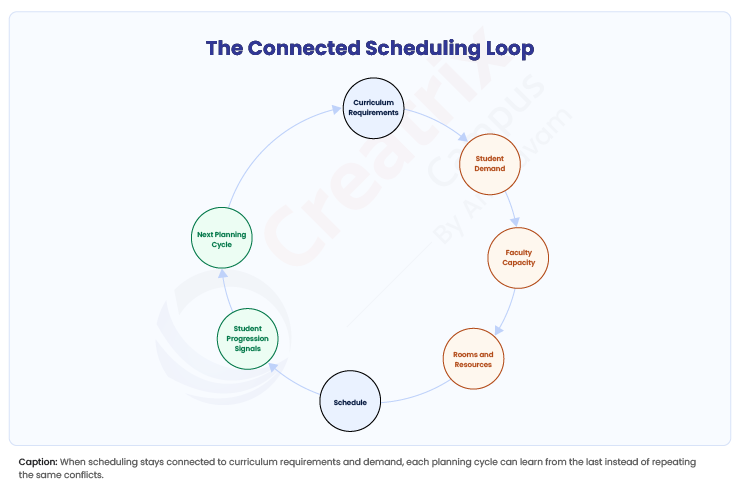
Here's the real problem underneath all of this. Scheduling, curriculum requirements, student demand, and faculty capacity are usually managed as separate exercises that only get compared when something has already gone wrong. A registrar builds a timetable. A curriculum committee approves programme requirements in a different cycle. Nobody is checking, at the point the timetable is built, whether it can actually deliver the sequence the curriculum requires for every cohort moving through it.
When those pieces are connected instead, the same scheduling process can surface a different kind of information. Instead of only asking "does this timetable fit the rooms and faculty we have," a connected process can also ask "does this timetable let every student currently enrolled in this pathway take what they need, in the order they need it." That's a shift from scheduling as a logistics exercise to scheduling as a source of institutional intelligence about where progression is at risk.
This doesn't mean a scheduling system can predict which individual student will drop out, and it shouldn't be described that way. What it can reasonably do is make visible, earlier than a retention report would, where a structural conflict, a capacity shortfall, or a sequencing gap is likely to affect a group of students before the term even starts. That's a meaningful head start for academic planning, even without claiming it as a retention prediction tool.
Curriculum requirements defined through curriculum and catalog management and the scheduling decisions made through academic operations work best when they're informed by the same underlying data rather than reconciled after the fact. That's the practical meaning of treating scheduling as part of a connected academic operating model rather than an isolated timetable exercise.
Where Creatrix Campus Fits
Creatrix Campus connects scheduling to the academic operations it depends on, including curriculum requirements, course offerings, and faculty workload, within one governed system, so a timetable is built from the same underlying data as the curriculum it's meant to deliver, rather than reconciled against it afterward. Because a curriculum change made in program governance shares that same data model, it can propagate into scheduling and course availability instead of surfacing as a mismatch only after the term has started.
That connection helps academic operations leaders see capacity and sequencing conflicts earlier in the planning cycle. It does not predict which individual students are at risk of leaving, and it does not replace the judgment of registrars, department chairs, and academic leadership in deciding how to resolve a conflict once it's visible.
Conclusion
A timetable is not just where classes happen. It's one of the places where an institution's academic plans either become a student's actual experience or quietly work against it. The more useful question for a leadership team isn't whether the scheduling software is efficient. It's whether a student who needs a required course, at the right point in their programme, without an avoidable conflict, can actually get into it, and whether anyone would know if they couldn't until it was too late to fix. If you want to see how scheduling can connect to curriculum and academic operations instead of standing apart from them, request a demo of Creatrix Campus.
Quick recap
Scheduling decisions such as course conflicts, capacity limits, and poor sequencing can restrict a student's options before any advisor or retention team is involved. Connecting scheduling to curriculum requirements and demand data helps institutions see these risks earlier in the planning cycle, though scheduling alone does not cause or solve retention.
Frequently asked questions
How does course scheduling affect student success in universities?
Does better scheduling directly improve retention?
What is the difference between a scheduling problem and a student success problem?
Can scheduling systems predict which students are at risk?
Join the conversation
Want to contribute?
We welcome thought leaders to share ideas and write for our blog.
Become a guest author