
On this page
Most software sold as "competency-based education" software is a learning management system with a badge or checklist feature added on top. Students still move through the term on a fixed calendar. Grades still average performance across assignments. A "competency" becomes just another label attached to an assignment that was never designed to measure mastery in the first place.
Genuine competency-based education, CBE, is a different model entirely: students progress when they demonstrate mastery of a defined competency, not when a fixed number of weeks has passed. That model requires software built around competency mapping, evidence collection, and mastery decisions, not a seat-time system with new terminology bolted on.
Competency-based education software needs to do more than relabel a course structure. Why most CBE implementations struggle even after buying dedicated software, and what to look for when evaluating a platform meant to support mastery-based progression, is where the real gap shows up.
Quick answer
Competency-based education software supports a model where students advance by demonstrating mastery of defined competencies, rather than by completing a fixed amount of instructional time. The genuinely useful version of this software maps competencies to learning outcomes and assessments, collects evidence of mastery from multiple sources, and lets faculty make explicit mastery decisions, rather than repackaging a standard seat-time gradebook with competency labels attached to it.
Article summary
Implementing competency-based education software raises a practical question: what the category should deliver, why implementations commonly stall even with dedicated software in place, and how to evaluate a platform against the actual requirements of mastery-based progression rather than its marketing description.
Key takeaways
- Competency-based education software fails most often when the underlying system still tracks seat time and averaged grades instead of mastery evidence.
- Competency mapping, linking competencies to learning outcomes and specific assessments, is the foundation CBE software needs, not an added feature.
- Flexible pacing only works if the software can track individual student progress against competencies independently, not against a fixed class calendar.
- C-BEN, the Competency-Based Education Network, describes itself as the national leader in building systems that connect education to workforce needs, working with a global network of colleges, employers, and state agencies, reflecting how much specialized infrastructure genuine CBE implementation actually requires.
- The institutions that implement CBE successfully evaluate software for mastery-decision support and competency mapping specifically, not for how well it relabels a standard course structure.
What Is Competency-Based Education Software?
Competency-based education software supports a model where students demonstrate mastery of specific, clearly defined competencies to progress, rather than advancing because a fixed number of weeks has elapsed. At its core, this requires three things a standard learning management system was not built to do: competency mapping that links each competency to specific learning outcomes and the assessments that provide evidence for it, individualized pacing that tracks each student's progress against competencies rather than a shared class calendar, and explicit mastery decisions, a faculty judgment, informed by evidence, that a student has or has not demonstrated a given competency.
Genuine CBE software also needs to support personalized learning paths, since students demonstrating mastery at different rates need different sequences and pacing, and flexible assessment, since evidence of mastery can come from a project, a portfolio, a direct assessment, or a combination, not only a single exam.
What separates this category from a relabeled seat-time system is whether progression logic is actually built around competency demonstration, or whether "competency" is simply a tag attached to the same weekly assignment structure every other course uses.
Why Most CBE Implementations Struggle
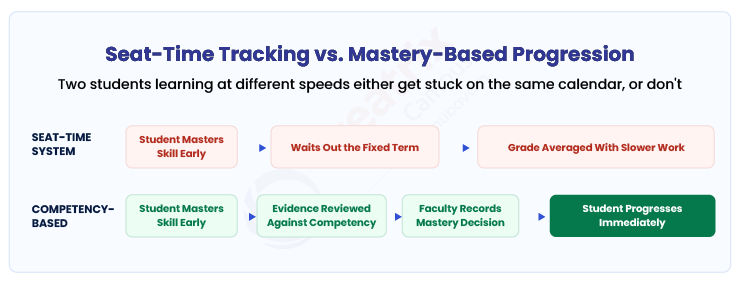
Here is the test that reveals whether a CBE implementation is real or cosmetic: can two students in the same program progress through competencies at genuinely different paces, one finishing in ten weeks and another in twenty, without the underlying system breaking down?
In most institutions that adopt CBE language without CBE-capable software, the honest answer is no. The registration system still assumes a fixed term. The gradebook still averages scores across assignments rather than tracking mastery per competency. Faculty end up doing extra manual work, tracking competency evidence in spreadsheets alongside the official system, because the software was never built to make mastery decisions the way the model requires.
C-BEN, the Competency-Based Education Network, describes its mission as revolutionizing education and workforce development "to better meet the needs of both learners and employers, ultimately creating skills-based systems that recognize people for what they know and can do," and describes itself as the national leader in building systems that connect education to workforce needs, working with a global network of colleges, employers, and state agencies, per C-BEN's own site. An organization built specifically around this model exists because implementing CBE well is a genuinely specialized undertaking, one that generic course software was not designed to support.
That is the real reason most CBE implementations struggle even after buying software labeled for the category. Not a lack of institutional commitment, but software that keeps the seat-time infrastructure underneath while adding competency terminology on top of it.
What to Look For When Evaluating CBE Software
Every vendor selling into this category can show a competency list or a badge feature. That is table stakes, and it does not tell you whether mastery-based progression will actually work operationally.
| Approach | What implementation looks like | What it costs the institution later |
| Standard LMS with competency labels added | Assignments tagged with competency names, grades still averaged normally | Faculty track real mastery evidence manually outside the system, students still bound to a fixed term calendar |
| CBE-branded software without true individualized pacing | Competency framework exists, but progression still follows a shared class schedule | Fast learners wait for the group, slower learners are pushed forward before mastery, defeating the model's purpose |
| Software built around competency mapping, evidence collection, and mastery decisions | Each student progresses against competencies independently, with evidence-based faculty decisions | Requires more upfront evaluation of the platform's actual architecture, not just its competency terminology |
If the goal is only to add competency labels to an existing course structure, most learning management systems can do that already. If the goal is to actually support mastery-based progression, the evaluation needs a harder question: can the system track an individual student's competency progress independently of a class calendar, and does it support faculty in making an explicit, evidence-based mastery decision.
| Capability | Why it matters | What to ask a vendor |
| Competency mapping to outcomes and assessments | Without this link, "competency" is just a label, not a measurable unit of progression | Ask to see how a specific competency connects to the learning outcomes and assessments that provide evidence for it |
| Individualized pacing per student | Flexible pacing is the core promise of CBE; a shared class calendar underneath defeats it | Ask whether two students in the same program can be at genuinely different points in the competency sequence |
| Evidence collection from multiple sources | Mastery evidence often comes from projects, portfolios, or direct assessments, not one exam | Ask what assessment types the system supports as evidence toward a competency |
| Explicit mastery decision workflow | Faculty need a clear, evidence-based way to record that a student has or has not demonstrated mastery | Ask how a faculty member records a mastery decision and what evidence is attached to it |
Where Creatrix Campus Fits
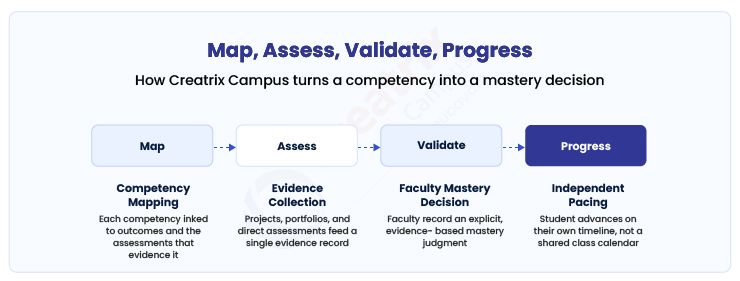
Creatrix Campus supports competency-based education as a genuine progression model, not a relabeled seat-time course structure.
Competencies map directly to learning outcomes and the specific assessments that provide evidence for them, so a competency is a measurable unit of progress rather than a tag on an assignment. Each student's pacing is tracked independently against their own competency sequence, so two students in the same program can genuinely be at different points without the system assuming a shared class calendar underneath. Faculty record mastery decisions directly against the evidence collected, whether that evidence comes from a project, a portfolio, or a direct assessment.
The practical effect is that an institution adopting CBE gets software built for the model it is actually implementing, rather than a standard course system with competency terminology layered on top of infrastructure that still assumes fixed terms and averaged grades.
Conclusion
Most institutions adopting competency-based education evaluate software on whether it has a competency list or a badge feature. That is the easy check, and it is not the one that determines whether the implementation actually works.
The harder, more useful question is whether the software can track individualized pacing against competencies, collect mastery evidence from multiple sources, and support an explicit faculty mastery decision, without a seat-time system underneath quietly limiting what the model can actually do. Institutions that evaluate for that get a genuine CBE implementation instead of a relabeled version of the course structure they already had.
If you want to see how Creatrix Campus supports competency mapping, individualized pacing, and evidence-based mastery decisions as a genuine progression model, talk to us about competency-based education software.
Quick recap
Competency-based education software should support students progressing by demonstrated mastery, not a fixed amount of instructional time. That requires competency mapping to learning outcomes and assessments, individualized pacing tracked independently per student, evidence collection from multiple assessment types, and an explicit faculty mastery decision workflow, not a standard learning management system with competency labels added to an unchanged seat-time structure underneath.
Frequently asked questions
What is competency-based education software?
How is competency-based education different from a standard course structure?
Why do CBE implementations struggle even after buying dedicated software?
What should institutions look for when evaluating CBE software beyond a competency list?
How does Creatrix Campus handle competency-based education?
Join the conversation
Want to contribute?
We welcome thought leaders to share ideas and write for our blog.
Become a guest author