
On this page
Digital credentials are multiplying faster than the language for describing them. The 2025 Badge Count from 1EdTech and Credential Engine reported about 1.71 million digital badges offered by responding platforms, more than three times the 2022 count, although more providers took part, so it is not a like-for-like growth rate. Gartner highlights microcredentials as a lever for a continuously upskilled workforce, and McKinsey notes employers accelerating skills-based hiring built on verifiable, competency-aligned credentials.
More credentials do not mean more value. Value depends on three questions: what learning occurred, how it was demonstrated, and how another institution or employer can trust and recognise it. A taxonomy answers the first. This guide compares Bloom, Dreyfus, Fink and the emerging radial model, then covers the evidence, standards and governance that answer the other two.
Quick answer
No single taxonomy is enough. Bloom, Dreyfus and Fink describe cognitive rigour, depth of skill and breadth of learning, and the emerging radial model combines breadth and depth for credential catalogues. But a taxonomy only says what a credential represents. Evidence makes the claim credible, open standards make it portable, and governance makes it consistent.
Article summary
This guide compares four microcredential taxonomies, explains how to choose and combine them, and covers the evidence, standards, governance and AI considerations that decide whether a credential is trusted.
Key takeaways
- Credential growth raises the need for classification, evidence, consistent metadata and verification. Issuing more credentials is not the same as improving their value.
- Bloom, Dreyfus and Fink answer different questions. The radial model, a 2025 practitioner proposal, is still emerging.
- Participation, knowledge and applied competence each need different assessment evidence.
- A taxonomy and a technical standard solve different problems. A radial label does not create a verifiable badge, and a badge does not establish rigour.
- In 2026, assessment must distinguish independent ability from AI-assisted work.
Why Taxonomies Matter as Credentials Multiply
The three questions that decide a credential’s value are different kinds of problem. What learning occurred is a classification problem, which taxonomies solve. How it was demonstrated is an evidence problem, solved by assessment design. How another institution or employer can trust and recognise it is a portability problem, solved by standards, quality assurance and governance.
Most taxonomy discussions stop at the first. Credential Engine separately counted 1,850,034 U.S. credentials across seven categories, and its count and the Badge Count use different definitions, so they should not be added together. Either way, as credentials multiply, unclassified and unevidenced ones become noise.
Four Frameworks, Compared
Bloom’s Taxonomy (1956, revised 2001). Six cognitive levels from Remember to Create, with a knowledge dimension added in the revision.
The Dreyfus Model (1980). Five stages from Novice to Expert.
Fink’s Taxonomy of Significant Learning (2003). Six non-hierarchical kinds of learning: Foundational Knowledge, Application, Integration, Human Dimension, Caring and Learning How to Learn.
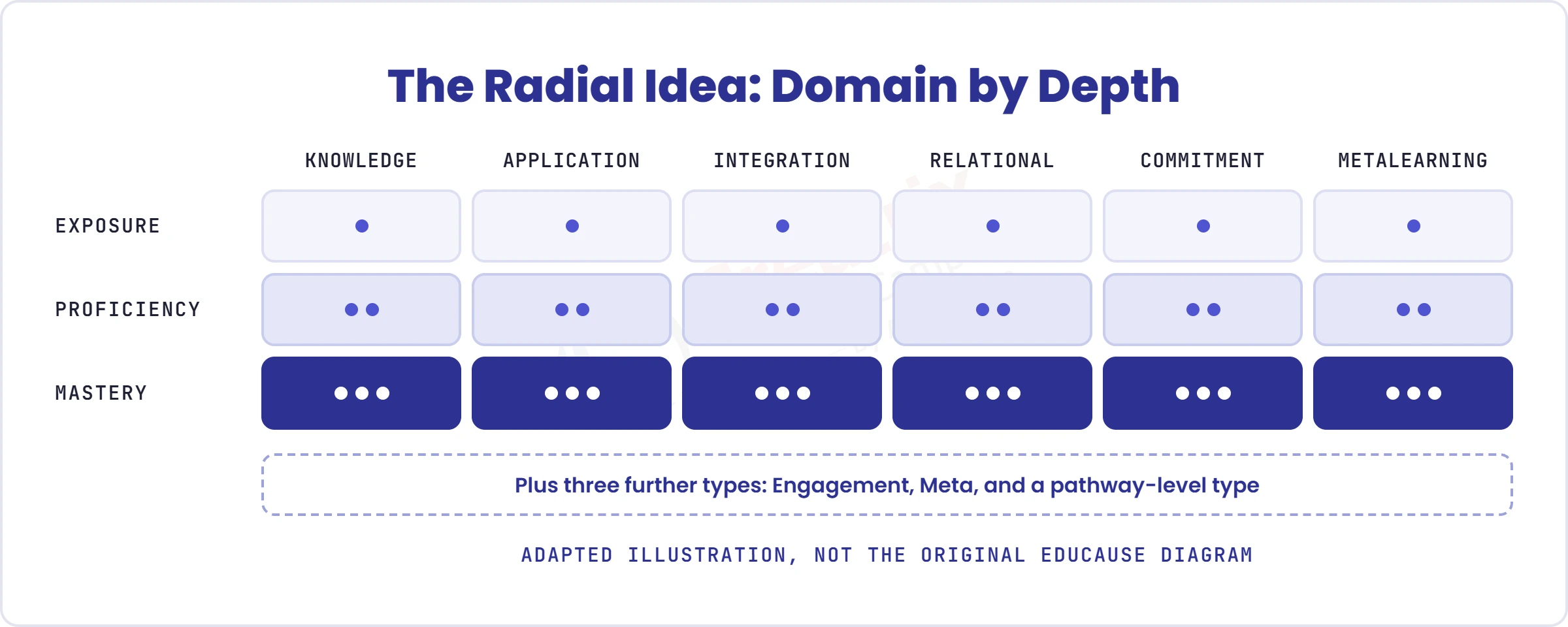
The Radial Microcredential Taxonomy. Proposed by Collin Sullivan in EDUCAUSE Review in November 2025, drawing on Fink’s significant learning and the idea of depth associated with Dreyfus. It crosses six domains (Knowledge, Application, Integration, Relational, Commitment, Metalearning) with three depth levels (Exposure, Proficiency, Mastery), giving 18 combinations, plus three further types: Engagement, Meta and a pathway-level type for integrated credentials. The distinction matters, because a participation badge, a demonstrated competency and a completed integrated pathway are not interchangeable achievements.
SOLO (Biggs and Collis, 1982) is also worth knowing: it describes the structural complexity of understanding and is sometimes used as a depth scale.
| Framework | Question it answers | Maturity and fit | Main limit |
| Bloom | How rigorous is the thinking? | Established. The working language of outcomes and accreditation mapping | Overly linear, limited for applied, interpersonal or reflective skills |
| Dreyfus | How far along is the skill? | Established. Strong for technical, clinical and vocational pathways | Domain-specific, relies on subjective interpretation |
| Fink | What kind of learning is it? | Established. Suits co-curricular, experiential and leadership credentials | No depth bands, less familiar to accreditation bodies |
| Radial | What kind, and how deep? | Emerging proposal, not an industry standard | Few institutional use cases, needs structured metadata and consistent tagging |
Evidence, Standards and Recognition
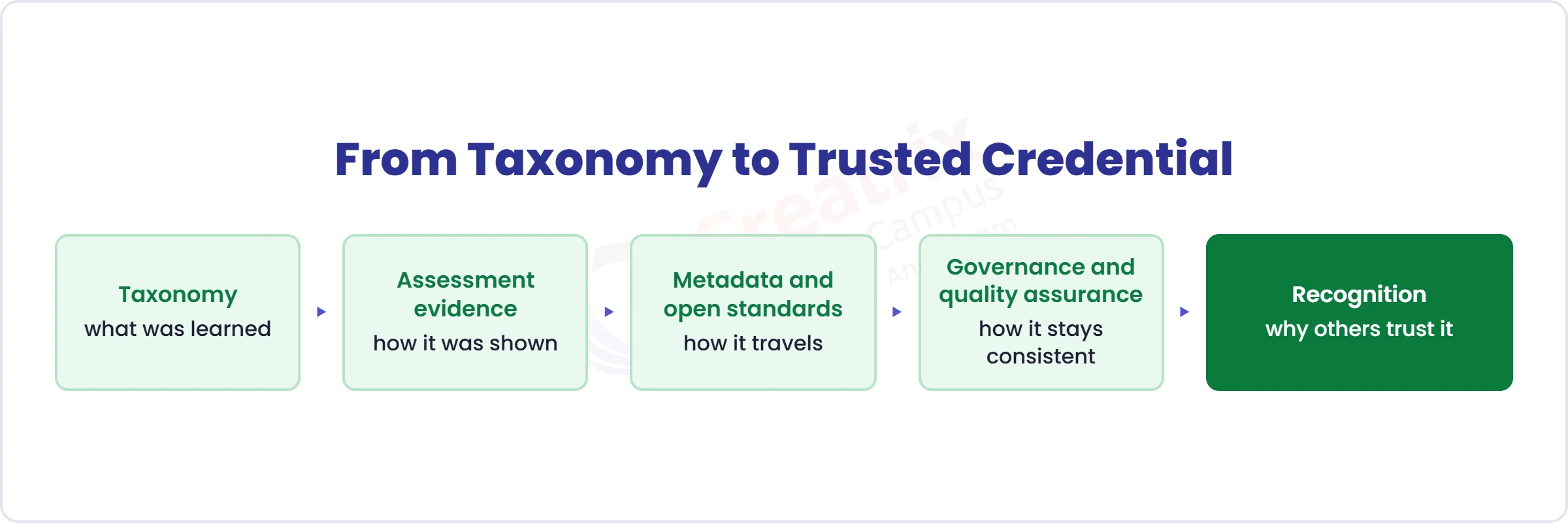
A taxonomy identifies what a credential represents. The evidence makes that representation credible. 1EdTech’s TrustEd Credential Framework, first announced in March 2024, separates credentials that demonstrate knowledge or application from recognition badges for participation or other achievements. Evidence should follow the same logic.
| Credential purpose | Appropriate evidence | Claim it supports |
| Participation | Verified attendance or participation record | Engagement |
| Knowledge | Validated quiz, exam or oral assessment | Understanding |
| Application | Evaluated project, lab or practical demonstration | Applied competence |
| Advanced expertise | Complex work, independent evaluation, transfer to new contexts | Context-specific advanced proficiency |
The last row is a recommended assessment design, not a TrustEd classification.
Portability needs open standards. Open Badges 3.0 packages verifiable achievement information, including issuer, recipient, criteria and potentially evidence and competency alignment. Comprehensive Learner Record 2.0 bundles achievements, including from more than one issuer, into portable records. CASE 1.1 supports exchanging skills and competency definitions. 1EdTech presents them as complementary.
Recognition is moving into implementation. The EU’s June 2022 Council Recommendation covers learning outcomes, workload, assessment, quality assurance and recognition, and a European Commission progress report of 17 December 2025 reviewed implementation across 27 member states plus Iceland, Liechtenstein and Norway. In Malaysia, the Malaysian Qualifications Agency (MQA) ran 2025 workshops on its Guidelines to Good Practices: Micro-Credentials, covering design, delivery, quality assurance and recognition. Nothing suggests MQA mandates any of these taxonomies. Reporting is arriving too: in the UAE, the Ministry’s higher education datasets include microcredential students and graduates, which feed KPI 2.5 of the Outcome-Based Evaluation Framework (OBEF), and in the US, Workforce Pell begins on 1 July 2026 for short-term workforce credentials.
Governance and AI
Without governance, even a strong taxonomy fragments across departments. A central credential governance group should set:
- Credential approval, with standard naming, metadata and outcome templates.
- Review cycles and version control, plus rules for renewal and revocation.
- Assessment and evidence expectations, with rubrics that reduce subjective variation.
- Rules for stacking, credit and recognition.
- Employer consultation: validating clarity of domain and depth, mapping outcomes to job roles, and refining annually.
Generative AI adds a new question. A March 2026 paper in the International Journal for Educational Integrity examines how AI affects ideas of authorship in assessment. A credential in independent analytical reasoning and one in AI-assisted analysis may both be valuable, but they should not share identical assessment methods or competency claims.
Where Creatrix Campus Fits
Creatrix Campus holds the pieces a taxonomy needs in the right places. Learning outcomes and competency frameworks are authored in Academic Governance. Assessment & Outcomes measures competency and outcome attainment against them, with attainment thresholds and analytics, for both OBE and CBE. Student Success & Records issues certificates and digital credentials from the official record, and where continuing education is activated it runs through Student Recruitment & Enrollment. Quality Assurance & Accreditation can reuse the same evidence for accreditation and reporting.
The choice of taxonomy, and of credential standards, remains the institution’s.
Conclusion
Taxonomies do not make microcredentials credible. Consistency does: one language for outcomes and depth, evidence that supports the claim, and standards that let others verify it. Choose the framework that answers your question, govern it centrally, and carry it into your data.
If you want to see how outcomes, attainment and credentials connect on one record, talk to us about a Tailored Proof Session.
Quick recap
Bloom for rigour, Dreyfus for depth, Fink for breadth, radial for both across a catalogue. Evidence, open standards and governance are what make any of them trusted.
Frequently asked questions
What is a microcredential taxonomy?
Which taxonomy is best for microcredentials?
What is the difference between a taxonomy and Open Badges?
How should AI affect microcredential assessment?
How does Creatrix Campus support microcredentials?
It authors outcomes and competency frameworks in Academic Governance, measures attainment in Assessment & Outcomes, and issues digital credentials from the student record.
Join the conversation
Want to contribute?
We welcome thought leaders to share ideas and write for our blog.
Become a guest author