
On this page
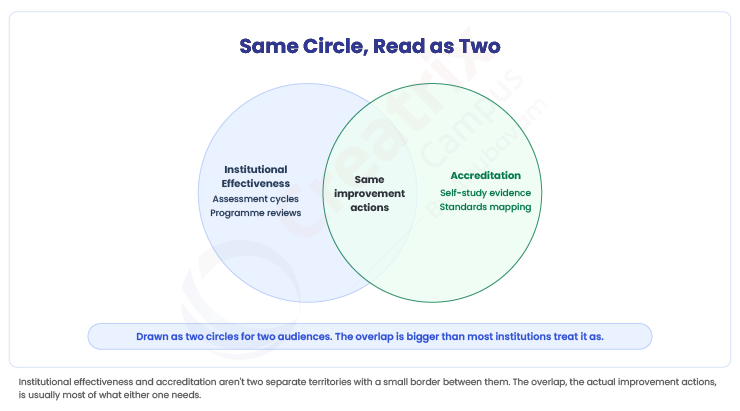
Ask a QA office what they did last term and they'll describe assessment cycles, programme reviews, improvement actions, the daily work of institutional effectiveness. Ask an accreditation liaison the same question and they'll describe self-study evidence, standards mapping, site-visit preparation.
Here's the part that rarely gets said out loud: they're often describing the same academic reality, twice, in two different vocabularies, to two different audiences, sometimes without either office fully realizing how much of their evidence overlaps.
Quick answer
Accreditation evidence and continuous improvement usually draw from the exact same source: assessment results, programme reviews, and improvement actions. When institutions manage these as separate exercises, they end up producing the same proof twice, in two formats, on two schedules, instead of once, continuously, for both purposes at the same time.
Article summary
Problem: Institutions manage accreditation and continuous improvement as two separate processes, even though both draw on the same academic evidence.
For: QA and Accreditation leaders, Institutional Effectiveness leaders, Provosts, Deans, and academic leadership.
Shift: From two parallel evidence exercises to one continuous cycle that serves improvement and accreditation at the same time.
Outcome: Less duplicated effort, and evidence that stays consistent across both purposes instead of drifting apart.
Key takeaways
- Accreditation evidence and continuous improvement evidence usually come from the same academic activity.
- Managing them separately means producing the same proof twice, on two different schedules.
- Divergence between the two versions is often the first sign a review will go badly.
- One continuous evidence cycle serves both purposes without duplicating the work.
Why This Matters
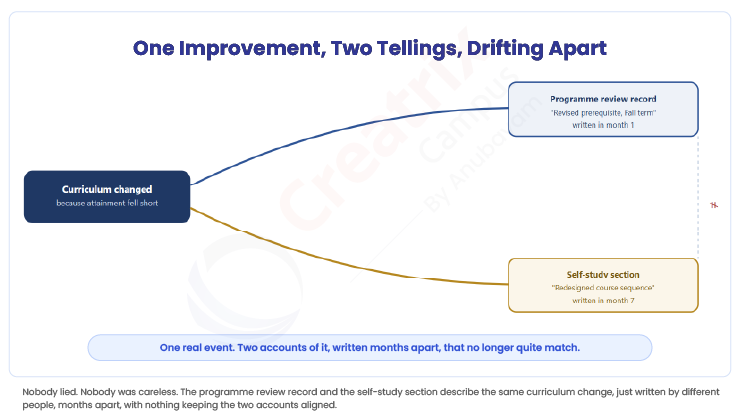
A programme review committee spends a term analyzing assessment results and documenting an improvement action, a curriculum change made because attainment fell short in one area, and six months later, the accreditation liaison starts building a self-study section on exactly that same programme, pulling different files, talking to different people, and often arriving at a slightly different account of what actually happened and why, because nobody treated the first version as the raw material for the second.
The Same Evidence, Filed Twice
Institutional effectiveness work produces a specific kind of evidence: assessment results, programme review findings, documented improvement actions, the record of a university doing what it says it does. Accreditation self-studies ask for almost exactly that evidence, organized against a different set of headings and a different audience's expectations.
Treated as two separate jobs, this means two separate timelines, two separate owners, and two separate versions of the same underlying facts, and versions drift. A programme review might describe an improvement action one way internally and a self-study might describe the same action slightly differently months later, not from dishonesty, but because nobody was reconciling the two tellings against each other. A reviewer who catches that drift doesn't see two departments doing their jobs. They see an institution that can't produce a consistent account of itself.
| Managed as | What gets produced | What breaks under review |
| Two separate exercises | Institutional effectiveness evidence and accreditation evidence, built independently | The two versions drift apart; nobody notices until they're compared |
| One evidence exercise, duplicated for accreditation | A single after-the-fact rewrite of existing evidence into accreditation format | The rewrite introduces small inconsistencies with the original record |
| One continuous evidence cycle | Assessment, programme review, and improvement actions that already serve both purposes | Nothing to reconcile; both audiences are reading the same record |
What If Improvement Evidence Just Was Accreditation Evidence?
This is worth sitting with for a moment, because it reframes what "readiness" actually means. If the assessment data, programme review findings, and improvement actions your institution already generates were structured once, well, and stored as one connected record, would you still need a separate accreditation evidence project at all? For most institutions, the honest answer is: mostly no, you'd need to organize what already exists against the standards, not recreate it.
HLC's Core Component 3.G requires institutions to demonstrate student learning and improvement, and "demonstrate" is the operative word: the evidence has to trace back to real assessment and improvement work, not a document built to look like it did. That's precisely what changes when assessment, programme review, and improvement actions run as one connected cycle instead of two: the accreditation evidence a reviewer eventually asks for is simply that same record, organized against the relevant standard, not a parallel project competing for the same people's time.
Conclusion
Accreditation and continuous improvement aren't two disciplines that happen to overlap occasionally. Most of the time, they're the same evidence, generated once, described twice. The institutions that struggle at review time usually aren't short on proof, they're managing two parallel versions of it that were never reconciled with each other. Running one connected evidence cycle instead of two doesn't just save effort. It removes the exact inconsistency reviewers are trained to look for.
If your QA office and your accreditation liaison are currently building separate accounts of the same programme's improvement work, that's worth connecting before your next review, not during it.
See how one connected evidence cycle serves both continuous improvement and accreditation.
Quick recap
Accreditation evidence and continuous improvement evidence usually come from the same underlying academic work: assessment, programme review, and improvement actions. Managed as two separate exercises, institutions end up producing the same proof twice, on different schedules, and the two versions can quietly drift apart. Running them as one continuous cycle means the evidence a reviewer eventually asks for is simply the same record, organized against the relevant standard, not a second project competing for the same people's attention.
Frequently asked questions
How are accreditation evidence and continuous improvement actually connected?
Why do institutions end up managing them as separate processes?
What's the risk of treating them as two separate projects?
Does connecting the two processes guarantee a positive accreditation outcome?
Who should be responsible for reconciling continuous improvement evidence with accreditation evidence?
Join the conversation
Want to contribute?
We welcome thought leaders to share ideas and write for our blog.
Become a guest author