

On this page
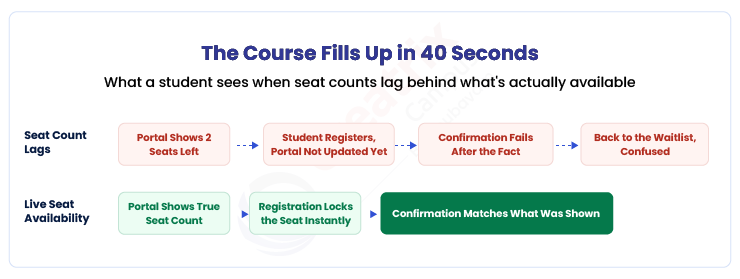
A required course opens for registration at 9am. The portal shows two seats left. A student, following their advisor's plan exactly, clicks register at 9:00:41. The confirmation fails. The two seats were already gone, claimed by other students whose registrations processed a few seconds earlier, and the portal simply hadn't caught up to reality yet.
That student did everything right. They met with their advisor, built a plan around the right prerequisite sequence, and registered the moment the window opened. What failed wasn't their planning. It was the gap between what the portal displayed and what was actually still available, a gap measured in seconds that can still derail a semester.
Cloud course registration software is supposed to close exactly that gap: showing a seat count that's actually current, and confirming a registration only when a seat genuinely still exists, rather than accepting a request the system can't actually fulfill.
Quick answer
Cloud course registration software benefits students by showing genuinely live seat availability and confirming enrollment only when a seat is actually still open, rather than displaying a count that lags behind real-time demand. The most common registration failure isn't a lack of planning. It's a gap between what the portal shows and what's actually available in the seconds a popular course fills.
Article summary
The case for genuinely live course registration rests on three things: why a portal's displayed seat count can lag behind real demand at the exact moment it matters most, how advising and registration can fail to connect even when both are working correctly on their own, and what to check for so a confirmed registration is actually reliable rather than provisional.
Key takeaways
- A registration failure at the moment a popular course fills is often not a planning problem. It's a gap between the displayed seat count and what's actually still available.
- NACADA, chartered in 1979, represents more than 14,000 academic advising professionals worldwide, but its focus is the advising profession itself, not the technical registration process a plan ultimately depends on.
- An advisor can build a perfect academic plan, and a registration system can still fail to deliver a seat, because advising and registration are frequently handled as two separate steps.
- Prerequisite checks that happen automatically at the moment of registration prevent a different kind of failure: a student registering for a course they aren't actually eligible for yet.
- The institutions that get real value from registration software evaluate for genuinely live seat data, not just a self-service interface layered on top of a system that still lags behind demand.
The Seat That Wasn't Really There
Seat availability lag is one of the most common, least discussed failure points in registration systems. A portal that refreshes its seat count every few seconds, rather than instantly, can show availability that's already gone by the time a student clicks confirm. The result is a rejected registration, a scramble for the waitlist, and a student who now has to rework a schedule an advisor helped them build carefully.
This is where advising and registration quietly become two separate systems doing two separate jobs, even when they should be working together. NACADA, the Global Community for Academic Advising, chartered in 1979 and now serving more than 14,000 advising professionals worldwide, per NACADA's own site, focuses specifically on the advising profession, helping students build the right academic plan. What NACADA's own site does not claim to cover is the technical registration process itself, whether the seat that plan depends on is actually still available at the moment a student tries to claim it.
That gap between the two is worth naming plainly: an advisor can build a perfect plan, and a registration system can still fail to deliver on it, because planning and seat availability are handled by different parts of the process, sometimes different systems entirely.
From an Advisor's Plan to a Confirmed Seat
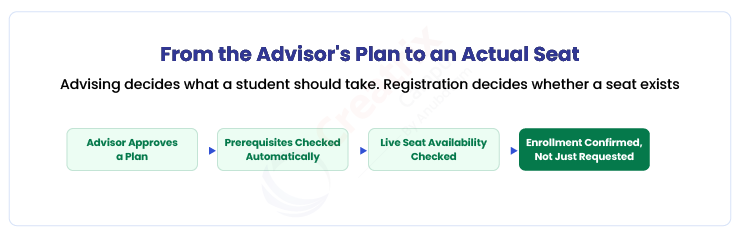
Advising decides what a student should take next, based on their program, progress, and prerequisites completed so far. Registration decides whether a seat actually exists for that plan right now. The handoff between those two steps is where a well-built advising process can still fail a student, if the registration system doesn't check prerequisites automatically and confirm seat availability at the actual moment of registration, not a few seconds before or after.
Automatic prerequisite checking closes one part of this gap: a student can't register for a course they aren't yet eligible for, which prevents a different, later failure, discovering mid-semester that a requirement was never actually met. Genuinely live seat availability closes the other part: what the portal shows is what's actually still open, at the moment a student tries to claim it.
What to Check Before Trusting "Live" Availability
| Approach | What it looks like to a student | Where it fails |
| Seat count refreshed on a delay | Portal shows availability that looks current | A student can register for a seat that's already gone, discovering the failure only after clicking confirm |
| Manual prerequisite verification | Registration allowed, prerequisites checked later by staff | A student may register for a course they aren't eligible for, only discovering the problem after the term starts |
| Genuinely live seat data with automatic prerequisite checks | What's shown matches what's actually available and eligible | Requires the underlying system to check both in real time, not on a batch schedule |
The honest test when evaluating registration software is asking what happens in the exact seconds a popular course fills: does the displayed seat count reflect true, current availability, or does it refresh on an interval that can fall behind real demand during a rush. That answer determines whether "self-service registration" actually delivers what it promises.
Where Creatrix Campus Fits
Creatrix Campus checks prerequisites automatically and confirms seat availability in real time, so a registration attempt reflects what's genuinely still open, not a count that's a few seconds out of date.
Because registration connects to the same student record used by advising, a student's approved plan and their actual registration stay linked, closing the handoff gap where a well-built plan can otherwise fail to translate into a confirmed seat.
Conclusion
A rejected registration in the exact moment a required course fills rarely means a student planned poorly. More often, it means the portal showed a seat that had already been claimed by someone else's registration a few seconds earlier.
Institutions that evaluate registration software for genuinely live seat data and automatic prerequisite checking close the gap between an advisor's plan and an actual confirmed seat. The rest keep watching students do everything right and still lose the race to a portal that hadn't caught up yet.
If you want to see how Creatrix Campus keeps registration genuinely live, talk to us about cloud course registration software.
Quick recap
Cloud course registration software should show genuinely live seat availability and check prerequisites automatically, so a confirmed registration reflects what's actually still open rather than a count that lags behind real demand. Institutions should evaluate for real-time accuracy at the exact moment a popular course fills, not just a self-service interface layered on top of a delayed system.
Frequently asked questions
What are the benefits of cloud course registration for students?
Why does a required course sometimes reject a registration even when seats appeared available?
How does automatic prerequisite checking prevent registration problems?
What should institutions look for when evaluating course registration software?
How does Creatrix Campus handle course registration?
Join the conversation
Want to contribute?
We welcome thought leaders to share ideas and write for our blog.
Become a guest author