
On this page
Universities already assess students constantly, through quizzes, rubrics, projects, and exams. The harder question isn't whether assessment is happening. It's whether any of it can be traced from a student's actual work to a learning outcome, an attainment judgment, a faculty decision, and an improvement that followed.
Quick answer
An outcome-based assessment becomes accreditation evidence only when it stays connected to four things: what the student demonstrated, how attainment was judged against a defined outcome, what faculty concluded from the result, and what changed afterward. A score by itself proves that grading happened. It doesn't yet prove that the institution learned anything or acted on it.
Article summary
Problem: Institutions generate large volumes of assessment scores, but most of that data stays disconnected from the outcome, judgment, and improvement decision that would make it accreditation evidence.
For: Assessment Leaders, QA and Accreditation Heads, Programme Chairs, Deans, and OBE Coordinators.
Shift: From counting assessments completed, toward tracing whether each one produced a defensible piece of learning evidence.
Outcome: A clearer view of what turns routine assessment activity into evidence an accreditor can actually use.
Key takeaways
- A score shows grading happened. It doesn't show what the institution learned or did next.
- Accreditation evidence needs four connected elements: outcome, judgment, decision, and improvement.
- The most common break isn't in scoring. It's in what faculty do with the result afterward.
- Attainment gaps that never produce a named response don't count as continuous improvement.
- Programme review depends on being able to check, later, whether a past improvement action actually worked.
A Score Is Not Yet Accreditation Evidence
Direct assessment methods, rubric scoring, and attainment levels all exist to answer one question: did the student demonstrate the outcome. That's a meaningful question, and most institutions have gotten reasonably good at answering it. The problem is that answering it produces a score, and a score on its own doesn't tell an accreditor anything about whether the institution noticed, judged, or acted on what that score meant.
The National Institute for Learning Outcomes Assessment has long described this as "closing the loop," the practice of using assessment results to inform actual decisions rather than simply reporting them. Their published research consistently finds that institutions are better at collecting outcomes data than at demonstrating what was done with it. That gap is exactly where a score-only process stalls.
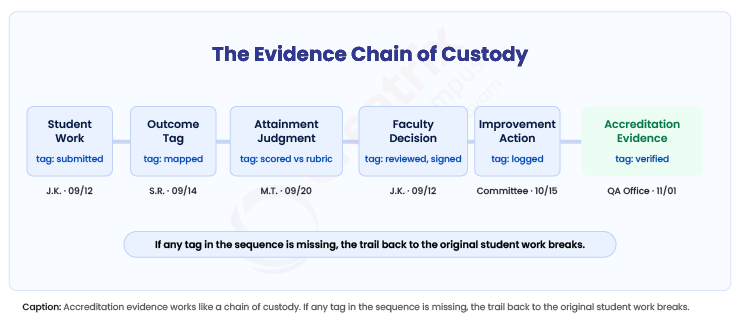
Here's where that distinction becomes concrete for accreditation reporting specifically.
| Assessment Activity | What Accreditation Actually Needs From It |
| Student score | Evidence tied to a defined, mapped outcome |
| Rubric result | A clear, documented attainment judgment |
| Attainment gap | A named academic response, not just a flagged number |
| Faculty action | Evidence that the loop was actually closed |
| Programme review | Proof that a past improvement was checked later, not just proposed |
Each row in that table represents a place where institutions commonly stop one step short. They have the score, the rubric result, the gap identified, but the response, the closure, and the later check are the parts that turn activity into evidence.
The Missing Link Is What Faculty Do With the Result
If scoring were the hard part, most institutions would have solved this years ago. The harder part is what happens after a rubric result comes in showing an attainment gap. Someone has to look at it, decide it means something, and connect that decision to a specific action, and that sequence has to be recorded well enough to survive being asked about two years later.
This is where a score-only model and an evidence-to-improvement model diverge sharply, even though both start from the same rubric result.
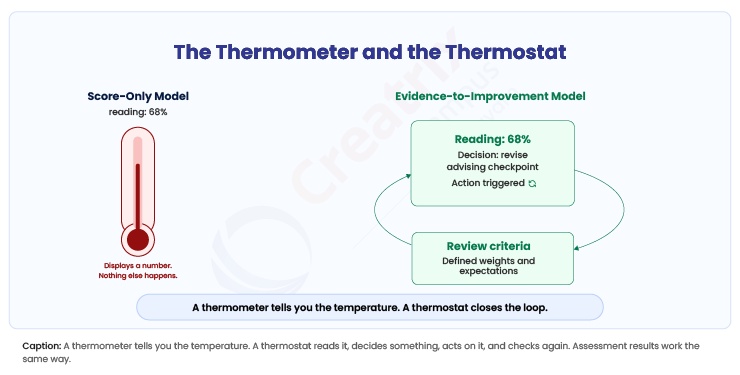
Programme review depends entirely on this closed loop existing somewhere in the record. A reviewer doesn't just want to see that an attainment gap was identified three years ago. They want to see what the institution decided, what it changed, and whether that change actually improved the next round of results. Without that third step, "continuous improvement" is really just "continuous measurement."
Keeping that loop intact is less about any single tool and more about whether assessment and outcomes data stay connected to programme-level decisions as they're made, rather than being reconstructed afterward. When a faculty decision, the rubric result that prompted it, and the resulting action can all be retrieved together, programme review stops being a research project and becomes a retrieval task. The same connected structure is what eventually feeds accreditation evidence management, since that evidence has to be traceable back to the assessment record it came from, not assembled from memory during self-study season.
None of this happens automatically just because a platform stores assessment data. The judgment about what a gap means and what to do about it still belongs to faculty and programme leadership. What changes is whether that judgment, once made, stays attached to the evidence that prompted it.
Conclusion
Outcome-based assessment was never short on data. What it's often short on is a traceable line from a student's demonstrated work to the judgment made about it, the decision that followed, and the improvement that was later checked. That traceable line, not the volume of scores collected, is what accreditation review actually tests.
If your institution can produce assessment reports but struggles to show the decisions and follow-through behind them, that's worth talking through directly. Talk to our team about keeping outcomes, judgment, and improvement connected across your assessment process. Results vary by institution, and no platform can guarantee accreditation, compliance, or improved outcomes.
Quick recap
A rubric score proves grading happened. It doesn't prove the institution noticed what the result meant, decided something about it, or checked later whether that decision worked.
Accreditation evidence needs all four pieces connected: outcome, judgment, decision, and a later check on improvement. Institutions that only have the score are usually the ones reconstructing the rest under deadline.
Frequently asked questions
Is a rubric score the same as accreditation evidence?
What does "closing the loop" mean in outcomes assessment?
Does every accreditor require the same assessment model?
Why do attainment gaps sometimes not lead to any real action?
How does programme review depend on outcome-based assessment?
Can technology guarantee accreditation once assessment data is connected?
Join the conversation
Want to contribute?
We welcome thought leaders to share ideas and write for our blog.
Become a guest author