
On this page
Most institutions do not have one campus management system. They have several, a student information system for records, a spreadsheet for hostel occupancy, a separate login for library resources, and a shared folder for whatever the last audit needed. Each piece works well enough on its own. None of them talk to each other.
Campus management software promises to fix this by putting operations under one roof: admissions data, student records, fee collection, facilities, faculty workload, all of it. Most vendors deliver the first half of that promise easily. Bringing everything into one interface is the easy part. Making that data actually connected, so a change in one place is reflected everywhere else without someone re-entering it, is where most platforms quietly fall short.
Campus management software should do more than digitize paperwork. What a genuinely connected system looks like, across general campus operations, specialized cases like engineering colleges, and mobile or cloud-first institutions, is what actually matters before signing a multi-year contract.
Quick answer
Campus management software is a platform that centralizes core institutional operations, admissions, student records, fee management, facilities, and faculty data, that would otherwise live in separate spreadsheets or point tools. The version that actually improves institutional performance goes further: it keeps that data in one connected system of record, so a change made in one module (a fee payment, a room reassignment, a grade update) is instantly reflected everywhere it matters, instead of requiring manual re-entry across disconnected tools.
Article summary
Institutions evaluating campus management software all end up asking the same handful of questions: what it should include, how it holds up for specialized cases like engineering programs, and whether cloud and mobile access are enough on their own. What actually separates a connected operating core from a collection of digitized forms is not any single module. It's whether the modules share one data model.
Key takeaways
- Campus management software fails most often not because it lacks features, but because its modules do not share data with each other
- Institutional performance gains come from eliminating manual reconciliation between systems, not from digitizing any single process in isolation.
- Specialized institutions, engineering colleges included, need the same connected core plus program-specific tracking (labs, outcomes, professional-body requirements), not a separate system.
- Mobile and cloud access are table stakes for any current platform. They are not, by themselves, evidence of a connected system.
- AACRAO and EDUCAUSE, the two major professional bodies for academic records and higher ed technology, both exist because keeping institutional data accurate and usable across departments is a persistent, unsolved operational problem for most institutions.
What Is Campus Management Software?
Campus management software is a platform built to run the administrative side of a college or university: admissions and enrollment, student records, fee collection, facilities and housing, faculty and staff data, and institutional reporting. Instead of a registrar's office running one tool, finance running another, and facilities keeping its own spreadsheet, campus management software is meant to bring these functions into a shared system.
The category goes by several names depending on who is buying it. A registrar might search for a "college management system." A CIO evaluating infrastructure might call it "university management software." An engineering-focused institution might specifically look for software that also tracks lab usage, outcome-based accreditation evidence, and professional-body requirements alongside the standard administrative load. These are not different products. They are the same underlying need, described from different vantage points inside the institution.
What every version of this category should deliver, at minimum, is a single source of truth for student and institutional data, mobile and cloud access so staff and students are not tied to one office computer, and reporting that reflects the current state of the institution rather than last month's export.
Why Digitized Does Not Mean Connected
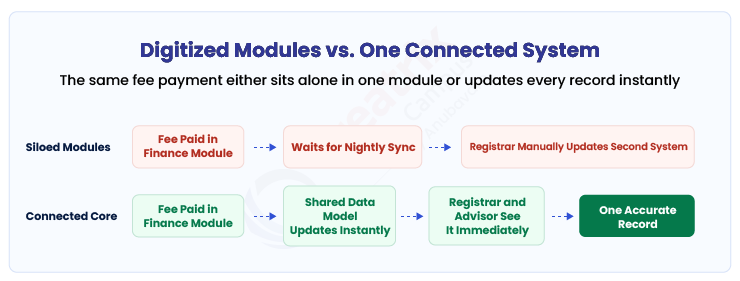
Here is the test that separates a genuinely connected platform from a set of digitized forms: when a student's fee status changes, does the registrar's view update automatically, or does someone have to manually update a second system to match?
In most institutions running several point tools under one brand name, the honest answer is that data moves in batches, or not at all, between modules. A fee payment posts in the finance module. The transcript system finds out at the next nightly sync, or when a staff member remembers to update it by hand. A room reassignment in housing does not reach the attendance system, so a student's location on record and their actual class schedule can disagree for weeks.
| Approach | What day-to-day operations look like | Where it breaks down |
| Separate spreadsheets and point tools per department | Each team manages its own data, some accuracy, no shared view | Reports disagree across departments, manual reconciliation before every audit or board meeting |
| Digitized modules under one brand, still siloed | Fewer logins, individually faster tasks | Same data entered more than once, updates lag between modules, no real-time institutional view |
| One connected system of record across modules | A change anywhere reflects everywhere instantly | Requires more upfront evaluation to confirm the platform is actually unified, not bundled |
AACRAO, the American Association of Collegiate Registrars and Admissions Officers, represents more than 22,000 higher education professionals across roughly 2,100 institutions in over 30 countries, working with a combined enrollment above 16.4 million learners, per AACRAO's own site. Its entire professional mandate centers on the integrity and portability of academic records, a problem that would not need a dedicated global association if keeping institutional data accurate and consistent across systems were already solved by most software on the market.
EDUCAUSE, the nonprofit association with more than 100,000 individual members and 2,100 member institutions focused on the use of technology and data in higher education, exists for a related reason, per EDUCAUSE's own site: institutions keep needing outside research and benchmarking on how to actually modernize campus IT, which suggests that buying software alone rarely closes the gap between digitized and genuinely connected operations.
What to Look For, Including Specialized Cases Like Engineering Colleges
Cloud access, mobile apps, and a modern interface are the baseline now. Nearly every vendor in this category offers some version of all three. None of that tells you whether the underlying data model is actually unified.
A useful decision framework asks harder questions than "does it have an app." Does a change in one module propagate to every other module without manual sync. Can a dean pull one institutional performance report that reflects finance, enrollment, and facilities data as of right now, not as of the last export. Can the platform handle specialized program requirements, engineering colleges being a common example, where labs, equipment scheduling, outcome-based curriculum tracking, and professional-body accreditation evidence (AICTE-style requirements, for institutions where that applies) need to sit inside the same system as general student records, not bolted on separately.
| Capability | Why it matters | What to ask a vendor |
| Unified data model across modules | Prevents the reconciliation cycle that consumes staff time before every report or audit | Ask for a live demo where a change in one module is shown updating in another, not a slide describing it |
| Mobile and cloud access | Table stakes for current staff and student expectations, not a differentiator | Ask what breaks or requires a desktop when accessed from mobile, rather than what works |
| Specialized program support (labs, outcomes, professional-body evidence) | Institutions with engineering or other accredited programs need this inside the core system, not a separate add-on | Ask whether program-specific tracking uses the same student and course records as the rest of the platform |
| Real-time institutional reporting | Leadership needs current numbers for board and funding decisions, not month-old exports | Ask how "real-time" is defined: instant, hourly batch, or nightly sync |
If a vendor's answer to "how connected is your platform" is a list of modules, that is a catalog, not a system. If the answer describes what happens automatically when one piece of data changes, that is closer to what actually improves institutional performance.
Where Creatrix Campus Fits
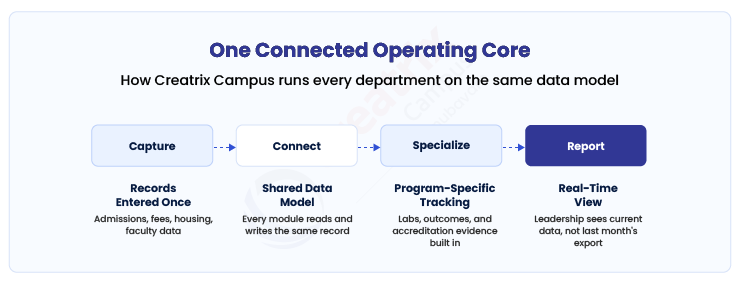
Creatrix Campus is built as one connected operating core for higher education institutions, not a set of modules bundled under a shared login. Student records, fee management, facilities, faculty data, and institutional reporting run on the same underlying data model, so a change in any one area is reflected everywhere it matters, without a manual sync step.
That includes specialized cases. Engineering colleges and other accredited programs get the same connected core plus outcome-based curriculum tracking, lab and equipment scheduling, and evidence collection aligned to the professional-body requirements relevant to their region, inside the same system that runs general student records rather than a separate add-on.
Mobile and cloud access come standard, the way any current platform should offer them. The difference shows up in what leadership can actually do with the data: a president or provost gets one institutional performance view built from live data across every department, a registrar gets accurate records without cross-checking a second system, and a CIO gets one platform to secure and maintain instead of several.
Conclusion
Most institutions evaluating campus management software ask the wrong first question. They ask what modules are included, when the question that actually predicts long-term satisfaction is whether those modules share one data model or simply share a login screen.
Whether an institution calls it a college management system, university management software, engineering college management software, or cloud-based college management, the underlying need is the same: operations that work as one connected system instead of several digitized ones. The institutions that get real value from this category are the ones that evaluate for that connection specifically, not just for a longer feature list.
If you want to see how Creatrix Campus runs student records, faculty data, and institutional reporting as one connected operating core instead of a bundle of modules, talk to us about connected campus management.
Quick recap
Campus management software should do more than digitize paperwork across departments: the real test is whether a change in one module, a fee payment, a room reassignment, a grade update, is reflected everywhere else instantly, without manual reconciliation. Cloud and mobile access are table stakes, not differentiators. Specialized cases like engineering colleges need the same connected core plus program-specific tracking built in, not bolted on separately, and leadership needs institutional reporting built from live data, not month-old exports.
Frequently asked questions
What is campus management software?
What is the difference between campus management software, a college management system, and university management software?
How is campus management software different for engineering colleges?
Are cloud and mobile access enough to evaluate a campus management platform?
How does Creatrix Campus handle campus management?
Join the conversation
Want to contribute?
We welcome thought leaders to share ideas and write for our blog.
Become a guest author