

On this page
A student receives a conduct notice by email. It cites a policy they have never read, names no process and sets a deadline. Two weeks later, another student with a similar case gets a different outcome. Nothing dramatic happened, but trust in the institution has moved a little.
A campus culture is judged by how fairly the institution responds when something goes wrong. This guide is for deans of students, student affairs leaders and provosts. It gives a consistency test you can run on your own cases this week, six practices that make conduct decisions fair and explainable, and five questions to put to any conduct system.
Quick answer
Behavior management in higher education, usually called student conduct, builds campus culture when decisions are consistent, explainable and followed through. Leaders can test this by comparing a sample of recent cases, then strengthen it with clear expectations, easy reporting, proportionate responses, a fair process, outcomes that reach registration, housing and advising, and support alongside accountability.
Article summary
This guide defines behavior management in higher education, gives leaders a consistency test, six practices, data guardrails and five questions to ask of any conduct system, and shows where connected records help.
Key takeaways
- Higher education usually calls this student conduct, and campus culture is judged by how fairly it responds.
- A consistency test on ten recent cases shows leaders quickly whether similar cases get similar outcomes.
- Fair conduct needs clear expectations, easy reporting, proportionate response and a process with written reasons and an appeal route.
- A decision that does not reach registration, housing and advising records has not really been carried out.
- Use data to find patterns and target support. Do not use it to monitor individual students.
What Behavior Management Means, and How Culture Judges It
Behavior management in higher education is the deliberate and systematic effort an institution makes to guide student conduct in ways that build a safe, respectful and conducive learning environment. At university level it is usually called student conduct or community standards, and it is broader than discipline: expectations, reporting, resolution, support and learning from patterns.
Students and staff form a view of the institution’s culture from how it handles the hard moments. Three things shape that view. Are decisions consistent, so similar cases get similar outcomes? Are they explainable, with reasons a student can understand and challenge? And are they followed through, so an outcome actually takes effect, and the student who needs help gets it? The rest of this guide is built around those three questions.
The Consistency Test
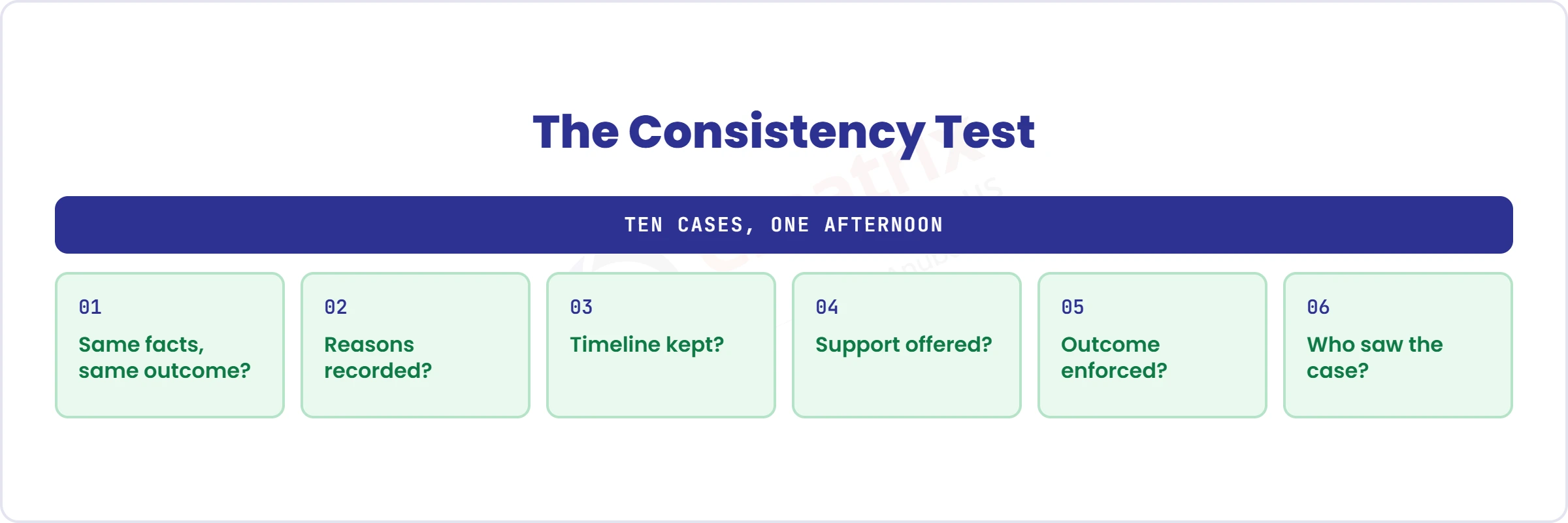
Pick ten recent cases across two or three categories, and compare them. It takes an afternoon and tells you more than a policy review.
| Check | What to look for | What a gap means |
| Same facts, same outcome? | Similar cases ending differently with no recorded reason | Sanction guidance is missing or not followed |
| Reasons recorded? | A written rationale in every case | Decisions cannot be explained or fairly appealed |
| Timeline kept? | Days from report to outcome | An ownership or capacity gap |
| Support offered? | A referral or plan alongside a sanction where relevant | Accountability without help |
| Outcome enforced? | The outcome appears in registration, housing and finance records | A follow-through gap |
| Who saw the case? | Access limited to those with a reason, and logged | A privacy risk |
Six Practices for Fair, Explainable Conduct
1. Make expectations and reporting clear and easy. Move: a plain-language code with a one-page summary and real examples, covered in orientation, plus one reporting route for students, faculty and staff, with an immediate acknowledgement and a named case owner. Example: a lecturer reports repeated classroom disruption in a few clicks and can see the status. Measure: the share of students who know how to report a concern, and time to acknowledge.
2. Respond in proportion. Move: classify incidents by severity, resolve minor matters through a conversation and written agreement, and reserve formal procedures for serious or repeated cases. Publish sanction guidance. Example: a first minor breach ends in a recorded agreement, and a repeat triggers a formal step. Measure: time to first contact, and outcomes by category.
3. Run a fair process. Move: notice of the concern, a chance to respond, impartial decision-makers, a written outcome with reasons, a route to appeal and published timelines. Example: every student receives the same case letter stating the policy, the process and the appeal route. Measure: cases closed within the timeline, and outcomes changed on appeal.
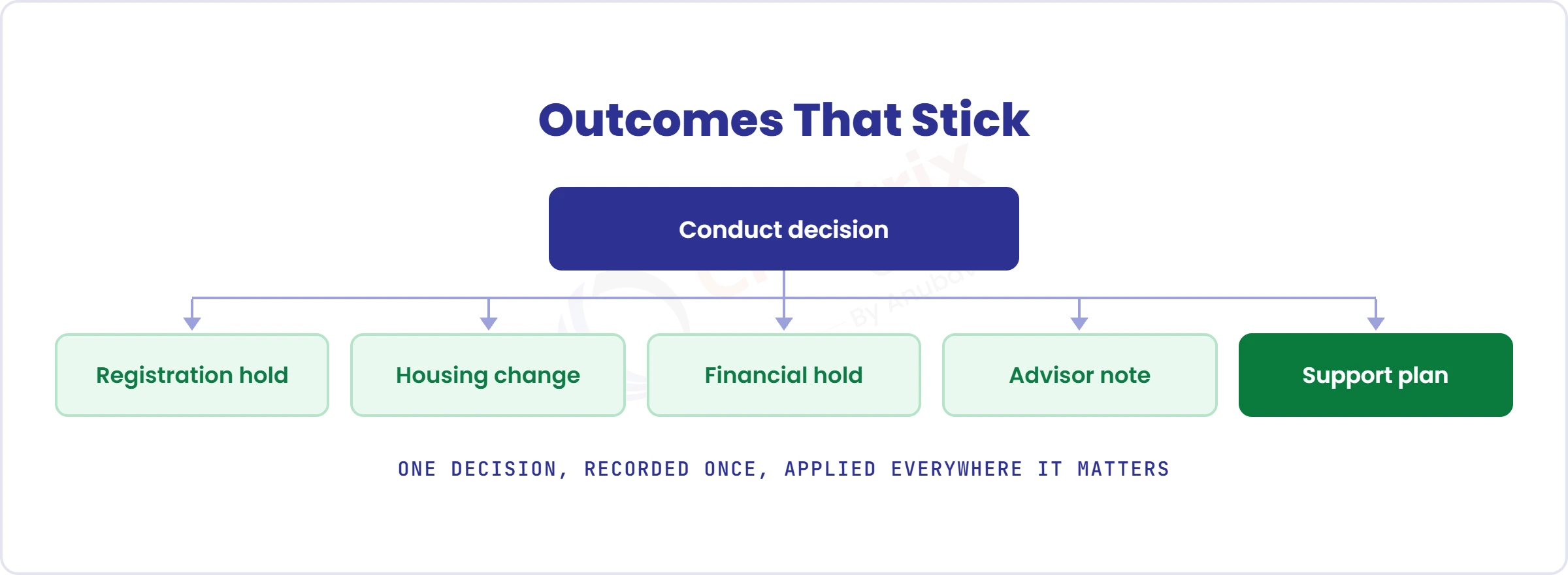
4. Make outcomes stick. Move: when a decision takes effect, make sure it reaches the systems that apply it: a registration hold, a housing change, a financial hold, a note for the advisor. Example: a suspension is recorded once and the registration hold, housing change and advisor note follow, instead of three emails. Measure: outcomes applied across all systems within the agreed time.
5. Pair accountability with support. Move: when a pattern suggests a student is struggling, add a support plan, an academic or wellbeing referral and a named contact alongside any sanction. Example: a student with repeated late submissions and conduct reports gets a plan with an advisor and a referral, not only a warning. Measure: repeat incidents after a support plan, and referral completion.
6. Prevent through belonging and recognition. Move: orientation and welcome programmes, mentoring that pairs new students with experienced ones, inclusive events, open forums and clubs, and visible recognition of helpfulness and leadership. Faculty and staff set the tone as role models. Example: every first-year student has a named senior peer for their first term. Measure: participation in orientation and mentoring, and belonging in a short pulse survey.
Using Data With Guardrails
Use data to learn, with four guardrails.
- Look for patterns, not people. Review incidents by type, campus, programme and time of year to find where help is needed, not to monitor students in real time. A rise in incidents at one residence each October might mean earlier orientation there.
- Humans decide. Where analytics or AI points to a pattern, a person reviews it. A risk score is a prompt, not a verdict.
- Limit access and retention. Only people with a reason see a case, and records are kept only as long as policy and law require.
- Check for bias. Compare outcomes across student groups and campuses, and correct drift.
Local rules apply: some jurisdictions set due-process requirements in law, and academic integrity cases, including those involving generative AI, often follow their own route.
Five Questions for Any Conduct System
Whatever you use, put these five questions to it.
| Claim | What it might actually cover | What to ask instead |
| “Case management” | A log of incidents | Ask to see one case from report to outcome, with reasons, timeline and appeal |
| “Integrated” | A shared login or an export | Ask whether an outcome creates a registration hold or housing change without retyping |
| “Analytics” | Counts of incidents | Ask for consistency by category and outcome, with access limited by role |
| “Support built in” | A referral note | Ask whether conduct, advising notes and support plans can be seen together by those entitled to |
| “AI insights” | A risk score | Ask who decides, how a score is explained, and how a student can challenge it |
Where Creatrix Campus Fits
In Creatrix Campus, the support side of conduct sits in Student Success & Records: advisor assignment and notes, early alerts and interventions, success plans, and wellbeing referral tracking (referral and status only, since clinical counselling records are not held there). Holds management for registration sits in the same lifecycle, financial holds come from Student Financials, and housing is managed in Student Housing.
That is the connection to design for: a conduct outcome has somewhere to land. Student Conduct records and tracks incidents and cases and applies the institution’s own conduct policy, and the other modules hold the records the outcome has to change, so the decision, the hold, the housing change and the advising plan sit on one student record, with access controlled by role.
Conclusion
A positive campus culture is not the absence of incidents. It is the confidence that expectations are clear, concerns are heard, outcomes are fair and carried out, and students who struggle are helped. A leader can start with ten cases and an afternoon.
If you want to see how conduct, holds, housing and advising would connect on one record, talk to us about a Tailored Proof Session.
Quick recap
Test consistency on ten cases, make decisions explainable, make outcomes stick across systems, and pair accountability with support.
Frequently asked questions
What is behavior management in higher education?
How is it different from discipline?
How can leaders check whether conduct decisions are consistent?
How can institutions make conduct processes fair?
Can analytics or AI be used in student conduct?
How does Creatrix Campus support student conduct?
Join the conversation
Want to contribute?
We welcome thought leaders to share ideas and write for our blog.
Become a guest author