
On this page
Most course learning outcomes already use Bloom's verbs correctly. The harder question a Dean actually needs answered is whether those verbs reflect real cognitive progression across a programme, or whether they're just correctly worded documentation sitting on top of a curriculum that never asked students to think harder as they advanced.
Quick answer
Bloom's Taxonomy is useful to a Dean only when it's used to check curriculum design, not just outcome wording. That means verifying whether CLOs are pitched at the right cognitive level for where a course sits in the programme, whether difficulty actually increases across years, and whether assessments test the level an outcome claims rather than a lower one. A syllabus with the right verbs and a curriculum with real cognitive progression are not the same thing.
Article summary
Problem: Institutions often write CLOs with correct Bloom's verbs, but that alone doesn't confirm students are being pushed toward higher-order thinking as they progress through a programme. For: Deans, Academic Heads, Curriculum Leaders, Programme Chairs, and Assessment Leaders. Shift: From asking "did we use the right verb," toward asking "can we show cognitive progression across the curriculum, backed by matching assessment." Outcome: A practical way to audit curriculum design against Bloom's Taxonomy, rather than another explainer of what the six levels mean.
Key takeaways
- Correct Bloom's verbs on a CLO don't prove curriculum-wide cognitive progression.
- The real audit question is whether difficulty rises across a programme, not just within one course.
- Assessments need to test the cognitive level an outcome claims, not a lower, easier one.
- Advanced courses that stay at "Understand" or "Apply" are a curriculum design gap, not a wording issue.
- Constructive alignment, matching outcomes, teaching, and assessment, is what actually makes Bloom's useful.
The Problem Is Not Choosing the Right Verb
Bloom's Taxonomy gets treated, too often, as a vocabulary exercise: pick "analyze" instead of "understand," and the outcome is fixed. That's a misreading of what the taxonomy is actually for. Bloom's was designed to classify cognitive demand, and classification only matters if it's used to check whether the demand placed on students is appropriate and progressing.
The real risk shows up when CLOs across a programme cluster at the same one or two levels, regardless of course sequence. A final-year capstone course sitting at "Understand" is a design gap a reviewer will catch immediately, and no amount of verb-polishing in the outcome statement changes what the coursework actually required of students.
This is also where constructive alignment matters more than the taxonomy alone. The framework, associated with education researcher John Biggs, holds that outcomes, teaching activities, and assessment all need to target the same cognitive level for learning to be genuinely demonstrated, not just documented. A well-established explanation of constructive alignment is worth reviewing directly, since the concept is frequently referenced but inconsistently applied.
Can Your Curriculum Show Cognitive Progression?
The more useful audit isn't course by course. It's whether cognitive demand rises as students move through a programme, foundational courses reasonably sitting at "Remember" and "Understand," core courses moving into "Apply" and "Analyze," and advanced or capstone courses genuinely requiring "Evaluate" or "Create."
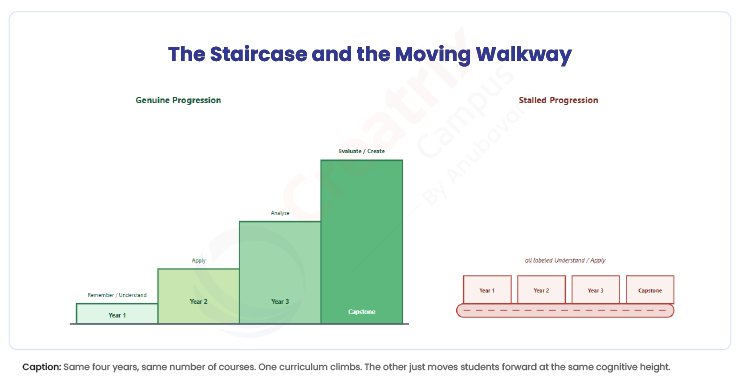
Checking this requires looking at the CLOs across an entire programme side by side, not one syllabus at a time. It's worth being specific about what to actually look for at each level, since a general sense of "our outcomes use Bloom's" isn't the same as being able to show it.
| Bloom's Level | What Students Are Expected to Demonstrate | What Curriculum Leaders Should Look For |
| Remember | Recall facts, terms, and basic concepts | Concentrated in early foundational courses, not final-year ones |
| Understand | Explain ideas in their own words | Present but not dominant past the first year of a programme |
| Apply | Use knowledge in a new, concrete situation | Common in core courses, with real scenarios rather than repetition |
| Analyze | Break information into parts and examine relationships | Appears clearly by mid-programme, tested through comparison or breakdown tasks |
| Evaluate | Make and justify a judgment against criteria | Expected in upper-level and capstone courses, not just mentioned in passing |
| Create | Combine elements into a new, coherent product | Concentrated in capstone or culminating project work |
A gap in this table usually shows up in one of two ways. Either the CLOs never reach the higher levels anywhere in the programme, which is a curriculum design gap, or the CLOs claim a higher level that the actual assessment never tests, which is an assessment alignment gap. Both are common, and both are invisible if outcomes are only reviewed course by course.
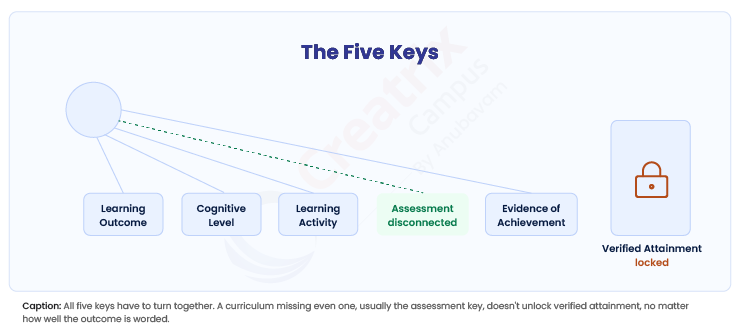
Programme-level visibility like this depends on keeping course outcomes connected to the assessment evidence that's supposed to test them, rather than reviewing CLOs and assessment plans as separate documents. When that connection holds, a gap in cognitive progression becomes visible during curriculum design, not during an accreditation review.
Where Creatrix Campus Fits
Creatrix Campus keeps course learning outcomes, their Bloom's-aligned cognitive levels, and the programme learning outcomes and attainment data they map to connected as one record, rather than as separate curriculum documents and assessment spreadsheets. This lets a Dean or curriculum leader view cognitive-level distribution across a programme's courses in one place instead of reconstructing it manually.
Creatrix Campus does not automatically determine whether a curriculum's cognitive progression is appropriate, that judgment remains with academic leadership and faculty. What it provides is the connected visibility needed to make that judgment with evidence, rather than assumption.
Conclusion
Bloom's Taxonomy was never the hard part of curriculum design. Writing a CLO with the correct verb takes a few minutes. Showing that a programme's cognitive demand genuinely rises across its courses, and that assessments test the level they claim, is the work that actually determines whether Bloom's alignment means anything.
If your programme's outcomes read well but you can't easily show cognitive progression across courses, that's worth a direct conversation. Talk to our team about connecting course outcomes, cognitive levels, and assessment evidence across your curriculum. Results vary by institution, and no platform can guarantee accreditation or specific review outcomes.
Quick recap
Correct Bloom's verbs on a CLO don't prove a curriculum has real cognitive progression. That requires checking whether demand actually rises across a programme's courses and whether assessments test the level each outcome claims.
A gap usually shows up as either outcomes that never reach higher-order levels anywhere in the programme, or outcomes that claim a level the assessment doesn't actually test.
Frequently asked questions
Does using the correct Bloom's verb guarantee a well-designed curriculum?
What is constructive alignment, and how does it relate to Bloom's Taxonomy?
How can a Dean tell if a programme's cognitive progression is stalled?
Is it a problem if a capstone course has some lower-level outcomes?
Can software determine the right Bloom's level for a course outcome?
Does Bloom's Taxonomy alignment guarantee accreditation success?
Join the conversation
Want to contribute?
We welcome thought leaders to share ideas and write for our blog.
Become a guest author