

On this page
Most institutions track attendance for one reason: compliance. Someone needs a record showing a student was enrolled and present, in case anyone ever asks. That is a legitimate need, but it is also a massive underuse of the data.
Attendance is one of the earliest, cheapest signals an institution has that a student is struggling, often weeks before a failing grade or a withdrawal request shows up anywhere else. Most attendance systems throw that signal away. They log the absence, maybe flag it for a registrar's file, and stop there.
Attendance management software should do more than log who showed up. Connected to the rest of a student's record, that same data becomes an early warning system, and the platforms worth choosing treat attendance as a retention tool, not a filing exercise.
Quick answer
Attendance management software tracks whether students show up to class, using methods from manual roll call to biometric and mobile check-in, and reports that data for compliance and administrative purposes. The more useful version of this software goes further: it turns attendance patterns into early alerts that reach academic advisors before a struggling student disengages completely, connecting a simple daily signal to real retention outcomes.
Article summary
Modernizing attendance tracking is the easy half of the question. The deeper one, which institutions rarely ask before they buy, is what happens to the data once it's collected. Together, these explain why attendance tracking needs modernizing at all, and what separates a genuinely useful system from a digital version of the same old sign-in sheet.
Key takeaways
- Attendance data is a leading indicator of student risk, available weeks before grades or withdrawal requests.
- Most attendance systems stop at logging presence. Few connect that data to advisor workflows or early alerts.
- Biometric, RFID, and mobile check-in solve accuracy and administrative burden, but that is not the main event.
- EDUCAUSE and NACADA, the two major professional bodies for higher ed technology and academic advising, both exist because turning student data into timely action is a persistent, unsolved problem for most institutions.
- The institutions that get the most value treat attendance as one input into a real-time risk picture, not a standalone report.
What Is Attendance Management Software?
Attendance management software records whether a student was present for a class, lab, or exam, replacing the paper roll call or spreadsheet with something faster and harder to falsify. Most platforms in this category support a mix of methods: RFID cards, biometric scans, mobile app check-in, or QR codes, and most can send automatic notifications when a student crosses an absence threshold.
That covers the baseline, and the baseline genuinely matters. Manual attendance is slow, easy to manipulate, and generates almost no usable data beyond a raw present or absent mark for a single day. Automated tracking fixes the accuracy problem and removes a real administrative burden, faculty are not spending class time on a roll call, and registrars are not reconciling paper sheets against enrollment records by hand.
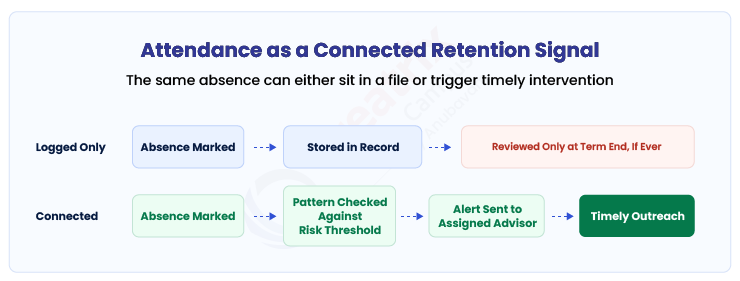
Where most institutions stop, though, is exactly where the real value starts. A present or absent mark, by itself, is a historical record. It only becomes useful the moment someone connects it to a pattern and does something with that pattern before the semester is over.
Why Attendance Data Needs to Reach Advisors, Not Just Files
Here is the question worth asking before buying any attendance system: when a student crosses a risk threshold, say, three unexplained absences in two weeks, does anyone find out in time to help?
In most institutions, the honest answer is no. The absence gets logged. Maybe a notification goes to the student, maybe not. It rarely reaches an academic advisor with enough context to act, and by the time a pattern becomes obvious in an end-of-term report, the student has often already withdrawn or failed.
EDUCAUSE, the nonprofit association with more than 100,000 individual members and 2,100 member institutions focused on higher education technology and data, exists in large part because this gap, data collected but not acted on, is common across the sector, per EDUCAUSE's own site. NACADA, the Global Community for Academic Advising, plays a related role from the advising side: it exists to support and professionalize academic advising precisely because getting the right information to an advisor at the right moment is a persistent, unsolved operational problem, per NACADA's own site.
That is the real case for connected attendance software. Not the biometric scanner, but the alert that reaches an advisor's queue automatically when a pattern crosses a threshold, with enough context (which course, how many sessions, any related flags) to make a five-minute outreach call instead of requiring a manual investigation first. Multiply that across a full student body and an institution has a live early-warning system instead of a historical archive nobody checks until it is too late.
What to Look For Beyond Biometric and Mobile Convenience
Every vendor in this category can offer some version of RFID, biometric, or mobile check-in. That is table stakes, not a differentiator, and it should not be the main criterion in a buying decision.
| Approach | What happens after an absence is logged | What it costs the institution later |
| Manual roll call or spreadsheet | Record exists somewhere, rarely reviewed until term end | Struggling students go unnoticed until grades or withdrawal, retention data reconstructed by hand |
| Standalone digital attendance | Fast, accurate logging, maybe a student notification | Better records, same blind spot for advisors, no automatic action |
| Attendance connected to advisor workflows and risk profiles | Pattern triggers an alert to the right advisor with context | Early intervention while the student is still reachable, retention data continuously available |
If the goal is only to replace a paper sign-in sheet, any digital attendance tool will do. If the goal is only to replace a paper sign-in sheet, any digital attendance tool will do. If the goal is to actually move retention numbers, the evaluation needs a harder question: does an absence pattern automatically reach a human who can act on it, and does that alert carry enough context to be useful, not just a bare notification. A second, related check is worth a table of its own.
| Signal | What it usually indicates | What a connected system should do |
| 2-3 unexplained absences in one course | Early disengagement, possibly a scheduling or workload conflict | Flag to the course instructor and advisor, no action required from the student yet |
| Absence pattern across multiple courses | Broader disengagement, often personal or financial | Escalate to an advisor for direct outreach |
| Attendance drop after a previously consistent pattern | A new, specific problem just started | Time-sensitive alert, faster response than a routine flag |
Where Creatrix Campus Fits
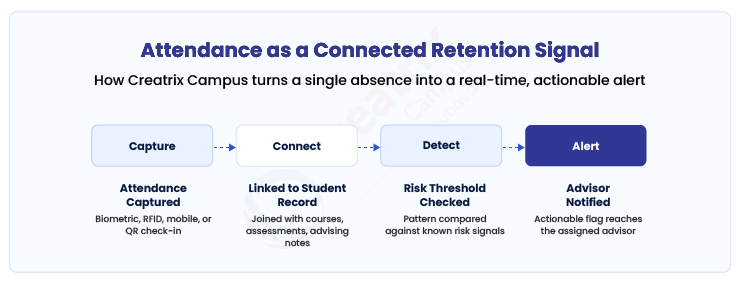
Creatrix Campus treats attendance as one input into a connected student record within an Academic Operating System, not a standalone log that ends at the registrar's office.
Attendance capture works the way any serious platform should, supporting biometric, RFID, mobile, and QR-based check-in, with automated notifications and real-time monitoring. The difference shows up in what happens next. Attendance patterns feed directly into the same system that tracks course progress, assessment performance, and advising notes, so a risk threshold triggers an alert to the advisor assigned to that student, not a report someone has to go looking for.
The practical effect is that attendance data stops being a compliance record and starts being an early-warning input. A registrar gets accurate, automated attendance the same way any platform would deliver it. A dean or provost also gets a real-time view of at-risk patterns across the institution, and an advisor gets a specific, actionable flag instead of a spreadsheet to comb through at the end of the term.
Conclusion
Most institutions buy attendance software to solve a logistics problem: faster, more accurate tracking than a paper sheet. That is a reasonable first filter, but it treats the most valuable part of the data as a byproduct instead of the point.
Attendance is one of the earliest signals an institution has that a student needs help. Software that only logs it and stops is solving the smaller problem. Software that turns it into a timely alert for the person who can actually intervene is solving the one that matters for retention.
If you want to see how Creatrix Campus turns attendance data into real-time early alerts instead of a compliance record nobody checks, talk to us about connected attendance management.
Quick recap
Attendance management software should do more than replace a paper sign-in sheet: it should turn attendance patterns into early alerts that reach the advisor who can act on them, before a struggling student disengages completely. Biometric, RFID, and mobile check-in solve accuracy and administrative burden, but the real differentiator is whether the system connects attendance data to advisor workflows and risk profiles, so retention data accumulates continuously instead of showing up too late in an end-of-term report.
Frequently asked questions
What is attendance management software?
How does attendance tracking help with student retention?
What are the benefits of biometric or mobile attendance tracking over manual roll call?
What should institutions look for beyond the tracking method itself?
What is EDUCAUSE, and why is it relevant to attendance and student success?
What is NACADA, and how does it relate to attendance and early alerts?
How does Creatrix Campus handle attendance management?
Join the conversation
Want to contribute?
We welcome thought leaders to share ideas and write for our blog.
Become a guest author