
On this page
Most universities can tell you exactly what a first-year student is doing. Which courses they are enrolled in, how they are performing, who their advisor is. Ask the same institution what a graduate from six years ago is doing, and the answer usually gets vague fast.
That gap is not because institutions stopped caring about their graduates. It is because the systems that track a student stop at commencement, and the systems meant to pick up from there, spreadsheets, a shared inbox, a LinkedIn group someone in advancement maintains on the side, were never built to carry an institutional relationship for the next forty years.
This piece covers why alumni management has become a real institutional priority, how it works underneath the surface, and where Creatrix Campus fits in.
Quick answer
Alumni management is the set of practices and systems institutions use to keep accurate records of graduates, keep them engaged through networking, mentorship and events, and convert that engagement into philanthropic and reputational support over time. Purpose-built software matters because it keeps this data structured and connected to the rest of the student record, instead of scattered across spreadsheets and inboxes that break down the moment a staff member leaves.
Article summary
Whether you're still building the case for why your institution needs a dedicated alumni management approach, or you already know you need one and want to understand how the pieces fit together, both angles matter here. It closes with what to actually look for in software that does this well.
Key takeaways
- Alumni relationships are a continuation of the student record, not a separate database that starts fresh at graduation.
- Institutions that treat alumni engagement as a side project usually end up with duplicate, outdated contact records within a few years.
- CASE, the global professional body for advancement, maintains reporting standards specifically because alumni engagement needs to be measured consistently, not just felt anecdotally.
- Good alumni management software does four things at once: keeps records accurate, gives alumni a reason to stay engaged, supports fundraising, and feeds usable signal back to career services and leadership.
- The strongest alumni programs are the ones where the platform is connected to the rest of the institution's academic systems, not bolted on separately.
Why Higher Education Institutions Need Alumni Management
Let's be honest about how most alumni relationships get managed today. A spreadsheet has last-known job titles, half of them out of date. A shared mailbox handles reunion RSVPs. Whoever ran the graduating class WhatsApp group in 2019 may or may not still work at the institution. None of this is anyone's fault; it is what happens when a real institutional function is left without a real system.
Here is the real problem: alumni are not a marketing list. They are graduates, donors, employers, mentors, referral sources and, often, future parents of your next applicant, all in one person. Losing track of them shows up as declining event turnout, fundraising campaigns that undersell because the ask goes to the wrong contact, and a career services team with no idea which graduates would actually take a call from a current student.
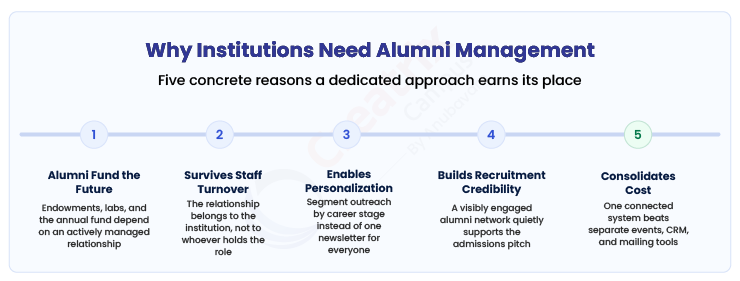
A dedicated alumni management approach earns its place for a few concrete reasons. Alumni and donors fund a meaningful share of an institution's future, from a scholarship endowment to the annual fund that keeps smaller programs alive, and none of that giving happens at scale from a relationship no one is actively managing.
Centralizing alumni data also solves a quieter problem: staff turnover. When one advancement officer keeps the "real" list in their own head or inbox, the institution loses that knowledge the day they leave. A shared, structured system makes the relationship belong to the institution rather than to whoever holds the role.
Personalization is another piece institutions underestimate. An alum ten years out wants something different from the platform than someone who graduated last spring, and a system tracking career stage and engagement can segment communication instead of sending the same newsletter to everyone, the fastest way to get an unsubscribe.
There is also a credibility angle: prospective students and families look at how visibly engaged an institution's alumni network is, especially for programs where alumni outcomes are part of the pitch. And centralized tools tend to pay for themselves through consolidation, institutions running a separate events tool, donor CRM and mailing list often find the combined cost is higher, and the data less trustworthy, than one connected system. None of this requires exotic technology; it requires treating alumni relationships as a system worth designing on purpose, not stitched together after the fact.
How Alumni Management Actually Works
Once an institution accepts it needs a real system, the next question is what that system actually has to do. Strip away the marketing language and alumni management software is really doing five jobs.
The first is the alumni database itself. This sounds basic, but it is where most institutions fail. A usable record needs to survive career changes, name changes and multiple email addresses over decades, and update without someone re-keying it every year. Get the database wrong, and every later feature inherits the same bad data.
The second is engagement, which has changed shape over the last several years. Reunions still matter, but so do virtual formats, a recorded lecture, a city-based virtual meetup, a panel with recent graduates, that extend the institution's reach to alumni who moved away or cannot fly back for a weekend reunion.
The third is networking and mentorship, arguably where alumni platforms earn their keep the most. A dedicated system lets alumni find each other by industry, location or cohort in a way a generic social network never will, because the shared context is already built in. Mentorship at scale needs a system actually matching mentors to mentees, not informal introductions someone has to remember to make.
The fourth is fundraising, usually the most visible function to leadership, but it depends entirely on the first three being solid; a campaign built on stale contact data underperforms no matter how well the ask is written. The fifth, and the one most likely to get skipped, is analytics: seeing which alumni open emails, attend events and update their own profiles is what tells the advancement team who is actually warm for an ask.
Put together, these five jobs, database, engagement, networking, fundraising and analytics, are what "alumni management" actually means underneath the phrase. A tool that only does one or two of them is a partial solution wearing a full one's name.
Why Alumni Data Needs to Follow Recognized Standards
Here is something most institutions do not think about until an accreditation review or board report forces the question: how do you actually count an "engaged alumnus," and does your number mean the same thing your peer institution's number means?
CASE, the Council for Advancement and Support of Education, is the global professional body for alumni relations and advancement, representing close to 100,000 professionals worldwide, per CASE's own site. It maintains the CASE Global Reporting Standards because institutions counted alumni engagement modes, totals and gift attribution differently enough that comparing one institution's numbers to another's was close to meaningless, per CASE's Global Reporting Standards page. A 2026 addendum updated the guidance again, a reminder that this is not a settled, static question.
That has a practical consequence for choosing software. If a platform cannot report engagement in a way that lines up with a recognized standard, the advancement office ends up doing the translation by hand, right before a board meeting or accreditation self-study, exactly the scramble a properly structured system is meant to prevent. Accreditation and quality assurance processes increasingly expect evidence, not description; an alumni program with no standards-aligned data is making the same mistake as a quality office that keeps its evidence in disconnected folders.
The Alumni Lifecycle, From Graduation to Lifelong Partner
Commencement is a handoff, not a finish line
The moment a student becomes an alum should be the smoothest data transition in the entire student lifecycle. In practice, it is often where the institution knows the least about someone for the longest stretch, because the systems that tracked them as a student and the systems meant to track them as an alum were never connected. An alumni record needs to stay accurate for forty or fifty years, not four to six, so the platform has to make self-update easy for alumni and bulk-update easy for staff.
Engagement changes shape as careers progress
A recent graduate wants career-adjacent content: job postings, resume workshops, a mentor. Someone fifteen years out is more likely to respond to a request to speak on a panel or hear about a major institutional milestone. Treating every alum the same way is one of the most common reasons engagement plateaus. Giving, when it comes, is rarely the first ask; it is usually the outcome of consistent engagement for years before any fundraising conversation happens.
Alumni as a feedback loop, not just a funding source
Alumni are a live signal about whether a program's outcomes hold up in the job market. Career services and academic departments that stay connected to alumni learn which skills mattered, which employers are hiring graduates, and where a curriculum might be falling behind, information that is hard to get any other way. The same network doubles as a recruitment asset: prospective students trust graduates more than a brochure.
What to Look For in Alumni Management Software
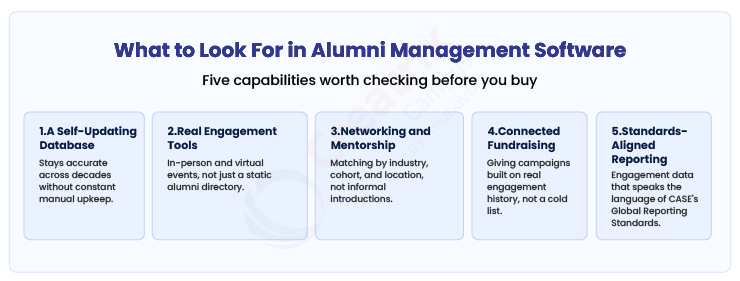
Strip away the feature marketing and there is a short, honest checklist: a database that stays accurate without constant manual upkeep; real engagement features, not just a static directory, covering in-person and virtual events, communications, and mentorship or networking that reflects how alumni actually want to connect; fundraising connected to the same engagement data rather than a separate donor tool; and reporting that can speak the language of recognized standards like CASE's.
The point institutions most often get wrong is integration. A platform disconnected from the student information system means every graduate's alumni profile starts from a blank slate the day they leave, throwing away years of academic and engagement history that already existed. A connected platform keeps that history intact and simply extends it.
Where Creatrix Campus Fits
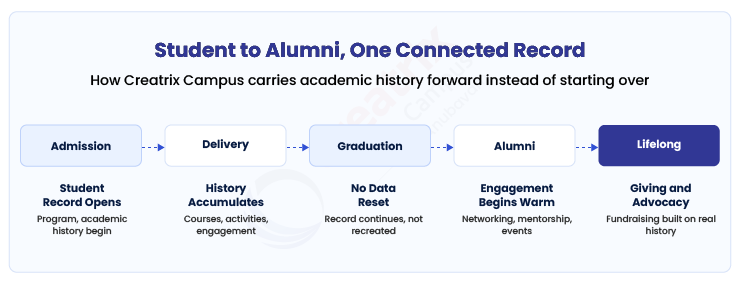
Creatrix Campus is not a single alumni tool bolted onto a website. It is part of an Academic Operating System that follows a student from admission through graduation and into alumni status, without the handoff gap most institutions live with today.
The practical difference shows up the day a student graduates. Instead of a new, empty alumni profile, the record continues, program, academic history, activities and prior engagement carry forward automatically, so advancement staff pick up a relationship the institution already has history with, rather than a blank contact card.
On the engagement side, Creatrix Campus supports the full range covered earlier: a searchable alumni directory, event management for in-person and virtual formats, mentorship matching, and communication tools built for segmented, career-stage-aware outreach. Fundraising sits on the same connected data, so a giving campaign targets alumni based on real engagement history rather than a cold list, and reporting maps cleanly to recognized frameworks like CASE's Global Reporting Standards rather than requiring a manual translation exercise before every review.
Conclusion
Most institutions do not have an alumni engagement problem so much as a data continuity problem. The relationship with a graduate does not actually end at commencement, the system tracking it just stops there, and everything downstream, weaker fundraising, thinner networking, a career services team working blind, is a symptom of that same root cause.
Treating alumni management as a real, connected system fixes more than it looks like it should. The database gets easier to trust, engagement stops depending on any one staff member's memory, and fundraising starts from warm relationships instead of cold lists. When a board or an accreditation review asks how engaged your alumni actually are, you have an answer built on real, standards-aligned data instead of a guess.
If your institution is still running alumni relationships out of a spreadsheet and a shared inbox, that is not a small gap to close, but it is a solvable one, and the institutions that close it tend to wonder why they waited so long. If you want to see how Creatrix Campus keeps that record connected from admission through alumni status, talk to us about connected alumni management.
Quick recap
Alumni management is the practice of keeping graduate records accurate, keeping alumni engaged through networking, mentorship and events, and turning that engagement into philanthropic and reputational support over time, and it works best when built as five connected functions, database, engagement, networking, fundraising and analytics, rather than separate disconnected tools; institutions that connect alumni data to the rest of the student record, and structure their reporting around recognized standards like CASE's, end up with stronger fundraising, better networking, and answers ready whenever leadership or an accreditation review asks how engaged their alumni really are.
Frequently asked questions
What is alumni management in higher education?
Why do universities need dedicated alumni management software instead of a spreadsheet?
What features should alumni management software include?
How is alumni engagement measured consistently across institutions?
Does alumni management software help with fundraising?
Should alumni data be connected to the student information system?
How does Creatrix Campus support alumni management?
Join the conversation
Want to contribute?
We welcome thought leaders to share ideas and write for our blog.
Become a guest author