
On this page
Universities will not transform simply because they adopt AI.
Real transformation begins when an institution understands what is preventing its learners, faculty and administrators from doing their best work — and is prepared to redesign the processes, policies, systems and organizational structures behind those barriers.
I have spent many years working with universities across different markets, and one thing has become increasingly clear to me: the technology is rarely the hardest part.
- Changing the way people work is harder.
- Getting departments to share data is harder.
- Changing ownership is harder.
- Questioning a process that has existed for 15 years is harder.
And getting an institution aligned around a common outcome can be much harder than implementing another piece of software.
That is why I think we need to move the conversation from AI adoption to institutional transformation.
The question is no longer:
Where can we use AI?
A better question is:
Where is institutional friction preventing people from creating value — and how can we remove it?
Quick answer
AI will not transform a university on its own. It is the catalyst, not the transformation.
Real transformation begins when an institution identifies the friction that stops learners, faculty and administrators from doing their best work, then redesigns the processes, policies, systems and structures behind it.
Data and AI enter after that redesign, to augment human judgement rather than replace accountability.
Article summary
Many universities treat AI as the next layer to add on top of existing processes. Putting AI on an inefficient process can simply produce a faster inefficient process.
Sivakumar Veerappan argues that the harder work is institutional: redesigning operating models, changing culture and governance, building a university that learns continuously, and rethinking teaching and assessment for a world where AI exists. The competitive advantage is the ability to change.
Key takeaways
- Start with the problem and the friction behind it, not with the AI.
- Every AI initiative should show meaningful value for learners, faculty or administrators.
- Transformation needs a change architecture (leadership, governance, capability, culture) as well as a technology architecture.
- An adaptive university continuously senses, understands, decides, acts, measures and learns.
- AI should augment human judgement, never remove human accountability.
Start with the problem, not the AI
There is a natural temptation with every new technology cycle.
We take what we already do and make it digital.
We digitized forms. We moved applications to the cloud. We created portals and mobile apps. Now we are adding copilots, agents and chatbots.
All of this can be useful.
But putting AI on top of an inefficient process does not necessarily transform it.
Sometimes it simply gives us a faster inefficient process.
Suppose an academic process requires twelve steps, four approvals, information from three systems and two spreadsheets.
We could use AI to make those twelve steps faster.
Or we could ask a more uncomfortable question:
Why do we have twelve steps in the first place?
- Maybe six are necessary.
- Maybe three could happen automatically.
- Maybe one policy needs to change.
- Maybe two departments are doing essentially the same work.
- And perhaps the spreadsheet should never have existed.
That is where transformation starts.
Not with the technology. With the problem.
What does AI transformation actually mean for a university?
I use a fairly simple test.
If an AI initiative cannot demonstrate how it creates meaningful value for learners, faculty or administrators, I would question why we are doing it.
For a learner, value might mean fewer administrative barriers, better academic guidance, more personalized support, faster responses, stronger learning experiences and clearer pathways toward employment.
For faculty, it might mean less repetitive administration, easier access to information and evidence, better support for teaching and research, and more time for students.
For administrators and institutional leaders, it might mean fewer manual processes, trusted data, earlier visibility into risks, better coordination and faster, evidence-informed decisions.
This sounds obvious.
In practice, however, it changes how an institution approaches AI.
Instead of starting with:
What can this technology do?
Start with:
Whose problem are we solving?
Then ask:
What has to change for that problem to actually disappear?
Because sometimes the answer is AI.
Sometimes it is process redesign.
Sometimes it is policy.
Sometimes it is data.
And quite often, it is people and culture.
Culture will beat technology every time
There is a familiar management saying that culture eats strategy for breakfast. Whatever its precise origin, the principle is particularly relevant to AI transformation.
An institution can have an excellent AI strategy.
It can establish an AI committee, appoint a Chief AI Officer, create governance frameworks and invest significantly in technology.
None of that guarantees transformation.
- If departments protect their data, transformation slows.
- If every decision has to travel through multiple layers of hierarchy, transformation slows.
- If faculty believe AI is something being imposed on them, transformation slows.
- If people are punished for experimentation that doesn’t work, transformation slows.
- If leadership delegates AI entirely to IT, transformation may never really begin.
This is why the work of John Kotter remains relevant. His model of organizational change emphasizes creating urgency, building a guiding coalition, developing a vision, removing barriers, generating short-term wins and ultimately anchoring change in organizational culture [Kotter, 1996].
The technologies have changed enormously since Kotter developed those ideas.
People haven’t changed quite as quickly.
AI transformation therefore requires two architectures.
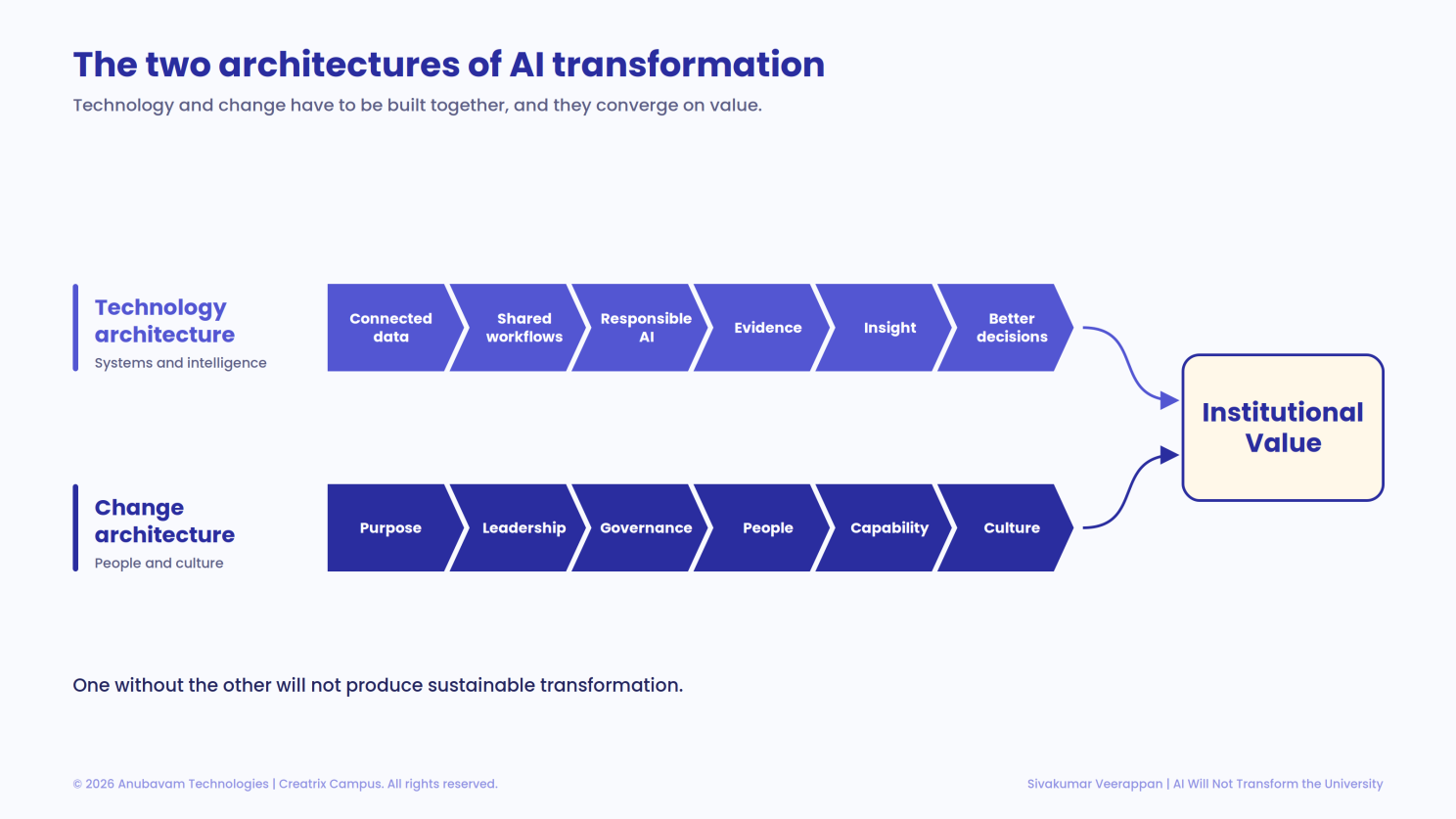
We spend a great deal of time designing the first architecture.
I think many institutions underestimate the second.
Don’t put AI on top of yesterday’s university
Here is a question I find useful.
If we were designing a university today from scratch, knowing what we now know about AI, data, learning, work and human behaviour — would we design it the same way?
I doubt it.
- Would students still have to navigate multiple disconnected administrative functions?
- Would information still be entered repeatedly?
- Would institutional quality depend so heavily on periodically assembling evidence that already exists somewhere inside the institution?
- Would faculty spend as much time on repetitive administrative activities?
- Would curriculum change at the same speed?
- Would leaders depend on retrospective reports when the underlying data is already being generated in real time?
- Would every department maintain its own version of the truth?
These are not technology questions.
They are operating-model questions.
And that is where I believe the next phase of higher education transformation has to go.
Instead of asking how AI fits into the existing university, we should also be willing to ask:
What should the university itself become now that these capabilities exist?
The university itself needs to learn
Universities are very good at talking about student learning.
We spend less time discussing institutional learning.
Yet I think this will become one of the defining capabilities of successful universities.
Consider how much information an institution generates every day:
Admissions behaviour. Student engagement. Learning outcomes. Assessment. Advising. Faculty activity. Research. Curriculum performance. Quality evidence. Employability. Finance. Student experience.
The problem is usually not that the institution has no data.
It has enormous amounts of data.
The problem is that the information lives in different places, under different ownership, interpreted by different teams and often arrives after the moment when it could have changed a decision.
A truly adaptive institution should be able to continuously:
This connects with Peter Senge’s idea of the learning organization — an organization capable of continually expanding its ability to learn and adapt [Senge, 1990].
AI makes this considerably more interesting.
Not because AI should make institutional decisions on our behalf.
But because it can help humans find patterns, connect evidence, identify emerging risks, understand alternatives and act earlier.
I think of this as institutional intelligence.
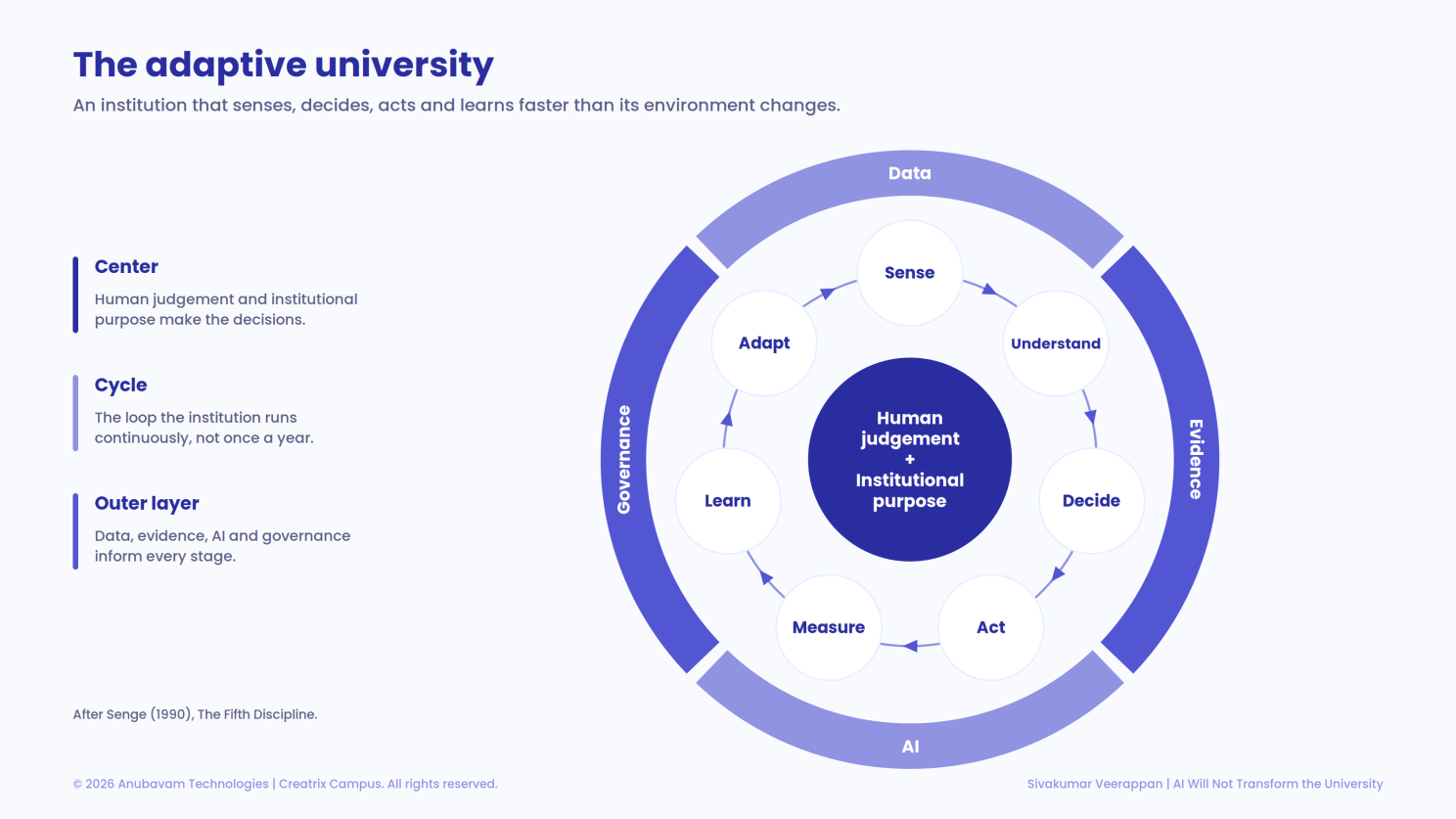
This distinction matters.
The objective isn’t an autonomous university.
It is a more intelligent institution.
And education itself cannot remain unchanged
The same principle applies inside the classroom.
For a long time, access to knowledge was scarce.
Universities organized knowledge. Faculty possessed expertise. Students came to learn from those who had spent years developing it.
That world has changed.
A student can now ask an AI system to explain a difficult concept in five different ways, summarize a research paper, generate examples, translate material, debate an argument or provide personalized tutoring at 2 a.m.
That does not make faculty less important.
In some ways, I think it makes good faculty more important.
When information becomes abundant, judgement becomes scarce.
The value of the professor increasingly lies not simply in transmitting information, but in helping students question it.
- Is the answer correct?
- What evidence supports it?
- What assumptions are hidden inside it?
- What is missing?
- What are the ethical implications?
- Can you defend your reasoning?
- Can you apply the idea in a completely different context?
This moves faculty further toward mentorship, contextualisation, inquiry and intellectual challenge.
And it raises an uncomfortable question about assessment.
If AI can successfully complete an assignment, perhaps we should not only question the student’s use of AI. We should also question the assignment.
Academic integrity remains important.
But attempting to preserve every assessment model exactly as it existed before generative AI is unlikely to be a sustainable strategy.
We need assessment that places greater value on reasoning, application, creation, critique, judgement and demonstrated capability.
The objective should not be to educate students in a world where AI does not exist.
It should be to educate people who know how to think when AI does exist.
AI should augment judgement, not remove accountability
There is also a boundary I believe universities need to protect.
AI can augment human judgement. It should not eliminate human accountability.
An AI system may identify a student who appears to be at risk.
A human being still needs to understand the context.
AI may surface evidence for an academic decision.
Humans remain accountable for consequential decisions.
AI may recommend.
Humans must retain responsibility.
This is particularly important in higher education because universities are not simply processing transactions.
They are making decisions that can influence people’s futures.
That is why AI governance cannot be reduced to an acceptable-use policy.
Institutions need clarity around purpose, privacy, transparency, fairness, assessment integrity, human oversight, model and vendor risk, monitoring and accountability.
But governance should not become another mechanism for stopping change.
Good governance should make responsible innovation easier, not impossible.
A practical model for institutional AI transformation
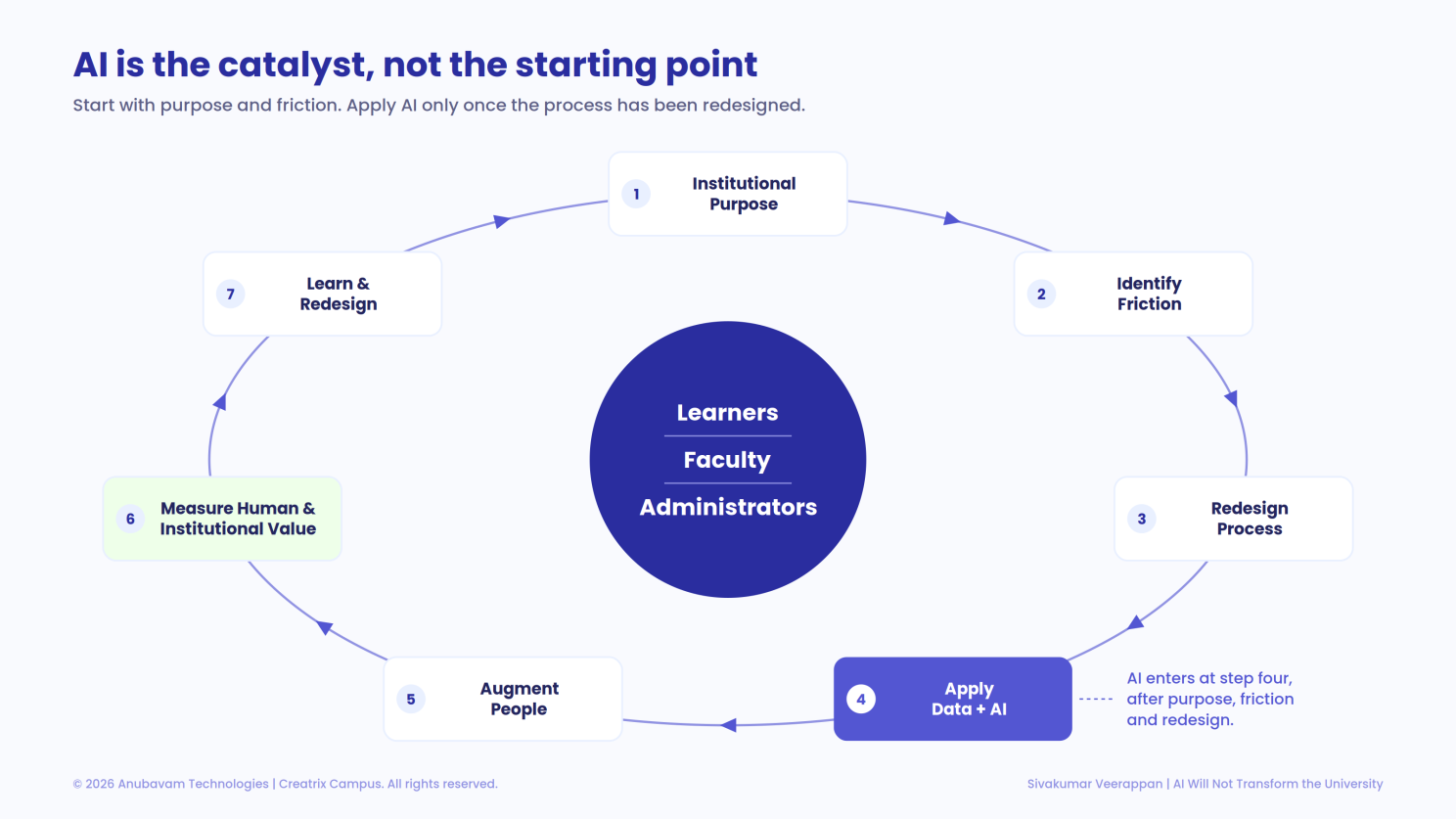
Bringing these ideas together, I would approach AI transformation through seven questions.
1. Purpose
What institutional outcome are we trying to improve?
- Don’t start with the technology. Start with the mission.
2. Friction
What is preventing people from achieving that outcome today?
- Look for unnecessary work, delays, fragmentation, duplication and poor information flow.
3. Redesign
If we were starting again, would we design this process the same way?
- Don’t automate something merely because it already exists.
4. Intelligence
Where can data and AI materially improve the redesigned process?
- This is where the technology enters — not at Step 1.
5. Human augmentation
What becomes better for the learner, faculty member or administrator?
- If we cannot answer this, the initiative probably needs more thought.
6. Evidence
How will we know that the change actually worked?
- Measure outcomes, not deployment. “AI implemented” is not an outcome.
7. Learning
What did we learn, and what should change next?
- Transformation should become a continuous institutional capability rather than a project with an end date.
That is the model I would use:
And then repeat it.
Because transformation is not an event.
The real competitive advantage may be the ability to change
Nobody knows exactly what AI will be capable of five years from now.
Nor can we perfectly predict student expectations, workforce requirements, geopolitics, regulation or new educational models.
So I am becoming less interested in the question:
Can we predict the future university?
And more interested in:
Can we build a university capable of responding intelligently when the future is different from what we predicted?
- How quickly can an institution recognize a problem?
- How quickly can evidence reach the people who need it?
- How quickly can leadership make a decision?
- How quickly can a process change?
- How quickly can curriculum respond?
- How quickly can the institution determine whether the change worked?
And perhaps most importantly:
How comfortable is the institution admitting that something did not work and changing again?
That, to me, is institutional resilience.
The goal is not an AI-powered university
There is a danger that we make AI itself the destination.
It isn’t.
The destination is a better university.
- A university where learners encounter fewer barriers and receive better support.
- Where faculty spend more time teaching, mentoring, researching and creating knowledge.
- Where administrators spend less time reconciling information and more time improving the institution.
- Where leaders have trustworthy evidence when they make important decisions.
- Where technology handles complexity without removing human responsibility.
- And where the institution itself continuously learns.
As machines become better at producing information, some deeply human capabilities may actually become more valuable:
Curiosity. Critical thinking. Empathy. Ethics. Creativity. Judgement. Leadership. Wisdom. Responsibility.
The future university should not become less human because of AI.
It should use AI to create more space for humans to do what humans do best.
That is why I don’t believe AI itself will transform the university.
AI is the catalyst. The university still has to do the difficult work of transforming itself.
And perhaps the institutions that ultimately thrive will not be those that deploy the most AI.
They will be the ones that develop the greatest capacity to learn, adapt and change — while remaining clear about the human purpose of education.
For university leaders, where are you seeing the greatest barrier to AI transformation today: technology, institutional processes, governance, or culture?
Quick recap
- 01 Purpose names the institutional outcome to improve.
- 02 Friction shows what stops people achieving it today.
- 03 Redesign questions the process before automating it.
- 04 Intelligence applies data and AI to the redesigned process.
- 05 Human augmentation makes work better for learners, faculty and administrators.
- 06 Evidence measures outcomes, not deployment.
- 07 Learning decides what changes next.
When AI is layered on yesterday's university, it produces a faster inefficient process.
When the institution redesigns first, AI creates more space for humans to do what humans do best.
Frequently asked questions
Will AI transform universities?
Where should a university start with AI?
Why does culture matter so much in AI transformation?
What is an adaptive university?
Should AI make decisions in higher education?
How should assessment change because of AI?
References
- Kotter, J. P. (1996). Leading Change. Harvard Business School Press.
- Senge, P. M. (1990). The Fifth Discipline: The Art and Practice of the Learning Organization. Doubleday.
Join the conversation
Want to contribute?
We welcome thought leaders to share ideas and write for our blog.
Become a guest author