
On this page
Ask a QA director what's wrong with their evaluation system, and the answer is rarely "grading is too rigid." It's that a rubric lives in one file, the CLO mapping lives in another, the attainment calculation happens in a spreadsheet nobody trusts, and by the time a programme review needs evidence, someone is reconstructing all of it from memory and email threads.
Quick answer
AI can genuinely help outcome assessment by reducing the manual work of moving, tagging, and reconciling assessment data, surfacing patterns in attainment faster, and keeping evidence traceable back to its source. It cannot decide what a passing standard should be, judge the quality of student work, or take the place of faculty and academic governance in interpreting results. The realistic gain is speed and traceability, not replaced judgment.
Article summary
This article steps back from the idea that AI is replacing evaluation models in higher education. It isn't, and treating it that way sets up institutions to either overtrust automation or dismiss it entirely. The more useful framing is operational: academic leaders already have outcomes, rubrics, and scores. What's missing is a connected path from a learning outcome to the evidence that confirms it. AI has a role in tightening that path. Academic judgment still owns every decision that follows from it.
Key takeaways
- The real problem in most institutions isn't rigid grading. It's assessment evidence that lives in disconnected systems.
- AI is most useful at reducing manual reconciliation work, not at making academic decisions.
- A learning outcome only becomes usable evidence once it survives the path from assessment to attainment to academic action.
- Faculty and academic governance remain responsible for judgment calls that AI should never be asked to make.
- Speed in reporting only matters if the evidence it produces is still traceable to what actually happened in the classroom.
What AI Can Improve in Outcome Assessment, and What It Shouldn't Decide
Most of the friction in outcome assessment isn't intellectual, it's clerical. Someone has to tag a score to the right CLO, check that the CLO still maps to the PLO the programme committee approved last year, and pull that into a format an accreditor will accept. None of that requires academic judgment. All of it eats faculty time that judgment actually needs.
This is the part AI is genuinely suited to help with. According to UNESCO's guidance on AI and education, artificial intelligence can support teachers by automating repetitive administrative tasks and surfacing patterns in learning data, provided it's deployed with clear human oversight and doesn't substitute for professional judgment in high stakes decisions (UNESCO, 2023). That's a fair description of where the realistic gains sit: moving data, flagging where attention is needed, and reducing the time between an assessment happening and its evidence being usable.
What it shouldn't do is decide anything with consequences for a student or a programme. Whether a piece of student work actually demonstrates Relational level understanding, whether a programme's attainment gap reflects a teaching issue or an assessment design issue, and whether a curriculum needs to change because of that gap are all judgment calls. They depend on context AI doesn't have and shouldn't be trusted to infer on its own.
| Assessment Activity | Where AI Can Assist | Where Academic Judgment Must Remain |
| Outcome mapping | Flagging when a CLO appears unmapped to any PLO | Deciding whether the mapping itself is pedagogically sound |
| Rubric design | Checking a rubric for missing criteria or inconsistent scoring bands | Setting the standard of performance each band actually represents |
| Assessment design | Surfacing whether an assessment matches the cognitive level an outcome specifies | Deciding what a fair and valid assessment for that outcome looks like |
| Evidence analysis | Organizing scores and artifacts by outcome so evidence doesn't need to be reassembled later | Interpreting what the evidence says about student learning |
| Attainment analysis | Calculating attainment percentages from recorded scores | Judging whether an attainment result reflects genuine mastery |
| Identifying patterns | Highlighting where attainment has dropped across a cohort or section | Determining the cause and the appropriate response |
| Continuous improvement decisions | Presenting attainment trends over multiple terms | Deciding what curriculum or teaching changes to make |
| Accreditation evidence | Assembling evidence already tied to outcomes into a reviewable format | Standing behind the evidence as an accurate account of student learning |
Read the table for what it actually says: AI's column is full of verbs like flagging, checking, surfacing, organizing, calculating, highlighting, and assembling. None of those verbs decide anything. The judgment column is where every consequential call still lives, and that split isn't a limitation to work around. It's the correct division of labor.
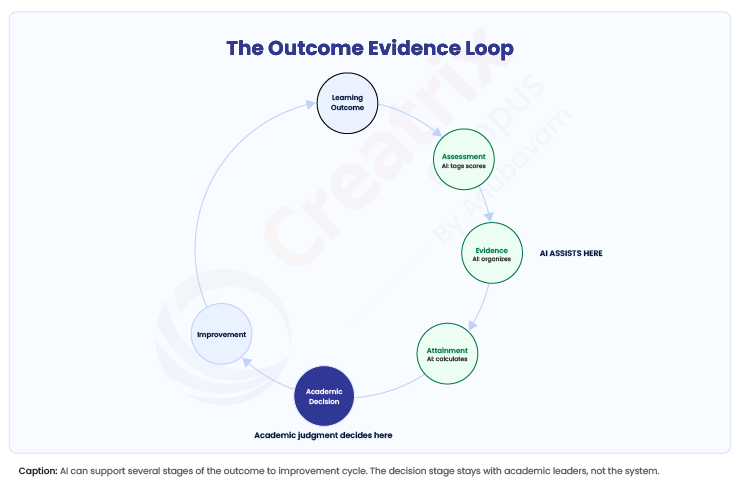
From Assessment Scores to an Evidence Trail Academic Leaders Can Act On
Here's the real problem most institutions are solving for, whether they name it this way or not: a score, by itself, is not evidence. Evidence is a score that can be traced back to a specific outcome, a specific rubric criterion, and a specific student artifact, on demand, without anyone needing to reconstruct that trail from memory.
Think about it this way. When an accreditor asks how a programme knows its graduates can apply a skill and not just recall it, "we gave an exam and most students passed" isn't an answer. "Here is the assessment, here is the rubric criterion it maps to, here is the attainment result, and here is what we changed in the curriculum because of it" is. That second answer only exists if the connections between outcome, assessment, and attainment were built in from the start, not assembled after the fact.
This is also where continuous evaluation earns its name. A single end of term score tells you almost nothing about whether learning is developing the way an outcome intended. A trail of formative assessments mapped to the same outcome over a semester tells you a great deal, and it's the kind of pattern that's genuinely tedious to track by hand across a full cohort. Surfacing that pattern faster is a legitimate, bounded use of automation. Deciding what the pattern means for a specific student or programme stays with faculty.
None of this works if curriculum design, assessment, and quality review operate as separate exercises that only meet each other in a spreadsheet before an audit. The Curriculum & Catalog Management system that defines a programme's intended outcomes and the Assessment & Outcomes processes that generate evidence against those outcomes need to be reading from the same structure, not reconciling two different ones after the fact.
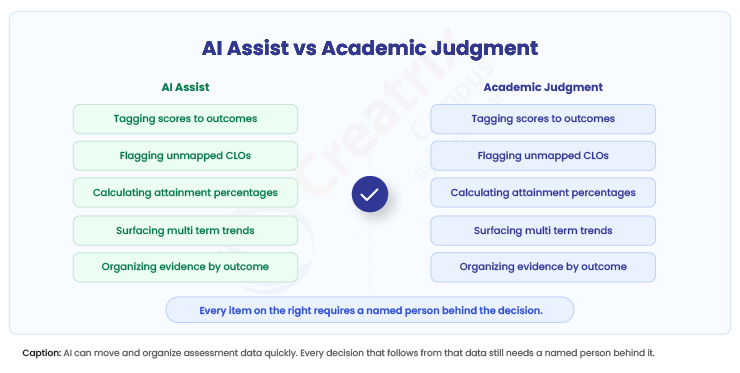
Where Creatrix Campus Fits
Creatrix Campus connects the parts of this cycle that are usually scattered across separate tools: outcomes defined in curriculum design, evidence generated through assessment, and attainment calculated from that evidence, within one governed system. Because attainment is calculated continuously from recorded assessment data rather than assembled at reporting time, a programme review can show a live trail from outcome to evidence instead of reconstructing one under deadline.
Where AI-assisted workflow automation applies within Creatrix Campus, it works on the administrative layer described above: reducing manual reconciliation and helping surface where attention is needed. It does not set standards, grade student work, or make curriculum decisions. Those calls stay with faculty, assessment leaders, and academic governance, exactly where accreditation standards expect them to sit.
Conclusion
The value of AI in outcome assessment isn't that it makes academic decisions for faculty. It's whether it helps an institution connect evidence faster and put better information in front of the people who still have to decide. That's a narrower promise than "AI is transforming evaluation," and it's also a more honest one. The better question for your next leadership meeting isn't whether to adopt AI in assessment. It's where your faculty's time is currently going toward judgment, and where it's being lost to moving, reconciling, and re-explaining data that should have been connected already. If you want to see how outcomes, assessment, and attainment can stay connected as one evidence trail, request a demo of Creatrix Campus.
Quick recap
- The core problem in outcome assessment is disconnected evidence, not rigid grading.
- AI is well suited to tagging, calculating, and surfacing patterns. It is not suited to deciding what those patterns mean.
- A usable evidence trail runs from outcome to assessment to attainment to academic decision, without manual reconstruction.
- Academic judgment stays fully with faculty and governance at every consequential step.
Frequently asked questions
How can AI improve outcome assessment in universities?
Does AI replace faculty judgment in grading or assessment design?
What is the difference between output-driven and outcome-focused assessment?
Is continuous evaluation different from formative assessment?
Join the conversation
Want to contribute?
We welcome thought leaders to share ideas and write for our blog.
Become a guest author