
On this page
Most universities do not ignore career readiness.
They simply concentrate too much of it near graduation.
That is when résumé workshops accelerate, placement activity becomes visible, employers arrive, applications begin, and leaders start asking about graduate outcomes.
But career readiness has already been taking shape for years.
Students have chosen electives, completed projects, developed some skills and neglected others, made decisions about internships, built evidence through assessment, and formed ideas about what kind of work they want.
By final year, Career Services is often working with the result of those earlier choices.
Career Services can prepare a student for an interview. It cannot retroactively create three years of missing readiness.
That is why career guidance needs to become part of the student lifecycle rather than a service that becomes urgent near graduation.
Quick answer
Career guidance in higher education becomes less effective when institutions wait until final year to connect academic progress, demonstrated skills, advising, career interests, and readiness gaps. A stronger model gives students relevant guidance earlier, allowing academic choices, skill development, experiential learning, and career preparation to influence one another throughout the student journey.
Article summary
| Problem | Career guidance often becomes intensive only after many readiness-shaping academic decisions have already been made. |
| Who this is for | Provosts, Deans, Career Services leaders, Advisors, Student Support teams, Programme Heads, QA leaders, and CIOs. |
| What changes | Career guidance moves from final-year placement preparation to lifecycle-wide readiness visibility. |
| Why it matters | Graduate readiness is built through academic choices, skills, evidence, experiences, and advising over time. |
| Outcome | Earlier guidance, better-informed student choices, clearer readiness gaps, and stronger connections between learning and employability. |
Key takeaways
- Career readiness cannot be created during placement season alone.
- Academic choices made in earlier years influence what students can demonstrate later.
- Career guidance becomes stronger when Career Services can see relevant academic and advising context.
- Skill evidence matters more than simply listing skills.
- AI can support timing and pattern recognition, but career judgement and guidance should remain human-led.
Why This Matters
NACE frames career readiness around core competencies that prepare college-educated learners for workplace success and lifelong career management.
That makes career readiness bigger than placement.
Students build it through courses, projects, assessments, internships, advising, portfolios, competencies, and the choices they make throughout their academic journey.
Yet institutional ownership often becomes most visible near graduation.
Career teams receive students when employment pressure is already high. Programme leaders may only then discover recurring skill gaps. Students may realise too late that the evidence they have collected does not match the career path they want.
Placement is an outcome point. Career readiness is built long before it.
Why Final-Year Career Guidance Comes Too Late
Final-year career activity matters.
Students need help with résumés, interviews, applications, employer interaction, and navigating the transition from university to work.
The problem is asking that activity to compensate for everything that did not happen earlier.
By final year, a student may already have:
- chosen most of their electives,
- completed important projects,
- passed on internship opportunities,
- built strengths in some competencies but not others,
- accumulated little evidence of certain skills,
- spent years without connecting academic choices to a career direction.
Career support at that point becomes reactive.
The institution is no longer asking:
“What should this student build next?”
It is asking:
“How do we present what this student has already built?”
Those are very different conversations.
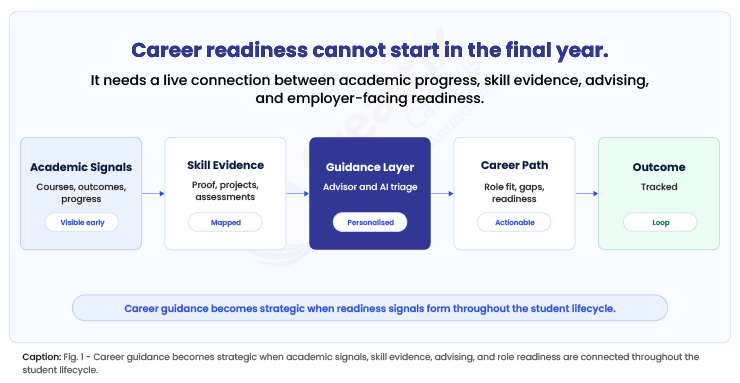
Where Career Readiness Signals Get Lost
Most institutions already hold pieces of the career-readiness picture.
The challenge is that those pieces often sit apart.
| Readiness signal | Where it may be visible |
| Academic progression | Student records and programme teams |
| Learning and competency evidence | Courses, assessments, portfolios |
| Career interests | Advising or Career Services |
| Projects and experiential learning | Faculties, internships, placement records |
| Previous guidance | Advisor notes or support workflows |
| Placement activity | Career or placement office |
Each team may understand one part of the student.
Very few see the full readiness story.
That means a student can reach final year with good academic performance while still lacking evidence for a preferred career pathway. Another may have strong skills that Career Services only discovers when placement preparation starts.
The institution can know many useful things about a student and still discover career readiness too late because nobody sees those things together.
Why Career Services Needs Academic Context
Career guidance becomes generic when Career Services knows only the student's programme and placement status.
More useful conversations need context.
What has the student studied? Which outcomes or competencies have they demonstrated? What kinds of projects have they completed? Where are performance gaps appearing? What guidance has already been given? What career direction is the student considering?
This is where student success advising becomes relevant.
Advising and career guidance should not exist as two separate conversations where one ends before the other begins.
An Advisor helping a second-year student choose electives may be influencing career readiness just as much as the Career Services professional helping that student prepare for an interview two years later.
AI can assist by helping surface patterns or possible gaps where appropriate.
But an algorithm should not decide what career a student ought to pursue.
Better career guidance comes from richer context around a human conversation, not from replacing that conversation.
What Career Readiness Visibility Should Show
Career readiness visibility does not need to become another score attached to every student.
It should help different institutional roles understand where guidance may be useful.
For example:
- which students may benefit from earlier career conversations,
- which skills or competencies have supporting academic evidence,
- where relevant skill gaps remain,
- which students have not yet engaged with career or experiential opportunities,
- which advising actions have already happened,
- how programme outcomes connect to likely career capabilities,
- which students are approaching placement with stronger or weaker readiness evidence.
This is also where outcome-based education becomes relevant.
If a programme claims that graduates develop particular capabilities, career readiness provides another reason to make those capabilities visible and demonstrable rather than leaving them as curriculum statements.
For Deans and QA leaders, the question becomes bigger than:
“Did our graduates get jobs?”
It becomes:
“Can we see how the academic journey prepared them for what came next?”
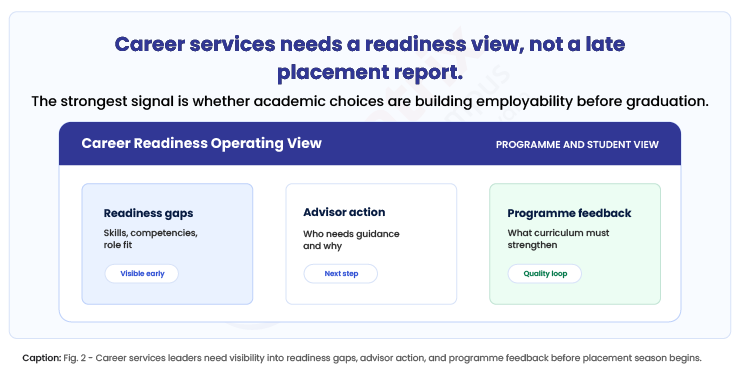
Where Creatrix Campus Fits
This is where Creatrix Campus becomes relevant.
Not simply as a final-year career counseling tool, but through the connection between the student lifecycle, advising, academic progress, learning outcomes, evidence of skills and competencies, and placement-related activity.
Creatrix Campus maintains one student identity across the journey, preserving context as students move between institutional functions.
For Advisors, that can create stronger context for earlier student conversations. For Career Services, academic evidence can make guidance more targeted. For Programme Heads and Deans, employability gaps can become visible as academic questions rather than appearing only in graduate-placement reports.
The wider student lifecycle management connection matters because career readiness is not created by Career Services alone.
Academic programmes shape capability. Advisors influence choices. Experiences create evidence. Career teams help students translate that evidence toward employment.
The value is not simply more career counseling.
It is making readiness visible while the student still has time to build it.
Conclusion
Final-year career support will always matter, but it should be the culmination of readiness building rather than the first serious conversation about it. Institutions need enough visibility across academic progress, skill evidence, advising, and experiential learning to help students make better choices before graduation pressure arrives.
If a second-year student in your university is already developing a career-readiness gap today, who would see it, and when would the student hear about it? Connect career guidance to the student lifecycle.
Quick recap
Career guidance becomes less effective when institutions wait until placement season to understand whether students are ready for work. Academic choices, competencies, projects, experiences, advising, and career interests develop throughout the student lifecycle. The stronger model gives students guidance while those things can still change. The goal is not to prepare students for their first job at the end. It is to make career readiness part of how they move through university.
Frequently asked questions
Why should career guidance start before final year?
What is career readiness visibility?
How can AI support career guidance?
Is career guidance only the responsibility of Career Services?
Why does academic context matter in career guidance?
How can Creatrix Campus support career readiness?
Join the conversation
Want to contribute?
We welcome thought leaders to share ideas and write for our blog.
Become a guest author