

On this page
Admissions teams rarely lose a student in one obvious moment.
More often, the applicant drifts away quietly.
A serious prospect asks about fees but waits too long for clarity. Another keeps returning to the same programme but remains buried in a general follow-up queue. A document problem stalls an otherwise ready applicant. Someone shows strong intent, but the signal is spread across emails, CRM activity, counselor notes, and separate systems.
By the time the applicant accepts or declines an offer, the institution may think it is measuring yield.
In reality, it is measuring the outcome of dozens of earlier moments.
Admissions yield is often lost in the gap between an applicant showing intent and the university knowing what to do with that intent.
That is why the next admissions challenge is not simply processing more applications or automating more communication. It is seeing applicant movement clearly enough to respond while the decision is still open.
Quick answer
Admissions teams lose yield before offer acceptance when applicant intent, programme interest, financial questions, document status, follow-up activity, and enrollment handoffs are not visible together early enough. Better admissions operations give teams enough context to recognise who is moving, who is stuck, and which next action could still influence the outcome.
Article summary
| Problem | Admissions teams see funnel stages, but not always the reasons applicants are slowing or disengaging. |
| Who this is for | VPs of Enrollment, Admissions Directors, Student Recruitment leaders, CIOs, Registrars, Finance leaders, and university leadership. |
| What changes | Admissions moves from processing applicants to understanding applicant movement. |
| Why it matters | A healthy application count can hide high-intent students who are waiting, stuck, or receiving the wrong follow-up. |
| Outcome | Better prioritisation, more relevant outreach, stronger programme visibility, and cleaner enrollment handoffs. |
Key takeaways
- Yield risk begins before offers are accepted or rejected.
- Application volume does not reveal applicant intent by itself.
- Admissions teams need to distinguish activity from meaningful movement.
- Follow-up timing matters only when it matches the applicant’s actual barrier.
- Stronger enrollment visibility connects Admissions with Finance, Registry, and the wider student lifecycle.
Why This Matters
The NACAC State of College Admission examines areas such as applications, acceptance, recruitment practices, and admission decision factors. Admissions has always involved much more than collecting forms.
The operational pressure today is that teams must manage applicant experience, programme demand, counselor capacity, document readiness, financial questions, and enrollment conversion at the same time.
Traditional funnel metrics tell leaders how many students reached each stage.
They do not always explain why movement slowed between those stages.
A student may still be marked as an active applicant while waiting for scholarship clarification. Another may have completed nearly everything but need one document reviewed. A third may be showing strong programme interest without receiving timely human attention.
A funnel can look full while the institution is quietly losing momentum inside it.
Why Application Volume Is Not Enough
High application volume can create confidence.
It can also create noise.
If 10,000 applicants enter the funnel, Admissions still needs to understand which programmes are attracting genuine intent, which applicants are becoming stuck, and where counselor attention has the greatest chance of changing the outcome.
That requires more than counting inquiries, applications, offers, and enrollments.
A useful admissions view distinguishes between:
| What the funnel shows | What the team still needs to understand |
| Inquiry submitted | Is interest becoming stronger or weaker? |
| Application started | What is preventing completion? |
| Application submitted | Is a decision or document still blocking movement? |
| Offer made | What could influence acceptance? |
| Follow-up completed | Did the follow-up address the real barrier? |
| Applicant inactive | Has intent disappeared, or is the applicant waiting on the institution? |
This is the difference between reporting applicant status and managing applicant movement.
Admissions teams need both.
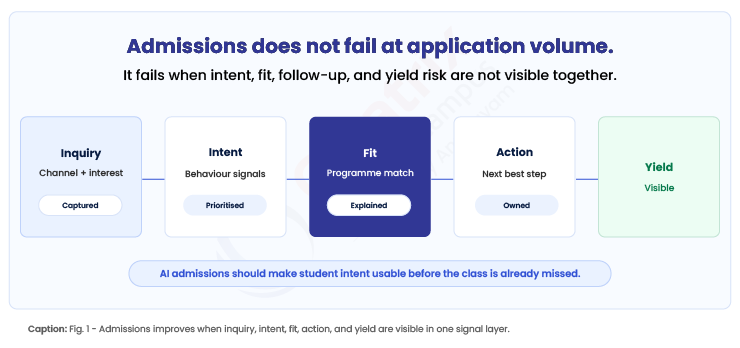
Where Admissions Teams Lose Applicant Intent
Applicant intent rarely appears in one neat field.
It emerges through behaviour and conversation.
A student revisits a programme, asks detailed questions about fees, attends a webinar, starts submitting documents, asks about transfer credit, or repeatedly checks deadlines. Another applicant may open every message but stop after a scholarship question remains unresolved.
Individually, those events may look small.
Together, they provide context.
The problem begins when the signals remain spread across marketing platforms, emails, CRM records, counselor notes, spreadsheets, and separate departmental workflows.
The admissions team then sees transactions rather than the story forming behind them.
This is where a connected student lifecycle management approach matters. Admission is not an isolated marketing funnel. It is the first operational stage of a much longer institutional relationship.
The institution should not have to wait for an applicant to disappear before recognising that their momentum had already changed.
Why Follow-Up Timing Decides More Than Teams Realise
Admissions teams often measure whether follow-up occurred.
Applicants experience whether the follow-up was useful.
A generic reminder adds little value to someone waiting for scholarship information. A chatbot response may not solve a complex programme-fit question. A counselor call may be unnecessary for a low-intent browser but extremely valuable for an applicant close to making a decision.
The goal is therefore not simply faster communication.
It is the right response to the right barrier at the right point in the decision journey.
That requires teams to see more than a follow-up queue. They need programme interest, application status, unanswered questions, financial concerns, document progress, previous communication, and readiness for the next stage.
AI can help with prioritisation or pattern recognition, but automation should not become the objective.
More messages do not create more yield when the institution is answering the wrong question.
What Better Enrollment Visibility Should Show
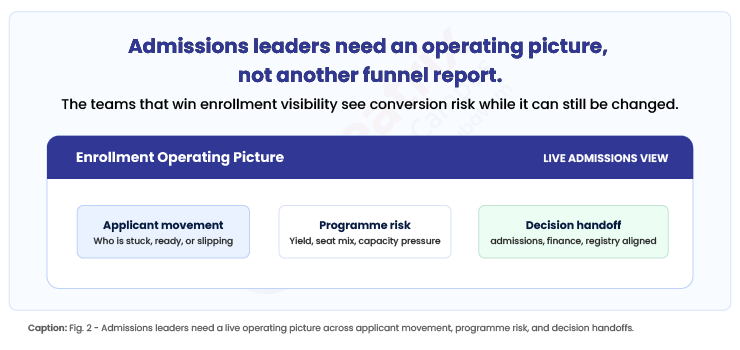
Better enrollment visibility should tell Admissions where movement is slowing and why.
Leaders and counselors should be able to understand:
- which applicants are active but stalled,
- which programmes are showing conversion pressure,
- where high-intent applicants may need human follow-up,
- where scholarship or fee questions are blocking a decision,
- where document or eligibility issues are delaying progress,
- which actions remain open,
- where admitted students are ready to move into registration and student records.
This is where Admissions eventually needs to connect with the student information system.
The applicant does not remain an applicant forever.
Admission becomes enrollment. Enrollment becomes a student record. Financial obligations begin. Registration follows. Advising and student support eventually need context.
If those handoffs lose information, the institution may win the enrollment and immediately create the next operational problem.
Good admissions visibility should therefore end not at the offer, but at a clean transition into the student lifecycle.
Where Creatrix Campus Fits
This is where Creatrix Campus becomes relevant.
Not simply as a way to automate admissions communication, but in connecting applicant movement with the wider institutional processes that influence enrollment.
Creatrix Campus connects inquiry and applicant activity, programme interest, counselor actions, document status, admissions decisions, financial handoffs, and student-record creation within the wider student lifecycle.
For Admissions teams, that can create stronger visibility into where applicants are moving or stalling. Enrollment leaders gain clearer programme-level context. Finance and Registry teams can receive cleaner handoffs as applicants move toward enrollment.
The connection can also matter later. Admissions context can become useful to student success advising once the applicant becomes a student rather than disappearing at the end of the recruitment process.
The value is not simply faster admission processing.
It is reducing the number of serious applicants who become invisible between institutional steps.
Conclusion
Admissions yield is not won or lost only when an applicant responds to an offer. It is shaped much earlier through programme questions, financial concerns, document delays, counselor interactions, and the institution’s ability to recognise changing intent.
How many applicants in your current funnel are genuinely losing interest, and how many are simply waiting for your institution to notice what is blocking them? Build clearer enrollment visibility with Creatrix Campus.
Quick recap
Application counts tell Admissions how many people entered the funnel. They do not fully explain who is moving, who is stuck, what is blocking a decision, or where a timely response could still protect yield. The stronger admissions model connects applicant intent, programme interest, follow-up, financial questions, document readiness, and downstream handoffs so teams can act before applicant momentum disappears.
Frequently asked questions
Why do admissions teams lose yield before offer acceptance?
Is application volume a reliable admissions success metric?
How can AI support admissions teams?
Why do admissions follow-ups fail?
Why should Admissions connect with student lifecycle systems?
How can Creatrix Campus support enrollment visibility?
Join the conversation
Want to contribute?
We welcome thought leaders to share ideas and write for our blog.
Become a guest author