
General
AI-Powered LMS for Higher Education: Why Smarter Delivery Isn't the Same as a Smarter Institution
AI-integrated learning systems are helping institutions support more personalized and modular learning while giving technology leaders stronger oversight of data, integration, and governance.
On this page
An AI-integrated LMS is a learning management system where AI features, adaptive sequencing, automated feedback, personalized pacing, operate on top of standard course delivery. That part of the market is real and moving fast.
What's not accurate is the idea, increasingly common in LMS marketing, that this makes the LMS the "intelligence hub" of the institution or the core of academic operations. It isn't, and treating it that way sets up the wrong evaluation. The LMS delivers learning. Curriculum, assessment standards, and the student record govern what that learning means, and those decisions live outside the LMS, in systems built to be accountable for them.
That's the real story behind AI-powered LMS for higher education right now: not whether the AI is good, but whether its decisions ever reach the parts of the institution that need to see them.
Quick answer
An AI-integrated LMS can genuinely improve learning delivery: sequencing content, personalizing pace, automating feedback. It cannot, on its own, connect that intelligence to curriculum decisions, assessment design, or the student record. Evaluate delivery-layer AI and institution-wide connection as two separate questions, because most vendor positioning only answers the first one.
Article summary
Problem: AI inside the LMS improves delivery without connecting to the academic decisions and records surrounding it.
For: CIOs, Provosts, Academic Technology leaders, and Digital Learning leaders evaluating LMS platforms.
Shift: From "how smart is the AI" to "where do the AI's decisions go next."
Outcome: An evaluation that separates delivery-layer AI from institutional connection, so the buying decision matches what the institution actually needs.
Key takeaways
- AI in the LMS improves delivery. It does not, by itself, connect to curriculum, records, or outcomes.
- The LMS is a delivery layer, not an intelligence hub, whatever the marketing says.
- A personalized pathway that never reaches the academic record is a new blind spot, not less risk.
- The right evaluation question is where the AI's decisions go, not how capable the AI is.
Why This Matters
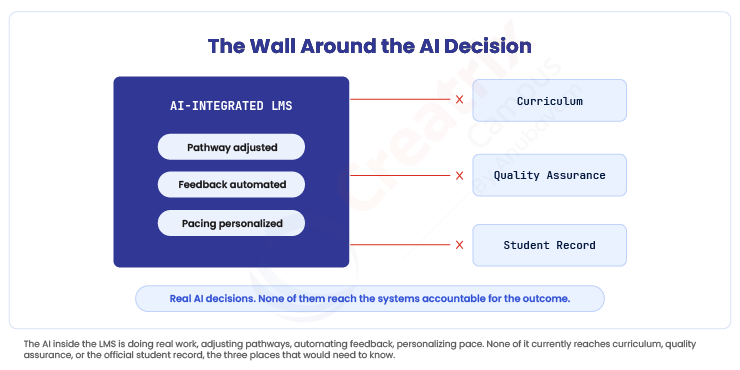
Picture a university piloting an AI-integrated LMS for a large first-year course. The AI notices students struggling with a concept, adjusts their sequence, and shifts pacing. Completion improves, and the pilot looks like a win on the LMS's own dashboard.
Then the term ends, and the questions that matter arrive: did the adjusted-pathway students perform differently on the course's official learning outcomes? Did curriculum know some students needed a different pathway? Does the registrar's "completed" record reflect what each student actually did? Nobody outside the LMS can usually answer this, because the AI's decisions never left the system that made them.
A UAE CIO survey covered by ComputerWeekly in February 2026 found 85% of CIOs there feel their role is at risk within two years without demonstrable AI ROI, and a dashboard metric inside the LMS isn't the same as ROI a board can trust, since a board asking about outcomes is asking an institutional question, not a delivery-layer one.
What AI Actually Changes Inside the LMS, and What It Doesn't Touch
AI genuinely changes what an LMS can do at the delivery layer: sequencing content to how a student is actually performing, automating first-pass feedback, flagging a struggling cohort before a final exam confirms it. These are real, useful capabilities, and a CIO shouldn't dismiss them because the marketing language around them runs hot.
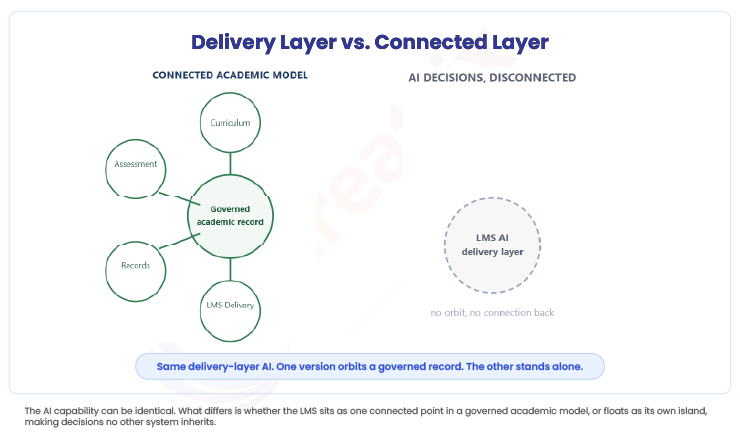
What AI inside the LMS doesn't do is answer for itself outside the LMS. A personalized pathway is still a decision about how a student met a learning outcome, and outcomes are curriculum's territory. An automated feedback loop is still an assessment event, a quality assurance concern, not a delivery-layer one. Calling the LMS an "intelligence hub" implies it should own these decisions. It shouldn't. It should feed them to the systems built to govern them.
| Approach | What it delivers | What it doesn't reach |
| AI features inside the LMS | Personalized pacing, automated feedback, in-course engagement signals | Curriculum alignment, quality assurance evidence, the official student record |
| LMS-to-SIS integration after the fact | Periodic sync of grades and completion data | Real-time visibility into why a pathway changed, and whether it still meets the approved outcome |
| LMS as the delivery layer of a connected academic model | The same personalization and automation, now visible in context wherever curriculum, assessment, and records already live | Nothing new to build; it uses connections an Academic Operating System already governs |
What Happens When Learning Delivery Isn't Connected to the Rest of the Institution?
This is the evaluation question CIOs are usually set up to skip. It's tempting to score an AI-integrated LMS on how sophisticated its personalization is. The more useful question is architectural: does this platform's intelligence stay inside its own walls, or does it plug into the governance the institution already runs on?
When it doesn't, the institution accumulates a specific kind of risk: personalization decisions that affected real students, with no record anywhere outside the LMS of why they happened. When an accreditation reviewer or a curriculum committee asks how a course's delivery matched its approved design, "the LMS decided" isn't an answer they can use. Treating the LMS as the delivery layer, not the decision-maker, is what keeps that answer available.
None of this makes AI-in-delivery the wrong investment. It changes what the RFP should ask: not "how personalized is the learning path," but "when this AI changes a student's path, who else in the institution can see that it happened, and why."
Conclusion
An AI-integrated LMS is not becoming the core of academic operations, and it shouldn't be evaluated as if it were. It's the delivery layer: excellent at pacing, feedback, and engagement, and dependent on curriculum, assessment, and records to give its decisions institutional meaning. Connecting learning delivery to the curriculum, assessment, and records governing it is what turns a personalization decision from an isolated LMS event into something the institution can stand behind.
If your current evaluation is measuring AI sophistication without asking where that intelligence goes next, raise it with your committee before the contract, not after the first accreditation cycle exposes the gap.
See how a connected learning delivery layer fits your institution's evaluation.
Quick recap
AI genuinely improves LMS delivery: pacing, sequencing, automated feedback. It isn't an intelligence hub and shouldn't be evaluated as one. The CIO's real question for 2026 is where the AI's decisions go once they leave the delivery layer, and whether curriculum, quality, and records can see them when it matters.
Frequently asked questions
Is an AI-integrated LMS the same as an institutional intelligence hub?
What should a CIO evaluate in an AI-integrated LMS beyond the AI features?
Does adding AI to the LMS reduce integration work?
Should the LMS try to manage the full academic lifecycle?
How is this different from what most AI-integrated LMS platforms claim?
Join the conversation
Want to contribute?
We welcome thought leaders to share ideas and write for our blog.
Become a guest author