

On this page
Faculty scheduling problems rarely begin when the timetable is published.
They begin earlier, while availability is being collected, teaching loads are being interpreted, rooms are being assigned, programme needs are being negotiated, and exceptions are being approved.
By the time faculty see the timetable, much of the logic behind it has already been decided.
That is why scheduling disputes often feel harder than they should.
A timetable may be technically complete, but faculty can still question why one person received heavier teaching pressure, why another has difficult back-to-back sessions, or why a late change affected some departments more than others.
The problem is not always the schedule itself. It is whether the institution can explain how that schedule became fair.
Quick answer
Faculty scheduling workflows break before timetable publication when workload context, availability, programme needs, room constraints, review points, and approval logic are handled separately. A stronger workflow makes those decisions visible before release so Deans, HoDs, and Academic Affairs teams can identify pressure, review trade-offs, and explain allocations with greater confidence.
Article summary
| Problem | Faculty scheduling can become a slot-filling exercise with limited visibility into workload and allocation logic. |
| Who this is for | Deans, HoDs, Academic Affairs, Registrars, Faculty Workload planners, Scheduling teams, and Academic Operations leaders. |
| What changes | Scheduling moves from timetable production to a reviewable faculty-allocation workflow. |
| Why it matters | A timetable can look balanced while hiding very different teaching pressures. |
| Outcome | Clearer workload decisions, less rework, stronger faculty trust, and better confidence before publication. |
Key takeaways
- Faculty scheduling problems often begin during planning, not after publication.
- Equal teaching hours do not automatically mean equal workload.
- Faculty trust depends partly on whether allocation logic can be explained.
- Strong workflows expose workload pressure and conflicts before approval.
- The real scheduling outcome is not simply a finished timetable. It is confidence in how the timetable was built.
Why This Matters
AACRAO has examined class scheduling across practice, policy, data use, and technology, which reflects how closely scheduling sits within wider academic operations.
For faculty, however, the process is often experienced only through the final timetable.
They see teaching times, rooms, sections, and allocations. They may not see the competing programme requirements, room limitations, workload rules, student demand, or exceptions that shaped those choices.
When that decision logic remains invisible, an allocation can feel arbitrary even when the scheduling team worked hard to balance it.
A scheduling workflow earns trust when people can understand the reasoning behind the result, not merely receive the result.
Why Scheduling Problems Start Early
Scheduling pressure often begins with individually reasonable decisions.
A faculty member takes an extra section because capacity is tight. A room is selected because it is available. A course is placed in the remaining workable slot. A late programme request is accommodated because the department needs flexibility.
None of those decisions looks serious on its own.
The problem appears when they interact.
An extra section may create an uneven teaching week. A convenient room may increase movement between campuses or buildings. A late programme change may affect another department’s faculty allocation. A workable course slot may create a poor sequence for students.
By the time the timetable is being reviewed as a finished product, those trade-offs have become much harder to unwind.
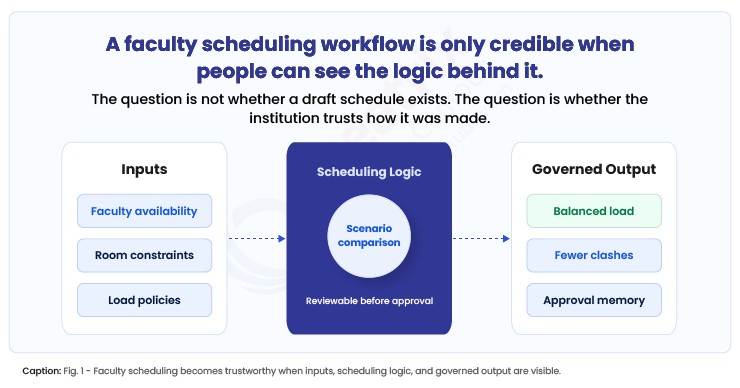
Slot-Filling Is Not the Same as Governance
A complete timetable answers one question:
“Did every class get a slot?”
A governed faculty scheduling workflow asks several more.
Was the teaching load reasonable?
Were programme needs balanced consistently?
Did room or laboratory requirements influence the allocation correctly?
Were exceptions reviewed?
Can the institution explain why one allocation differs from another?
These questions matter because scheduling is not simply a mathematical exercise. It combines institutional policy with academic judgement.
When that logic sits inside spreadsheets, emails, and individual memory, scheduling becomes difficult to review and even harder to explain later.
The timetable shows where faculty are teaching. Governance explains why that allocation makes sense.
Why Fairness Is Hard to See
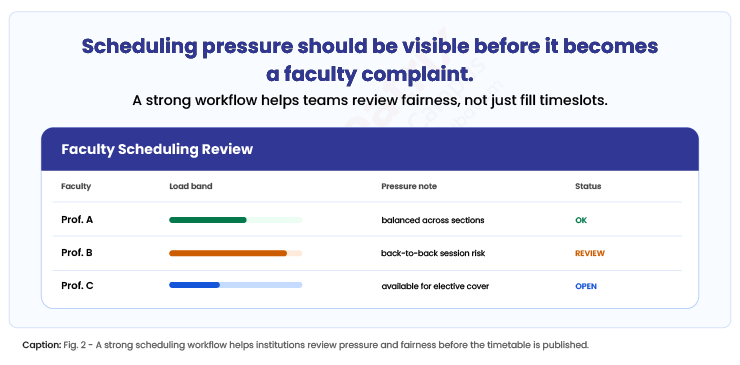
Faculty scheduling fairness cannot be judged simply by comparing teaching hours.
Two people can carry the same number of hours and experience very different workload pressure.
| What looks equal | What may actually differ |
| Same contact hours | Laboratory versus lecture intensity |
| Same number of courses | Cohort size or assessment load |
| Similar timetable | Back-to-back or fragmented teaching patterns |
| Equal section count | Cross-programme responsibilities |
| Similar teaching load | Advising, administration, or other assigned duties |
That is why faculty workload context matters.
The goal should not be to force every faculty member into an identical workload pattern. Academic roles differ, and disciplines differ.
The goal is to make those differences understandable enough that HoDs and Deans can review allocations fairly and faculty can see that the institution has considered more than a simple count of hours.
Transparency does not mean every schedule must look the same. It means differences should have an explainable reason.
What Stronger Scheduling Workflows Do Differently
A stronger workflow exposes scheduling pressure while there is still time to change it.
Before publication, academic leaders should be able to see faculty load, difficult teaching patterns, room and laboratory fit, cross-programme conflicts, unresolved constraints, late-change consequences, and the approval history behind important decisions.
That changes the role of scheduling review.
Instead of asking whether the timetable is finished, leaders can ask whether the underlying allocation is sustainable.
It also connects scheduling to the wider academic picture. Accreditation readiness may depend on evidence of faculty capacity and programme delivery, while learning outcomes ultimately depend on programmes being delivered as intended.
Scheduling therefore sits closer to academic quality than it first appears.
The timetable is not simply where teaching is placed. It is where the institution commits its academic capacity.
Where Creatrix Campus Fits
This is where Creatrix Campus becomes relevant.
Not simply as a timetable generator, but as part of a more reviewable faculty scheduling process.
Creatrix Campus connects faculty availability, workload rules, timetable planning, rooms, programme requirements, academic policies, and approval workflows within a connected academic operating model.
For HoDs, that can mean seeing workload pressure before allocations become difficult to change. For Deans and Academic Affairs leaders, it provides more context around trade-offs between faculty capacity and programme needs. For scheduling teams, it can reduce the amount of late rework created by hidden constraints.
The important outcome is not speed.
It is a scheduling decision that the institution can explain before faculty have to question it.
Conclusion
Faculty scheduling becomes difficult when the institution concentrates on making every class fit but leaves the reasoning behind workload and allocation difficult to see. Stronger workflows expose pressure, constraints, exceptions, and trade-offs while decisions can still be reviewed.
If a faculty member questioned their timetable tomorrow, could your department explain the workload and scheduling logic behind it without reopening spreadsheets and email threads? Build a more trusted scheduling workflow.
Quick recap
Faculty scheduling breaks before timetable publication when availability, workload, programme needs, room constraints, and approval decisions are handled without enough shared visibility. A stronger workflow makes those pressures reviewable before the timetable goes live. The goal is not simply a completed schedule, but an allocation that faculty and academic leaders can understand, review, and trust.
Frequently asked questions
Why do faculty scheduling workflows fail?
Is completing the timetable enough?
Why is fairness difficult to assess in faculty scheduling?
What should a stronger faculty scheduling workflow show?
How can scheduling affect accreditation readiness?
How can Creatrix Campus support faculty scheduling?
Join the conversation
Want to contribute?
We welcome thought leaders to share ideas and write for our blog.
Become a guest author