
On this page
A degree audit should not feel like a final inspection.
By the time a student is one semester away from graduation, the institution should already know whether requirements are complete, transfer credits have been applied correctly, substitutions are approved, exceptions are documented, and the remaining pathway is achievable.
Yet late surprises still happen.
A student believes they are on track. An Advisor has been working from one interpretation. A department approved an exception months earlier. The Registrar discovers during clearance that the official record tells a different story.
At that point, degree audit is no longer preventing risk.
It is documenting a problem the institution may have had years to see.
Graduation readiness has the greatest value while the student still has time to change the path.
Quick answer
Degree audit should prevent graduation risk by continuously comparing the student’s actual academic record with the requirements that govern their pathway, including completed and in-progress credits, transfer work, substitutions, exceptions, catalog rules, and remaining requirements. Its real value comes when students, Advisors, and Registrars can identify a problem early enough to correct the academic path rather than discover it during final graduation clearance.
Article summary
| Problem | Degree audit often becomes a final-stage eligibility check rather than an ongoing readiness process. |
| Who this is for | Registrars, Academic Affairs leaders, Advisors, Graduation teams, Student Records teams, Deans, and CIOs. |
| What changes | Degree audit moves from completion verification to continuous graduation-readiness visibility. |
| Why it matters | Late discoveries can delay completion even when the underlying problem began much earlier in the student journey. |
| Outcome | Fewer graduation surprises, clearer advising, less manual reconciliation, and stronger trust in academic progress information. |
Key takeaways
- Degree audit is most valuable before graduation risk becomes irreversible.
- Students and Advisors need a common, trustworthy understanding of progress.
- Transfer credits, substitutions, exceptions, and curriculum rules cannot sit outside the audit logic.
- Graduation readiness should be visible throughout the academic journey.
- The goal is not simply correct final clearance. It is fewer situations requiring last-minute rescue
Why This Matters
Graduation is one of the moments when students expect the university to know exactly where they stand. A late missing requirement does more than create an administrative delay. It can undermine confidence in advising, academic records, departmental approvals, and the institution itself. The important point is that most graduation problems do not suddenly appear in the final semester. Final clearance is often simply the first moment when all the earlier inconsistencies are forced to meet.
Why Degree Audit Becomes a Final-Semester Problem
A final degree audit can verify completion.
What it cannot do is return lost time.
The underlying issue may have appeared semesters earlier. A transfer course was accepted but applied to the wrong requirement. A substitution received departmental approval but never became part of the official pathway. A curriculum change affected students differently depending on catalog year. A repeated course was interpreted incorrectly. An Advisor believed an elective satisfied a requirement that the final audit did not recognise.
Individually, these can appear manageable.
Their consequence becomes serious when nobody sees the mismatch until graduation is close.
| Earlier record issue | Late-stage consequence |
| Transfer credit applied incorrectly | Requirement appears incomplete near graduation |
| Approved substitution not reflected | Student must prove an old decision |
| Catalog-year rule interpreted differently | Degree pathway suddenly changes |
| Repeat-course logic unclear | Credit or requirement calculation changes |
| Exception remains informal | Registrar must reconstruct approval |
| Advising relies on outdated information | Student follows the wrong remaining path |
A degree audit that finds the problem accurately but finds it too late has only solved half the problem.
Where Graduation Risk Usually Hides
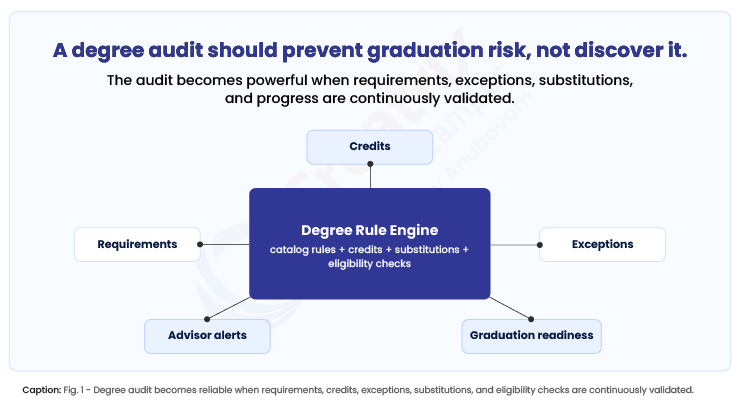
Graduation risk tends to hide between academic rules and the way those rules were applied to an individual student.
The catalog establishes the requirement. The student record shows completed work. The department may have approved an exception. The Advisor knows the intended plan. The Registrar needs an official basis for certification.
When those pieces do not agree, somebody eventually has to decide which version governs.
That is why a reliable student information system matters, but the challenge is larger than simply storing completed courses.
The record needs enough academic context to answer questions such as:
Which curriculum rules apply to this student?
Did this transfer credit satisfy the intended requirement?
Was the substitution formally approved?
Is an exception still pending?
Does the student’s current plan actually lead to completion?
Graduation risk often hides where institutional memory and institutional record stop matching.
Why Students and Advisors Need the Same View
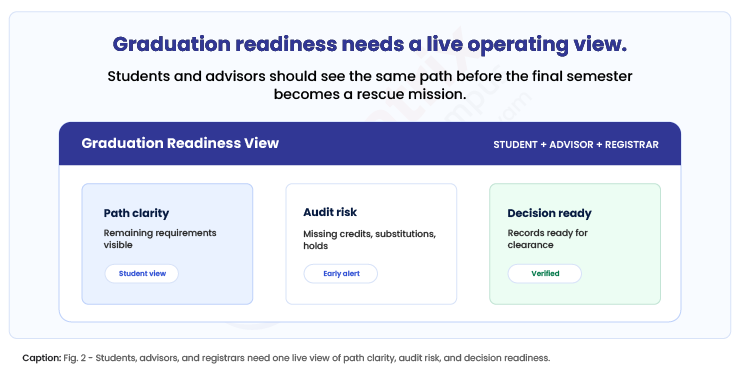
Advising becomes fragile when the student, Advisor, and Registrar are effectively working with different versions of degree progress.
Students need to understand what they have completed and what remains.
Advisors need enough confidence in the record to recommend the next course or pathway.
Registrars need the final progression logic to remain consistent with institutional rules.
That shared view should include completed and in-progress requirements, transfer credit, substitutions, exceptions, holds, remaining requirements, and potential graduation risks.
This is where student success advising needs to remain connected to degree progress.
An Advisor should not have to reconstruct the degree from spreadsheets or personal notes before every conversation.
And students should not hear:
“Yes, you appear to be on track, but the Registrar will confirm that later.”
A strong readiness model brings that confirmation much earlier into the journey.
What Continuous Graduation Readiness Should Show
Continuous graduation readiness does not mean performing a full graduation-clearance exercise every semester.
It means identifying the conditions that could eventually prevent completion while those conditions are still manageable.
Academic and Student Records teams should be able to understand:
- which students are progressing as expected,
- which requirements remain outstanding,
- which credits are not applying correctly,
- which substitutions or exceptions still need confirmation,
- where catalog or programme rules create uncertainty,
- which students would benefit from Advisor outreach,
- which records are approaching graduation with unresolved issues.
That makes degree audit part of student progression rather than a process that wakes up near completion.
It also changes the purpose of the audit.
Instead of asking only:
“Is this student eligible to graduate?”
the institution can ask much earlier:
“Is anything happening now that could prevent this student from graduating as planned?”
Where Creatrix Campus Fits
This is where Creatrix Campus becomes relevant.
Not simply as a final degree-clearance tool, but in connecting the academic information surrounding student progression.
Creatrix Campus connects student records, degree requirements, academic plans, advising workflows, transfer credits, substitutions, exceptions, eligibility checks, and graduation readiness.
For students, that can mean clearer visibility into progress toward completion. For Advisors, it creates stronger degree context before academic choices are recommended. For Registrars and Graduation teams, exceptions and substitutions can remain easier to trace instead of being rediscovered near final clearance.
The connection with student lifecycle management matters because degree completion is not an isolated event.
It is the accumulated result of academic decisions made throughout the student journey.
The value is not simply faster graduation clearance.
It is reducing how often graduation clearance discovers something the institution should have known earlier.
Conclusion
Degree audit should give students and academic teams enough visibility to correct the path before completion is at risk. Requirements, credits, substitutions, exceptions, advising decisions, and curriculum rules need to stay connected throughout the journey, not meet for the first time during final clearance.
If every student expected to graduate next year were audited today, how many surprises would your institution discover? Build continuous graduation readiness visibility.
Quick recap
Degree audit becomes far more valuable when it moves upstream from final graduation clearance. Students, Advisors, and Registrars need a consistent view of requirements, transfer credits, substitutions, exceptions, and remaining progress while there is still time to act. The goal is not to make the final audit better at finding problems. It is to give the institution fewer problems left to find.
Frequently asked questions
What is the purpose of degree audit?
Why do graduation surprises still happen?
Why is graduation readiness visibility important?
Should students and Advisors see the same degree-progress information?
How does degree audit support student success?
How can Creatrix Campus support graduation readiness?
Join the conversation
Want to contribute?
We welcome thought leaders to share ideas and write for our blog.
Become a guest author