
On this page
Most institutions do not have an attendance data problem.
Attendance is captured every day. Faculty record it, systems store it, and reports can usually show who attended, who missed class, and what percentage a student has reached.
Yet students can still disengage quietly.
The reason is simple: recording an absence and responding to a pattern are two different institutional capabilities.
One missed class may mean very little. Repeated absence, declining participation, and weakening academic performance together may mean much more. But that pattern only becomes useful when it reaches someone who understands the context, owns the next step, and can intervene while the student is still reachable.
Attendance capture tells the institution what happened.
Attendance intervention determines what the institution does about it.
Quick answer
Attendance data becomes useful only when institutions can turn repeated patterns into timely action. That means identifying meaningful changes, connecting attendance with student context, assigning the right owner, and recording what happened after intervention. Without that response path, attendance remains a historical record rather than an early student-support signal.
Article summary
| Problem | Attendance is captured, but emerging patterns do not always lead to timely action. |
| Who this is for | Registrars, Student Success leaders, Advisors, Academic Affairs, Deans, Student Records, and Academic Operations teams. |
| What changes | Attendance moves from passive recording to an actionable academic signal. |
| Why it matters | Early patterns are most valuable while the institution still has time to influence what happens next. |
| Outcome | Earlier intervention, clearer ownership, better follow-up, and fewer students disappearing between departments. |
Key takeaways
- Recording attendance is not the same as managing attendance risk.
- Patterns matter more than isolated absences.
- Alerts create little value without clear ownership.
- Advisors and Registrars need context, not simply percentages.
- Institutions should know not only who was flagged, but what happened after the flag.
Why This Matters
NCES tracks retention and graduation as important postsecondary outcomes. Institutions naturally want to understand the signals that appear long before a student reaches one of those final outcomes.
Attendance can be one of them.
A student rarely disengages in a single moment. The pattern may begin with occasional absence, reduced participation, missed work, or a gradual decline in academic connection. By the time the institution sees the problem through a formal progression or retention measure, the best intervention window may already have narrowed.
That is why the more useful attendance question is not simply “Was the student present?”
It is “Is something changing, and does someone need to respond?”
Why Attendance Data Often Goes Unused
Many attendance processes are designed primarily around capture and compliance.
Was attendance submitted? Is the percentage correct? Can the report be generated? Has the student crossed a threshold?
Those are legitimate operational questions, but they describe the record rather than what the institution should do with it.
A report does not automatically explain whether absence is becoming a pattern, whether the student has wider academic difficulty, whether an Advisor should make contact, or whether there is already another intervention underway.
The problem is therefore not that universities have failed to collect attendance.
The information often stops before it reaches the person who can change the outcome.
The Real Gap Between Capture and Intervention
The gap between attendance recording and student support is largely operational.
Faculty may see classroom behaviour. Registrars may watch attendance requirements. Advisors understand individual student circumstances. Student Success teams coordinate support. Academic leaders need to understand patterns across programmes.
Each team can be doing its job while the student still falls between them.
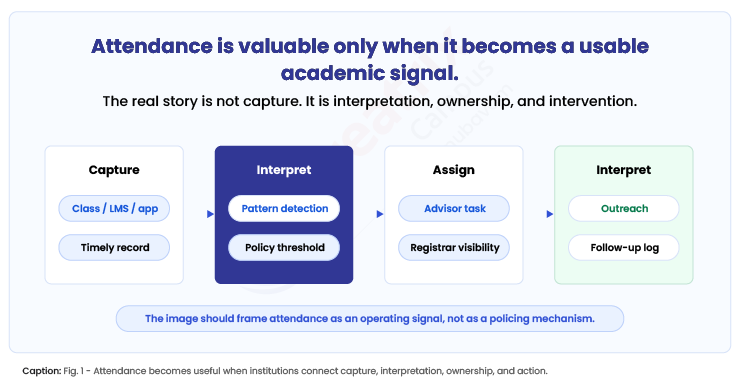
A useful attendance-response model needs four things to remain connected:
| Response question | What the institution needs |
| Who sees the pattern? | Relevant risk should become visible to the right role |
| What does it mean? | Attendance needs enough student and academic context |
| Who acts next? | Responsibility for follow-up must be clear |
| What happened afterward? | Outreach, intervention, and outcome should be recorded |
Without those answers, a university can prove that it captured attendance while remaining unable to show that anybody responded to the risk.
The failure is not always that nobody saw the absence. It is that nobody clearly owned what came next.
What Useful Attendance Visibility Looks Like
Useful attendance visibility is not a dashboard with hundreds of percentages.
Different roles need to see the cases that matter to them.
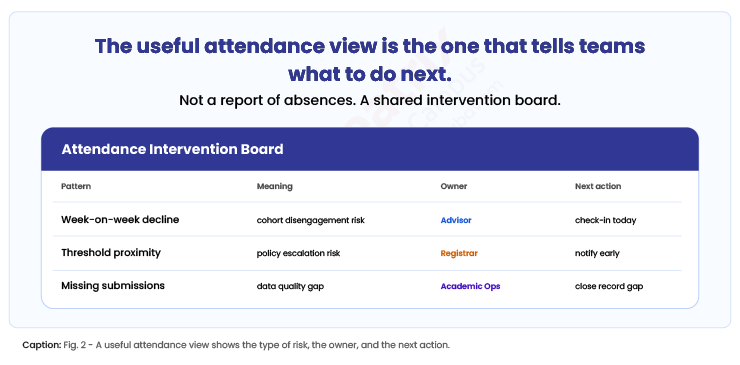
An Advisor may need students showing a new pattern of disengagement. A Registrar may need those approaching a policy threshold. A Dean may need to know whether unusual absence is concentrated within a course, cohort, or programme. Academic Operations may need to distinguish genuine student absence from incomplete faculty submissions.
The view should also show whether intervention has already happened.
That changes attendance from a retrospective reporting question, “Who has been absent?”, into an operational question:
“Who needs attention now, and is somebody already handling it?”
Why Ownership Matters More Than Automation
Automation can recognise a threshold and send an alert almost instantly.
That does not make it an intervention.
If the same warning goes to five people and none is clearly responsible, the institution has automated notification while preserving the original problem.
Different attendance signals also require different responses.
A Registrar may need to understand a policy risk. An Advisor may need to contact a student. A Dean may need to investigate a programme-level pattern. Academic Operations may need to resolve a data-quality problem.
The goal should therefore be role-aware intervention, not more alerts.
The right signal needs to reach the right person with enough context to decide what should happen next.
Attendance can also become more meaningful when interpreted alongside related academic evidence such as learning outcomes, assessment evidence, and continuous improvement activity.
That does not mean every absence indicates academic failure.
It means attendance should not be interpreted as though nothing else is known about the student.
An alert tells somebody to look. An intervention makes somebody responsible for what happens after they look.
Where Creatrix Campus Fits
This is where Creatrix Campus becomes relevant.
Not simply as a place to capture attendance, but in connecting attendance signals with the academic and student-support processes that determine what happens next.
Creatrix Campus connects attendance patterns, student context, Registrar visibility, Advisor workflows, academic risk, and follow-up actions within a connected operating model.
For Advisors and Student Success teams, that can mean clearer context around which students may need attention. For Registrars, it supports visibility into relevant attendance patterns and thresholds. For Deans and academic leaders, it can provide a broader understanding of recurring attendance risk rather than isolated student records.
The important outcome is not stricter attendance monitoring.
It is making it harder for an early student signal to disappear between institutional responsibilities.
Conclusion
Attendance data has limited value if the institution can only explain what happened after a student is already in difficulty. Its real value appears earlier, when a changing pattern can still lead to meaningful support.
If a student's attendance began changing this week, would your institution know who should act, what context they need, and whether the intervention actually happened? Turn attendance into earlier intervention.
Quick recap
Attendance becomes valuable when institutions move beyond recording absence and build a clear path from signal to context, ownership, intervention, and follow-up. The aim is not to treat every missed class as a crisis. It is to make sure meaningful patterns reach the right person before disengagement becomes much harder to reverse.
Frequently asked questions
Why is attendance important in higher education?
Why do institutions still miss risk when attendance is tracked?
What makes attendance data actionable?
Is attendance mainly a compliance tool?
Who should own attendance intervention?
How can Creatrix Campus support attendance intervention?
Join the conversation
Want to contribute?
We welcome thought leaders to share ideas and write for our blog.
Become a guest author