
On this page
Many universities already have an admissions technology stack.
Applications come through a portal. Applicant details sit in a CRM or SIS. Documents can be uploaded online. Emails are templated. Dashboards report funnel activity.
Yet somewhere inside the admissions office, a spreadsheet is still open.
It tracks exceptions. Or reviewer assignments. Or incomplete files. Or scholarship cases. Or applicants who need urgent attention. A shared inbox may still carry approvals that the system cannot route clearly.
That does not automatically mean staff are resisting technology.
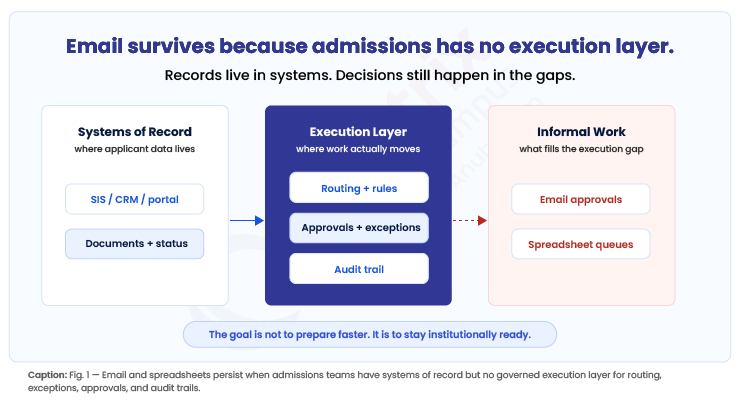
It may mean the formal systems record the applicant, while the real admissions work still happens somewhere else.
When teams keep rebuilding the workflow in spreadsheets and email, the problem is often not digitisation. It is missing execution.
Admissions automation therefore has to go beyond capturing forms. It needs to govern how decisions, exceptions, approvals, ownership, and handoffs actually move.
Quick answer
Admissions workflow automation fails when universities digitize applicant records and forms but leave the work between those records dependent on email, spreadsheets, manual coordination, and individual memory. Stronger workflow execution makes ownership, routing, rules, exceptions, approvals, communication, and handoffs visible so the admissions team can manage how work moves, not merely where applicant data is stored.
Article summary
| Problem | Admissions systems may capture applicant data while important operational work continues outside them. |
| Who this is for | Admissions Operations leaders, Registrars, Enrollment leaders, CIOs, Compliance teams, and university operations leaders. |
| What changes | Admissions automation moves from digitized intake to governed workflow execution. |
| Why it matters | Informal workflows make ownership, decisions, exceptions, and bottlenecks difficult to see consistently. |
| Outcome | Less shadow work, clearer accountability, stronger decision trails, and admissions operations that scale with greater control. |
Key takeaways
- Email and spreadsheets often survive because they solve workflow gaps that core systems leave open.
- Digitizing an application does not automate the decisions that follow it.
- Admissions workflows need explicit ownership, routing, rules, and exception handling.
- Workarounds create operational knowledge that can disappear when people change roles.
- The goal is not to eliminate every spreadsheet. It is to stop critical admissions decisions from depending on one.
Why This Matters
The NACAC State of College Admission covers application trends, admission decisions, recruitment practices, and counseling issues, reflecting how many moving parts sit behind the admissions process.
Inside a university, those moving parts can involve different programme requirements, document verification, reviewer roles, exceptions, scholarship decisions, regulatory expectations, applicant communication, and the transition into enrollment.
The challenge is not simply capturing more data.
It is coordinating what should happen because of that data.
An admissions system can know everything about an applicant and still leave the team uncertain about who is supposed to act next.
Why Email and Spreadsheets Still Run Admissions
Email and spreadsheets survive because they are remarkably good at filling operational gaps quickly.
Need a list of applications requiring faculty review? Make a spreadsheet.
Need approval for an unusual qualification? Send an email.
Need to track scholarship exceptions? Add another tab.
Need someone to follow up urgently? Message them directly.
Each workaround solves an immediate problem.
But the institution pays for that flexibility elsewhere.
The official applicant status may no longer reflect what is actually happening. Approvals become buried in inboxes. The latest explanation sits in a private conversation. Two teams maintain slightly different trackers. Leadership sees the system dashboard, while Operations is managing the real queue somewhere else.
The important issue is not that employees use email.
It is when the admissions process cannot continue reliably without the email thread.
The Missing Layer Between Records and Decisions
Admissions systems are often strong at recording events.
Application submitted.
Document uploaded.
Offer created.
Applicant accepted.
But admissions operations happens in the verbs between those events.
Review. Route. Verify. Approve. Escalate. Clarify. Decide. Notify. Handoff.
That work needs structure.
| Record says | Workflow still needs to decide |
| Application received | Who owns the next step? |
| Document uploaded | Is it complete and acceptable? |
| Eligibility condition met | Does an exception still require review? |
| Academic review required | Which reviewer should receive it? |
| Decision recorded | Who must approve or be informed? |
| Offer accepted | What should happen in Finance, Registry, and enrollment next? |
This is why adding another digital form does not necessarily remove administrative work.
The form captures information.
The workflow determines what the institution does with it.
Automation becomes useful when the next action stops depending on someone remembering the process.
Where Admissions Workflow Debt Builds Up
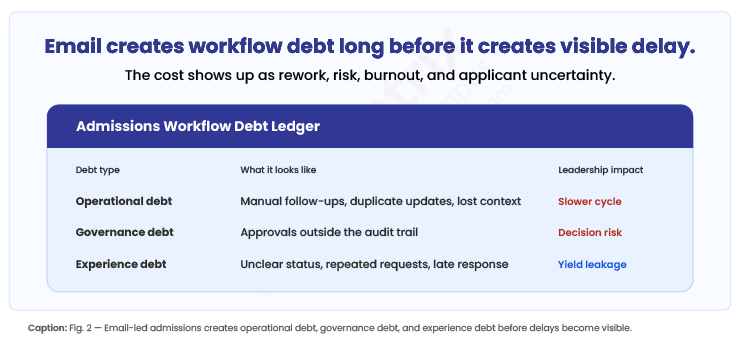
Workflow debt rarely begins as a major transformation problem.
It begins with sensible shortcuts.
A temporary spreadsheet becomes the official tracker because everyone trusts it. A shared inbox becomes the exception queue. A senior employee becomes the person colleagues ask whenever an unusual case appears. A manual report becomes the only reliable view leadership receives.
Over time, the university has two admissions processes.
The formal one represented by its systems.
And the practical one understood by the people who keep the work moving.
That becomes harder to sustain as volumes and complexity rise.
Common App reported more than 10 million first-year applications across its member institutions in 2024–25. Whatever an institution’s individual scale, increasing volume magnifies every manual handoff and informal dependency.
What Modern Admissions Workflow Execution Should Do
Modern workflow execution should not simply replace email with notifications or manual handoff and informal dependency.
Workflow debt is dangerous because the process can appear to be working right up until the people carrying the hidden coordination can no longer absorb it.
Modern workflow execution should not simply replace email with notifications or replace spreadsheets with another screen.
It should make the institutional logic of admissions explicit.
Teams should be able to define how applications move by programme, intake, applicant type, readiness, or decision condition. Reviewer ownership should be clear. Exceptions should follow an approved path rather than disappear into side conversations. Important status changes should trigger the appropriate next action or communication.
Leadership also needs to see where work is accumulating.
How many applications are waiting for documents?
Where is academic review slowing?
Which exceptions remain unresolved?
Which stage contains repeated manual intervention?
Which applicants have technically progressed but still have an incomplete downstream handoff?
That is the shift from workflow automation as task automation to workflow execution as operational control.
It also explains why student lifecycle management matters.
Admissions does not finish when a decision is recorded.
That decision needs to become enrollment, student identity, financial context, registration readiness, and eventually an active academic record.
Where Creatrix Campus Fits
This is where Creatrix Campus becomes relevant.
Not because universities need anoor another isolated admissions tool, but because admissions sits inside a wider student lifecycle that requires governed movement between states, people, rules, and institutional processes.
Creatrix Campus connects applicant records, routing, document checks, approvals, exception handling, communication, and downstream student-record workflows.
For Admissions Operations teams, that can mean less dependence on informal trackers to understand where work sits. For Registrars and Compliance teams, exceptions and approvals can remain easier to follow. For CIOs, the value is reducing the shadow processes that emerge when systems exchange data but the workflow between them remains manual.
As an applicant becomes an enrolled student, the connection with the student information system becomes particularly important.
The admissions decision should not finish one workflow and start another from zero.
The stronger model allows the context behind the decision to travel with the student.
Conclusion
Admissions automation fails when universities digitize what applicants submit but leave staff to manually coordinate everything that happens afterward. That is why email and spreadsheets can survive even inside institutions with substantial admissions technology.
If your admissions team stopped using its shared inboxes and operational spreadsheets tomorrow, which parts of the process would stop moving? Move admissions from email to governed execution.
Quick recap
Admissions teams often return to email and spreadsheets because the real operational gap sits between applicant records and institutional decisions. Forms capture information, but teams still need governed routing, ownership, exceptions, approvals, communication, and handoffs. The goal of admissions workflow automation is not to digitize more things. It is to make critical work executable without depending on hidden coordination.
Frequently asked questions
Why do admissions teams still use email and spreadsheets?
Is admissions workflow automation the same as digitizing forms?
What is admissions workflow execution?
Are spreadsheets always a problem in admissions?
How does admissions workflow connect to the student lifecycle?
How can Creatrix Campus support admissions workflow execution?
Join the conversation
Want to contribute?
We welcome thought leaders to share ideas and write for our blog.
Become a guest author