
On this page
Accreditation readiness means being able to produce current, traceable evidence of compliance and quality at any point in the cycle, not just in the weeks before a review. That's a narrower definition than most checklists imply, and it's the one that actually predicts whether a self-study goes smoothly.
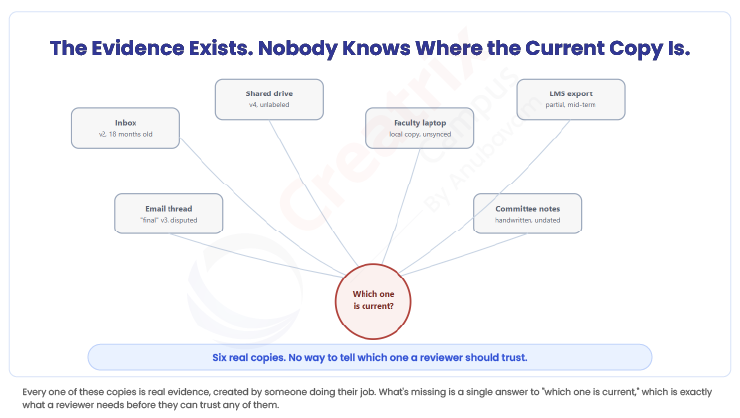
Most institutions aren't short on evidence. Faculty credentials get updated. Course assessments happen. Self-study notes get taken throughout the year. What's usually missing isn't the work, it's a reliable way to know where the current version of any of it lives, and who's responsible for it staying current.
That's the real story behind accreditation readiness for universities, and it's why more documentation rarely solves it.
Quick answer
Accreditation readiness isn't a document you assemble before a review. It's whether your evidence, faculty credentials, assessments, audit trails, self-study notes, stays current and locatable throughout the year. Most readiness failures trace back to evidence that's scattered, outdated, or ownerless, not evidence that never existed.
Article summary
Problem: Accreditation readiness often fails because evidence is scattered, outdated, or ownerless, not because it doesn't exist.
For: QA and Accreditation leaders, Provosts, Deans, and Institutional Effectiveness leaders. Shift: From treating readiness as a pre-review project to treating it as evidence that stays current through normal academic operations.
Outcome: Evidence you can produce on any given day, not just the weeks before a scheduled review.
Key takeaways
- Readiness failures are usually a scattering problem, not a missing-evidence problem.
- Outdated or unowned evidence is functionally the same as no evidence during a review.
- Audit trails matter as much as the evidence itself, reviewers need to see when and by whom something was recorded.
- Readiness that starts before a review is already too late to be continuous.
Why This Matters
A QA team preparing for a self-study usually isn't starting from zero: faculty credentials were updated through the year, course assessments happened on schedule, and someone took notes every time a programme discussed an improvement, but when the review clock starts, the team spends weeks just locating which version of each document is current, who last touched it, and whether the audit trail behind it can actually be shown to a reviewer, which is a search-and-verify problem dressed up as a compliance one.
Why Evidence That Exists Still Fails a Review
Most institutions assume a failed or delayed accreditation review means the evidence wasn't good enough. Usually it means the evidence couldn't be produced fast enough, or in a form a reviewer could trust. A faculty credential file sitting in someone's inbox from eighteen months ago is technically evidence. It's not readiness, because nobody can confirm it's still current, who owns updating it, or what changed since.
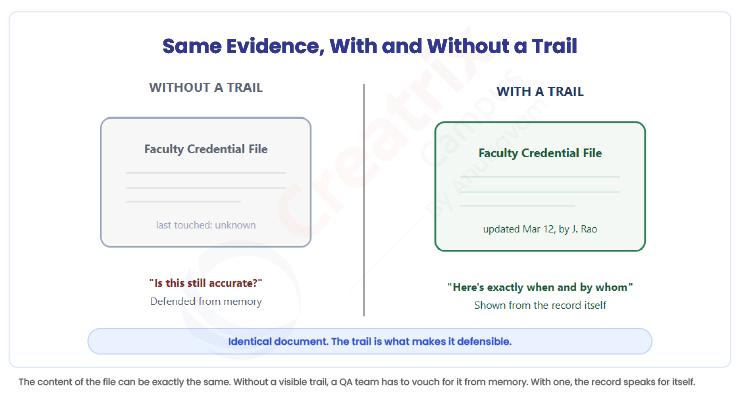
This is where audit trails matter more than the underlying document. A reviewer isn't just asking "does this exist." They're asking "when was this recorded, by whom, and has anything changed since." Evidence without a trail behind it, timestamps, ownership, version history, is evidence a QA team has to defend from memory instead of from the record itself, which is a much weaker position during any review.
| Treated as | What exists | What a reviewer actually needs |
| A document to produce when asked | The current file, wherever it happens to be stored | Confidence it's the current version, not last year's |
| A folder of past evidence | Historical records, accurate at the time they were created | A visible audit trail showing who updated what, and when |
| A continuously current record | The same evidence, always traceable to who owns it and when it last changed | Exactly this, without a separate assembly step |
What Would "Ready Today" Actually Look Like?
This is a more useful question than "are we ready for next year's review." Could your QA team pull up a specific programme's current self-study evidence, faculty credentials, and course assessment data, right now, on an ordinary Tuesday, and know with confidence it's current? For most institutions, the honest answer involves a multi-day search, not a few clicks.
That gap is what connecting evidence generation to the quality and accreditation lifecycle is meant to close, so the audit trail exists at the moment evidence is created, not reconstructed afterward. A connected accreditation evidence layer does the same for the review itself: it doesn't create better evidence, it keeps the evidence you already generate connected to who owns it and when it last changed, so being ready today and being ready during a scheduled review are the same state, not two different projects. CHEA, the recognized voice for accreditation quality in the US, describes accreditation as an ongoing relationship between institution and accreditor, not a one-time event, which is exactly the continuous framing readiness needs to match.
Conclusion
Accreditation readiness rarely fails for lack of evidence. It fails because the evidence that exists is scattered across inboxes and shared drives, outdated without anyone noticing, or missing the audit trail a reviewer needs to trust it. Treating readiness as something that stays current through normal operations, not a project that starts when a review is scheduled, is what actually closes that gap.
If your QA team couldn't produce a specific programme's current evidence today without a multi-day search, that's worth addressing before your next review cycle, not during it.
See how a connected accreditation evidence trail works for your institution.
Quick recap
Most accreditation readiness failures aren't a missing-evidence problem, they're a scattering problem. Evidence that's outdated, ownerless, or missing its audit trail is functionally as weak as evidence that doesn't exist, because a reviewer can't trust what they can't trace. Readiness that stays current through the year, rather than starting when a review is scheduled, is what actually makes evidence reliable when it's asked for.
Frequently asked questions
What does "accreditation readiness" actually mean day to day?
Why does an institution with real evidence still struggle during a review?
Is an accreditation readiness checklist enough on its own?
Does continuous evidence guarantee a successful accreditation outcome?
Who should be able to answer whether the institution is "ready today"?
Join the conversation
Want to contribute?
We welcome thought leaders to share ideas and write for our blog.
Become a guest author