
On this page
Most lists of "OBE accreditation problems" read like a catalogue: inconsistent CLO-PLO mapping, delayed attainment visibility, fragmented evidence, unclear ownership, disconnected improvement actions. Treated as a checklist, each one looks like it needs its own fix.
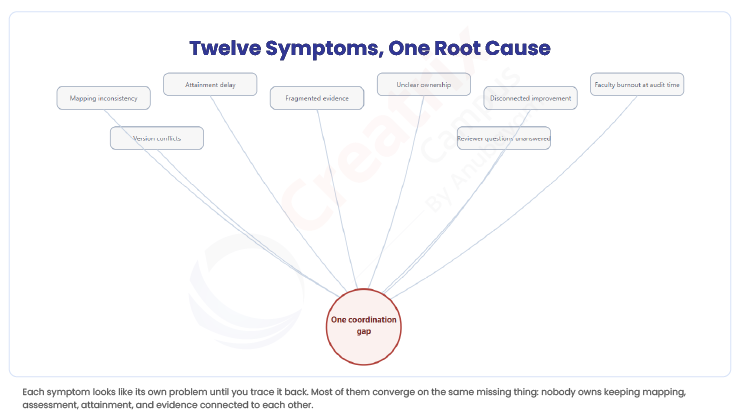
They usually don't. Pull on any one of these threads and it leads back to the same place: mapping, assessment, attainment, evidence, and improvement decisions live in different hands, on different schedules, with nothing keeping them in sync. The "twelve problems" are twelve symptoms of that one coordination gap, not twelve separate diseases.
That's the real story behind common accreditation challenges in outcome-based education, and it changes what's worth fixing first.
Quick answer
Most recurring OBE accreditation problems, inconsistent mapping, delayed attainment data, fragmented evidence, unclear ownership, are symptoms of one underlying issue: mapping, assessment, attainment, evidence, and improvement aren't coordinated as one process. Fixing the coordination gap resolves most of the individual symptoms at once.
Article summary
Problem: Institutions treat OBE's recurring accreditation problems as separate issues, when most trace back to the same coordination gap.
For: QA and Accreditation leaders, Academic Heads, Programme Leaders, Deans, and Provosts.
Shift: From fixing individual symptoms (mapping errors, missing evidence, unclear ownership) to fixing the coordination between the people and processes that produce them.
Outcome: Fewer recurring accreditation problems, because the root cause gets addressed instead of its symptoms.
Key takeaways
- Inconsistent mapping, delayed attainment, fragmented evidence, and unclear ownership usually share one root cause.
- Fixing each symptom separately treats the institution to the same problems every cycle.
- Ownership gaps are often the clearest sign of a coordination breakdown, not a staffing problem.
- Coordinating mapping, assessment, attainment, and improvement as one process resolves most symptoms at once.
The Twelve Problems Are Usually Five Coordination Gaps
Most "accreditation problems" lists read like independent issues: mapping inconsistency, attainment delay, evidence fragmentation, ownership confusion, disconnected improvement. Looked at individually, each seems to call for its own fix, a mapping template, a faster reporting cadence, a shared drive, a RACI chart, a better meeting cadence.
Looked at together, a pattern shows up.
- Mapping inconsistency happens because nobody owns keeping CLO-PLO mapping current across departments.
- Attainment delay happens because assessment data has to be manually pulled together before it can be calculated.
- Evidence fragmentation happens because mapping, assessment, and attainment were never stored as one connected record to begin with.
- Unclear ownership and disconnected improvement are what's left when nobody was accountable for the connections between the other three.
Malaysia's MQA COPPA framework, for example, treats CLO-PLO mapping as a continuous institutional requirement, not a one-time submission, precisely because a mapping exercise done once a year and left unmaintained is what produces the inconsistency reviewers eventually catch.
| Symptom | What it looks like | Root coordination gap |
| Inconsistent CLO-PLO mapping | Different departments hold different versions of the same mapping | No single owner keeps mapping current as courses change |
| Delayed attainment visibility | Results aren't available until weeks after a term ends | Assessment data has to be manually assembled before it can be calculated |
| Fragmented evidence | Mapping, scores, and improvement notes live in separate files | Nothing connects the record at the point each piece is created |
| Unclear ownership | No one is sure who's accountable when data doesn't match | The connections between mapping, assessment, and evidence were never assigned to anyone |
Whose Job Is It When the Data Doesn't Match?
This is the question that exposes the coordination gap fastest. When a programme's mapping says one thing and its assessment data implies another, who resolves it? In most institutions, the honest answer is "whoever notices first, eventually," not a defined role. That's not a staffing failure, it's a structural one: nobody was ever assigned ownership of the connection between mapping and assessment, only ownership of each piece separately.
Closing that gap doesn't require twelve separate fixes. It requires connecting curriculum mapping, assessment, and attainment into one governed process, so a mismatch surfaces immediately, to a defined owner, instead of surfacing months later to whoever happens to be reconciling data before a review. The same connection is what feeds accreditation evidence that doesn't need last-minute assembly, since evidence is simply the record of a process that was already coordinated, not a separate document built afterward.
Conclusion
Twelve accreditation problems in OBE almost always trace back to a smaller number of coordination gaps, mapping that nobody keeps current, assessment data that has to be manually pulled together, evidence that lives in disconnected files, and ownership that was never clearly assigned. Fixing the coordination, not each symptom individually, is what actually reduces how often these problems recur.
If your institution's list of recurring accreditation issues reads like a dozen unrelated items, it's worth checking whether they trace back to the same handful of missing connections before treating each one separately.
See how a connected OBE and accreditation process addresses these coordination gaps.
Quick recap
Most recurring OBE accreditation problems, inconsistent mapping, delayed attainment, fragmented evidence, unclear ownership, aren't twelve separate issues. They're symptoms of the same coordination gap: mapping, assessment, attainment, evidence, and improvement aren't connected as one process. Assigning clear ownership to those connections, not fixing each symptom in isolation, is what actually reduces how often these problems come back.
Frequently asked questions
Are the common accreditation challenges in OBE really all connected?
Why does fixing one OBE problem at a time not seem to work?
Who should own the connection between mapping, assessment, and evidence?
Does solving the coordination gap guarantee a better accreditation outcome?
Is this different from just automating OBE reporting?
Join the conversation
Want to contribute?
We welcome thought leaders to share ideas and write for our blog.
Become a guest author