
On this page
A Programme Chair asks for the latest student outcome evidence.
The assessment team has the scores.
Faculty have the supporting work.
The curriculum committee has the improvement decision.
The accreditation coordinator has last year’s report.
Everything exists.
Yet nobody can see the complete story without bringing several people, files, and systems together.
That is where many ABET accreditation challenges begin.
The problem is not that the programme failed to assess quality. It is that the evidence of quality became disconnected from the work that created it.
Quick answer
ABET accreditation becomes reporting-heavy when student outcomes, assessment evidence, curriculum decisions, faculty contributions, and improvement actions are maintained separately. For Engineering Deans, Programme Chairs, and accreditation teams, stronger ABET readiness means keeping the evidence chain visible throughout the programme cycle so review preparation becomes validation of existing quality work rather than reconstruction of it.
Article summary
| Problem | Programme teams spend review cycles rebuilding evidence that already exists across departments. |
| Who this is for | Engineering Deans, Programme Chairs, Accreditation Coordinators, Assessment Leaders, Academic Affairs, and Quality Offices. |
| What changes | Assessment, evaluation, curriculum review, and improvement remain connected throughout the programme cycle. |
| Why it matters | ABET requires programmes to demonstrate outcomes and continuous improvement, not simply produce reports. |
| Outcome | Less evidence chasing, stronger programme visibility, and more credible continuous improvement. |
Key takeaways
- ABET readiness should not begin when the review calendar does.
- Student outcome data becomes useful when leaders can trace the assessment, evaluation, action, and impact behind it.
- Accreditation teams should not repeatedly chase faculty for evidence the institution has already created.
- Continuous improvement needs a visible connection between findings and what changed afterward.
- Better readiness comes from Evidence by Design, not bigger accreditation folders.
Why This Matters
For an Engineering Dean, the real ABET question is not whether programme teams can produce another report. It is whether leaders can see where outcomes are weak, what evidence supports that conclusion, what the programme changed, and whether the change worked. ABET’s engineering criteria connect assessment, evaluation, student outcomes, and continuous improvement. If that connection becomes visible only during accreditation preparation, the programme has a readiness problem, not a reporting problem.
Why ABET Turns Into a Reporting Exercise
Consider what happens during a normal academic cycle.
A student outcome is defined.
An assessment generates evidence.
Faculty evaluate performance.
A committee discusses improvement.
Curriculum changes may follow.
Each activity can happen correctly.
But months later, the accreditation coordinator still has to ask:
Which evidence led to this decision?
Who acted on it?
What changed?
Did the change improve the outcome?
That is when quality work turns into reporting work.
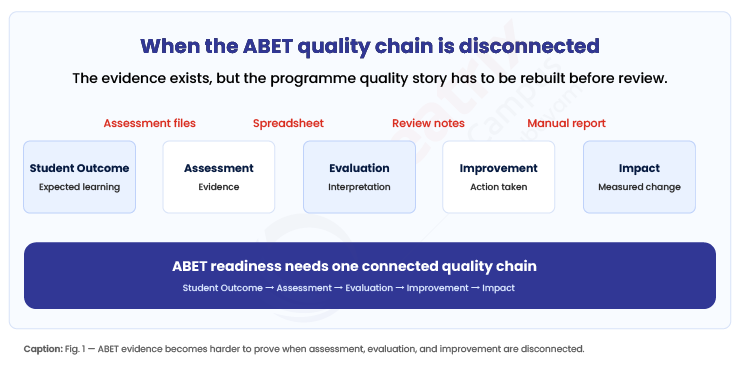
ABET readiness depends on a visible chain:
Student Outcome → Assessment → Evaluation → Improvement → Impact
Assessment without evaluation is data.
Evaluation without action is a report.
Action without evidence of impact is difficult to defend as continuous improvement.
Where ABET Readiness Usually Breaks
The burden rarely comes from one missing document.
It comes from small breaks across the programme.
| What leadership needs to see | Where readiness often breaks |
| Student outcome attainment | Results become visible too late |
| Assessment evidence | Evidence is distributed across faculty or systems |
| Evaluation decisions | Analysis is separated from the underlying evidence |
| Curriculum action | Decisions are documented elsewhere |
| Faculty contribution | Records are assembled near the review |
| Continuous improvement | Action is visible, but impact is harder to prove |
For the accreditation coordinator, every break creates another evidence request.
For the Programme Chair, every request becomes another round of coordination.
For faculty, it can feel like documenting work they already completed.
The institution ends up paying twice for the same quality activity: once to do the work and again to prove it happened.
Why Student Outcomes Become Hard to Prove
Most engineering programmes can list their student outcomes.
The more difficult task is showing how those outcomes are assessed, evaluated, and improved over time.
A single student outcome may be assessed through several courses. A course may contribute evidence to several outcomes. Different faculty may use different assessment activities.
That complexity is manageable until the evidence becomes disconnected.
Then the Programme Chair can see an attainment result but still needs to ask:
Why is this outcome below expectation?
Which assessment produced the result?
Was the problem curriculum, assessment design, or student performance?
What did the programme change?
Did that intervention work in the next cycle?
This is where an attainment number becomes programme intelligence.
A percentage tells the Dean what happened.
A connected evidence trail helps explain what to do next.
From Reporting to Continuous Quality
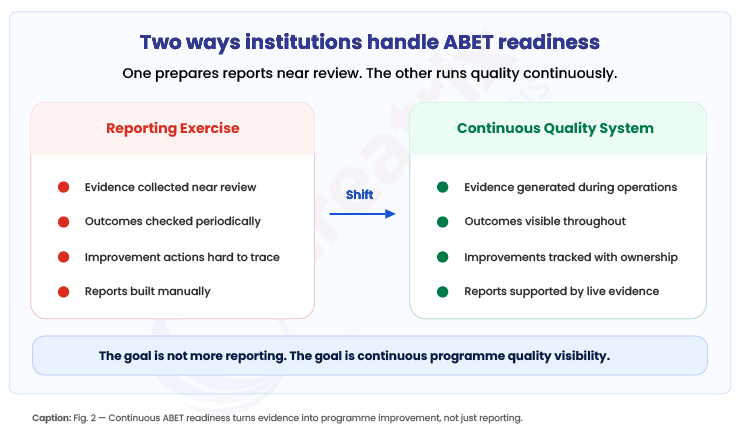
There is a significant difference between preparing for ABET and operating with ABET readiness.
Reporting asks:
“What do we need for the review?”
Continuous quality asks:
“What is our evidence telling us right now?”
That shift changes the work.
Assessment evidence remains connected to the outcomes being evaluated. Findings can be reviewed while there is still time to intervene. Improvement actions have ownership. Curriculum changes can be tied back to the evidence that triggered them.
Reporting does not disappear.
The scramble does.
The strongest ABET-ready programme is not the one that works hardest before the visit.
It is the one that can explain its quality decisions before anyone asks.
Where Creatrix Campus Fits
Creatrix Campus brings the academic work behind accreditation into one connected process, keeping evidence linked to the decisions, actions, and outcomes that produced it.
Accreditation readiness becomes more sustainable when student outcomes, assessment evidence, curriculum governance, faculty contribution, and continuous improvement do not exist as separate institutional records.
For the Assessment Leader, that means stronger traceability from evidence to evaluation.
For the Accreditation Coordinator, fewer repeated evidence requests.
For the Programme Chair, clearer visibility into unresolved quality gaps.
For the Dean, a better view of whether programme interventions are actually improving outcomes.
The shift is subtle but important:
from reporting on quality to operating a quality system.
Conclusion
ABET accreditation becomes a reporting exercise when the programme has to reconstruct the connection between outcomes, evidence, decisions, and improvement every review cycle. When that evidence remains connected as academic work happens, reporting becomes easier and programme leaders gain something far more useful: continuous visibility into quality.
If your ABET review started tomorrow, would your programme retrieve its improvement story or begin rebuilding it? See how Creatrix Campus can support continuous ABET accreditation readiness.
Quick recap
ABET readiness is not the ability to produce more reports. It is the ability to trace a student outcome through assessment, evaluation, action, and measurable improvement without reconstructing that story at review time. For Deans, Programme Chairs, Assessment Leaders, and accreditation teams, that means less evidence chasing and a stronger view of whether the programme is genuinely improving.
Frequently asked questions
What are the most common ABET accreditation challenges?
Why does ABET accreditation become a reporting exercise?
Why are student outcomes difficult to manage at scale?
What is continuous improvement in ABET?
What is the difference between ABET preparation and ABET readiness?
How can Creatrix Campus support ABET readiness?
Join the conversation
Want to contribute?
We welcome thought leaders to share ideas and write for our blog.
Become a guest author