

On this page
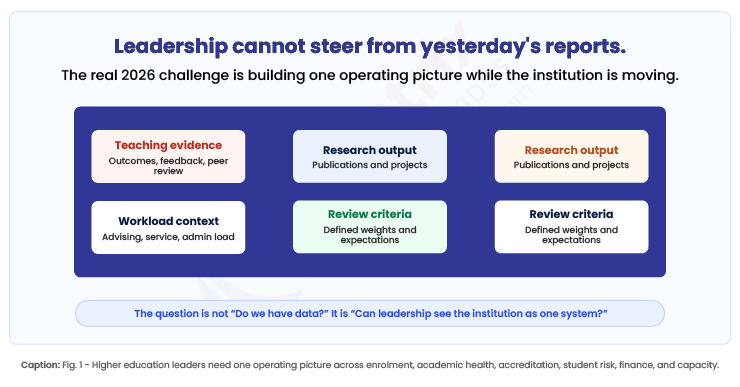
University leaders have more data than ever.
That does not mean they can see the institution clearly.
Enrollment may sit in one system while student risk appears somewhere else. Academic quality is discussed through programme and committee processes. Accreditation readiness has its own evidence trail. Faculty capacity is understood department by department. Financial implications may become clear only after an academic decision has already moved forward.
Each part of the university may be reporting accurately.
Leadership can still be seeing the institution too late.
That is what makes operating visibility one of the defining higher education leadership challenges in 2026: the ability to see important institutional movement early enough to do something about it.
AI matters here. So do dashboards and analytics.
But none of them solves the underlying problem if the institution remains visible only in pieces.
Quick answer
A major higher education leadership challenge in 2026 is operating visibility: the ability to understand how enrollment, student risk, academic quality, accreditation readiness, faculty capacity, finance, and institutional performance are changing while there is still time to act. The problem is not simply insufficient data. It is the delay created when signals, context, ownership, and decisions remain separated across the institution.
Article summary
| Problem | Leadership receives information through fragmented systems and reporting cycles. |
| Who this is for | Presidents, Provosts, CIOs, CFOs, QA leaders, Deans, Registrars, and Institutional Effectiveness teams. |
| What changes | Leadership moves from reviewing institutional status to seeing institutional movement. |
| Why it matters | Delayed visibility turns manageable signals into larger academic, operational, or financial problems. |
| Outcome | Earlier decisions, clearer institutional priorities, and less dependence on reconciled retrospective reporting. |
Key takeaways
- Higher education leaders do not simply need more data. They need connected context.
- The real cost of fragmented visibility is decision delay.
- Enrollment, student risk, quality, accreditation, faculty capacity, and finance influence one another.
- AI becomes more useful when it works with connected institutional context.
- Operating visibility should tell leaders what is changing and where attention is needed next.
Why This Matters
The 2026 EDUCAUSE Horizon Report highlights forces including AI, enrollment pressures, policy changes, and sustainability concerns shaping higher education strategy.
The challenge for senior leadership is that these pressures do not arrive according to the institution’s reporting calendar.
A student can begin disengaging before a retention report is reviewed. Enrollment patterns can shift before financial implications are fully understood. Accreditation gaps can accumulate between formal readiness exercises. Faculty capacity can become strained while individual departments are still solving the problem locally.
That is why student lifecycle management, academic quality, faculty planning, accreditation, and finance cannot be treated only as separate operational conversations.
The university operates continuously. Leadership visibility cannot remain periodic.
Why Leadership Now Depends on Live Institutional Visibility
Different executives need different views of the institution, but their decisions increasingly depend on the same underlying reality.
A President may need to understand whether enrollment pressure is changing programme viability. A Provost needs to connect progression, outcomes, programme quality, and faculty capacity. A CFO needs to understand the financial implications of academic decisions. A CIO needs to reduce fragmentation without disrupting essential operations. A QA leader needs to know where quality or evidence gaps are forming before review pressure arrives.
The problem begins when each leader receives an internally correct but incomplete picture.
The Registrar sees one part. Finance sees another. QA sees another. Academic Affairs sees another.
Leadership then has to wait for those realities to be reconciled before it can make a cross-institutional decision.
An institution can have excellent departmental reporting and still have poor institutional visibility.
The Real Leadership Challenge Is Decision Latency
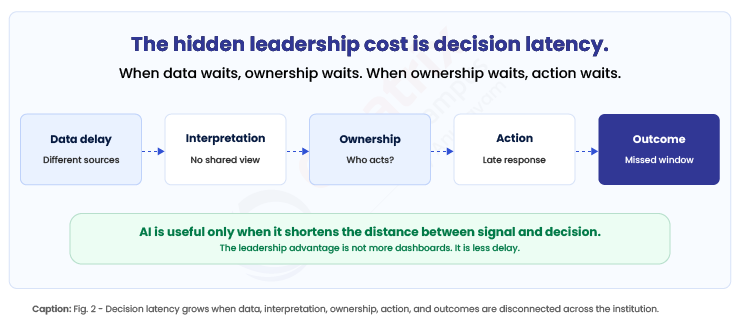
Decision latency is the distance between the institution beginning to change and the institution being ready to respond.
Consider what that looks like in practice:
| Signal | What delayed visibility can create |
| Student disengagement | Intervention begins after risk has deepened |
| Enrollment movement | Capacity or financial response comes late |
| Programme underperformance | Academic action waits for consolidated evidence |
| Accreditation gap | QA discovers the issue close to review |
| Faculty pressure | Leadership reacts after workload concerns escalate |
| Financial pressure | The consequence becomes visible after the academic commitment |
None of these necessarily begins as a crisis.
They become harder because the signal travels slowly across systems, reports, meetings, and ownership boundaries.
This is also why accreditation readiness belongs in the leadership conversation. If senior leaders see readiness only when the institution enters evidence-recovery mode, the information has arrived after the most useful decision window.
The leadership advantage is not knowing more eventually. It is knowing what matters sooner.
Why AI Alone Will Not Fix Fragmented Institutions
AI can identify patterns, surface anomalies, predict risk, and help leaders explore institutional information more quickly.
But intelligence is only as useful as the context beneath it.
If enrollment, academic performance, student risk, faculty workload, accreditation evidence, and financial indicators remain disconnected, AI may produce individual insights without giving leadership a reliable picture of how those insights relate.
That is a structural problem, not an AI problem.
A better AI conversation therefore starts with the questions leaders actually need answered:
Which programmes are beginning to lose momentum?
Where is student progression slowing?
Which quality indicators need attention?
Where are readiness gaps emerging?
Where is faculty capacity becoming constrained?
Which academic decisions have wider institutional consequences?
Learning outcomes, for example, become more strategically useful when they can contribute to decisions about programme quality rather than remaining confined to an isolated reporting exercise.
AI can shorten the path to an answer. It cannot compensate for an institution that has never connected the question.
What Operating Visibility Should Help Leaders See
Operating visibility is different from having a dashboard for every function.
A dashboard often describes status.
Leadership needs to understand movement.
That means seeing where the university is changing, where those changes intersect, and where action may be required.
For example:
- where enrollment demand is shifting,
- where students are slowing or disengaging,
- where programme performance needs attention,
- where faculty capacity is tightening,
- where quality or accreditation evidence is incomplete,
- where learning outcomes are weakening,
- where academic decisions are creating financial or operational consequences.
Senior leaders do not need every operational detail on one screen.
They need enough connected context to know where to look next and who needs to act.
That is the difference between another executive dashboard and an institutional operating picture.
Where Creatrix Campus Fits
This is where Creatrix Campus becomes relevant.
Not because Presidents or Provosts need another reporting layer, but because meaningful leadership visibility depends on how well the underlying academic lifecycles connect.
Creatrix Campus is designed around interconnected institutional lifecycles spanning areas such as student operations, academic progress, learning outcomes, faculty activity, quality and accreditation, and institutional intelligence.
For a Registrar, that creates greater continuity around student and academic operations. For QA leaders, readiness can become easier to see before review pressure intensifies. For Deans and Provosts, programme, faculty, and academic-quality context becomes easier to understand together.
For Presidents and other senior leaders, the larger value is straightforward:
less time waiting for the institution to reconcile itself before a decision can be made.
That is where operating visibility begins to change leadership.
Conclusion
Higher education leadership in 2026 is not simply about having better dashboards or adopting AI faster. It is about shortening the distance between something important changing inside the institution and leadership being able to understand and act on it.
If something began going wrong in your institution this morning, how long would it take your leadership team to see the full picture? Explore a connected institutional operating picture with Creatrix Campus.
Quick recap
The real visibility problem in higher education is not that leaders lack reports. It is that enrollment, student risk, academic quality, accreditation, faculty capacity, finance, and institutional performance often become visible on different timelines and in different systems. Operating visibility connects those signals early enough for leadership to move from explaining what happened to deciding what should happen next.
Frequently asked questions
What are the biggest higher education leadership challenges in 2026?
What is operating visibility in higher education?
What is decision latency?
Can AI solve higher education leadership challenges?
Why are more dashboards not necessarily the answer?
How can Creatrix Campus support higher education leadership?
Join the conversation
Want to contribute?
We welcome thought leaders to share ideas and write for our blog.
Become a guest author