

On this page
A student at your second campus wants to take one module at the main campus. The registrar's honest answer is, "That is a different system." So the student fills in two forms, two fees are raised, and two records now describe one person.
Universities with more than one campus feel this every term. The campuses share a name, a mission and a degree, but often not a record, a rulebook or a report. This guide sets out how to run several campuses as one institution: what to standardise, what to leave local, and fifteen areas to get right.
Quick answer
A multi-campus university runs well when policies, records and reporting are shared across campuses while day-to-day operations stay local. That means one student and faculty record, institution-wide rules with approved campus variations, shared scheduling and finance services, and consolidated reporting and evidence. Fifteen areas, from admissions to accreditation, show where to start.
Article summary
This guide explains what a multi-campus university needs, how to decide what to standardize and what to localize, and fifteen areas to run as one institution.
Key takeaways
- The core question for a multi-campus university is what is institution-wide and what is campus-specific.
- One student record and one faculty record across campuses removes most cross-campus friction.
- Rules should be shared, with approved variations recorded, so campuses do not drift apart.
- Campus managers need local views, and leadership needs a consolidated view of the same data.
- Campuses in different countries answer to different data protection laws, so where data lives matters.
What Does a Multi-Campus University Need?
A multi-campus university is one institution delivering its programmes at more than one location, sometimes in different cities or countries. Each campus has its own people, rooms and local needs, but students, faculty and regulators expect the institution to behave as one.
The question that shapes everything else is what is institution-wide and what is campus-specific. Get it wrong in one direction and campuses drift apart, with different rules and numbers. Get it wrong in the other and local teams cannot respond to local needs. Where campuses sit in different countries, there is a further layer: each answers to its own data protection laws, so where data is stored becomes a design decision, not an afterthought.
Standardise or Localise?
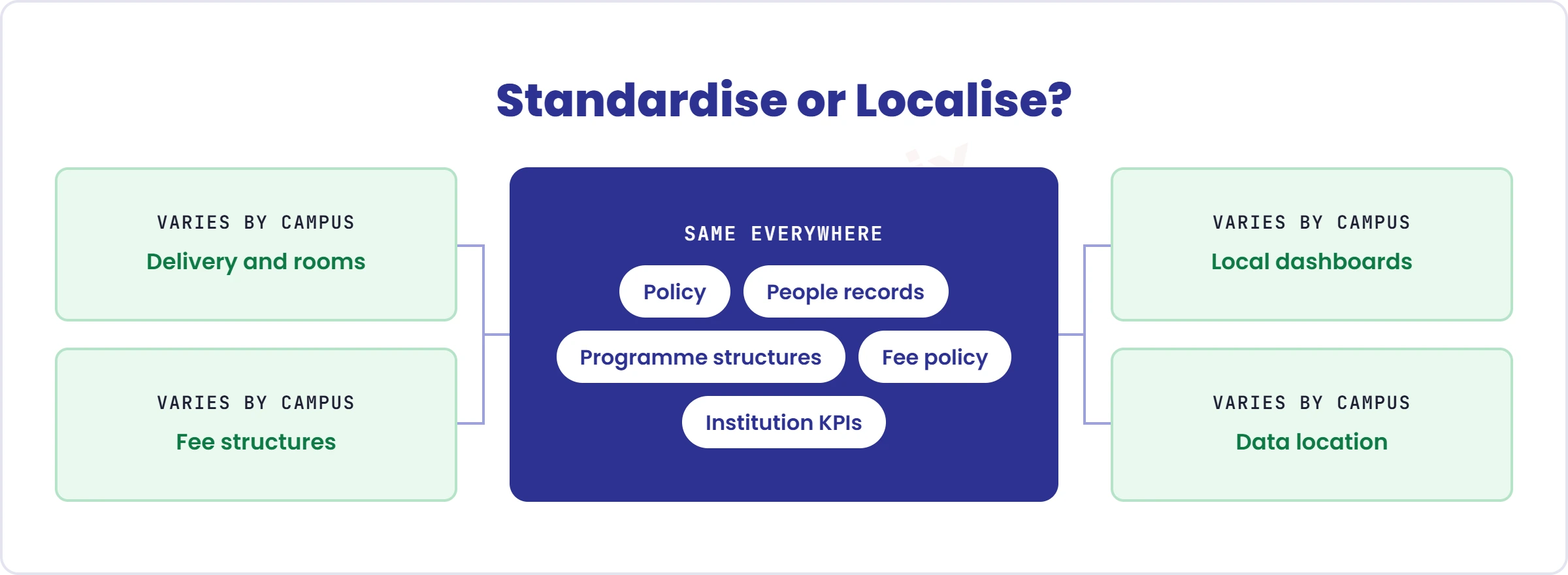
A useful test for each area is whether it should be the same everywhere or allowed to vary.
| Area | Keep the same everywhere | Allow to vary by campus |
| Policy | One rulebook for admission, academic and assessment rules | Approved variations, recorded |
| People records | One identity per student and faculty member | Campus attributes |
| Curriculum | Programme structures and outcomes | Delivery, rooms and schedules |
| Fees | Fee policy | Structures, currency and payment methods |
| Reporting | Institution KPIs and definitions | Campus dashboards |
| Data protection | Institution-wide controls | Where data is stored, per local law |
Fifteen Ways to Run Campuses as One
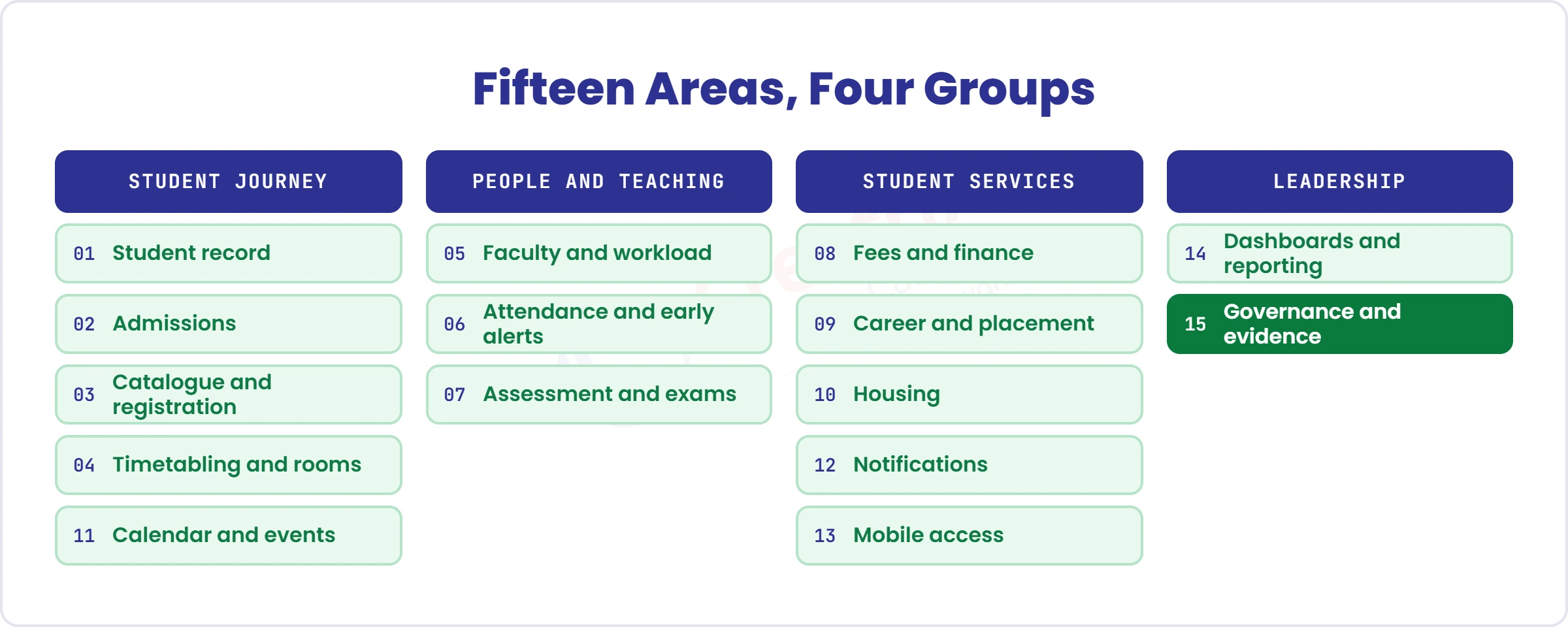
- One student record. One identity from admission to graduation, whichever campus a student starts at or moves to.
- Admissions. Shared admission policies and eligibility rules, with campus intakes and applications routed to the right team.
- Course catalogue and registration. One catalogue with offerings by campus, so cross-campus enrolment is a registration, not a request.
- Timetabling and rooms. Campus schedules built on shared services, with conflicts flagged before they reach students.
- Faculty records and workload. One faculty record and workload view across campuses, so equity can be seen and shown. Payroll stays with HR.
- Attendance and early alerts. Attendance captured where teaching happens, feeding early alerts to advisors.
- Assessment and examinations. Common standards for outcomes and exams, delivered by campus.
- Fees and finance. One fee policy, campus-level structures and payments, and holds that follow the student.
- Career and placement. Employer relationships and placements managed by campus and visible to the institution.
- Student housing. Housing allocation and records per campus, linked to the student record.
- Campus calendar and events. One academic calendar with campus events layered on it.
- Notifications and alerts. Email, SMS and push messages to the right people, by campus or institution-wide.
- Mobile access. Records, schedules and alerts available from a phone, wherever students and staff are.
- Dashboards and reporting. Campus views for local managers and a consolidated view for leadership.
- Governance and accreditation evidence. Policies set at institution level, variations approved and recorded, and evidence assembled across campuses.
What Breaks When Campuses Run on Separate Systems
When campuses run on separate systems, the same problems recur.
- Duplicate student records and IDs when students move between campuses.
- Cross-campus enrolment handled by email and forms.
- Reports that do not add up across campuses.
- Policy drift, with each campus interpreting the rules differently.
- Evidence for accreditors and regulators collected campus by campus.
Each one is a handoff, and handoffs are where students and staff lose time.
Where Creatrix Campus Fits
In Creatrix Campus, multi-campus operation is part of the platform. Multi-Institution & Network Management lets a parent institution govern branch campuses or a consortium, with institution isolation, shared identity and access, and a business rules engine, so institution-wide rules and approved campus variations are configured, not coded.
Admissions, student records, scheduling, finance, faculty and assessment run on the same record across campuses. Notifications reach people by email, SMS and push, and the Mobile Platform and Student Portal Framework give students and staff access from a phone.
Conclusion
Running several campuses as one institution is mostly a question of design: shared rules, shared records, local delivery, and one view for leadership. Institutions that decide what is institution-wide early spend less of every term reconciling campuses.
If you want to see how your own campuses would run on one record, talk to us about a Tailored Proof Session.
Quick recap
Share rules and records, localise delivery, and give leadership one consolidated view. Decide early what is institution-wide.
Frequently asked questions
What is a multi-campus university?
What is the biggest challenge in managing multiple campuses?
What should be standardised across campuses?
How do you handle students who move between campuses?
How does Creatrix Campus support multi-campus institutions?
Join the conversation
Want to contribute?
We welcome thought leaders to share ideas and write for our blog.
Become a guest author