
On this page
Say "TEQSA accreditation" in a meeting of Australian academic leaders and you will likely get several different reactions, because the phrase means different things depending on what kind of provider is in the room. A university with self-accrediting authority experiences TEQSA very differently from an institute of higher education that needs each course externally accredited. Getting that distinction right matters more than most institutions realize.
Quick answer
TEQSA does not issue one general "accreditation" to every Australian higher education provider. It registers providers under the Higher Education Standards Framework, and separately governs course accreditation, which works differently depending on whether a provider holds self-accrediting authority. Universities and university colleges can seek self-accrediting authority after demonstrating a sustained compliance record, while institutes of higher education generally require TEQSA to accredit their courses directly.
Key takeaways
- Provider registration, course accreditation, and self-accrediting authority are three distinct things under Australia's regulatory framework, not one blanket "TEQSA accreditation."
- The Higher Education Standards Framework, in force since 2021, still structures its requirements around seven domains under Part A, including Institutional Quality Assurance and Governance and Accountability.
- Self-accrediting authority is not automatic. Providers must demonstrate a sustained compliance record before TEQSA grants it.
- Regulatory readiness depends more on whether governance and quality systems are visibly functioning than on how quickly evidence can be assembled when scrutiny arrives.
First, Understand What TEQSA Actually Regulates
TEQSA's regulatory role rests on the Higher Education Standards Framework, known as the Threshold Standards, which remains in force in its 2021 form and structures requirements across seven domains: Student Participation and Attainment, Learning Environment, Teaching, Research and Research Training, Institutional Quality Assurance, Governance and Accountability, and Representation, Information and Information Management. Provider registration sits at the foundation of this system. It is TEQSA's recognition that an institution meets the Threshold Standards well enough to operate as a higher education provider in Australia.
Course accreditation is a separate matter, governed under the framework's Institutional Quality Assurance domain, specifically the standard on Course Approval and Accreditation. According to the Higher Education Standards Framework (Threshold Standards) 2021, a provider must have processes for internal approval of a course, or, where it holds self-accrediting authority, internal accreditation of every course leading to a higher education qualification. That authority is not universal. The framework sets out separate criteria for seeking self-accrediting status, requiring a provider to show a sustained, multi-year track record of course accreditation applications that consistently met the standards before TEQSA extends that authority. In practice, institutes of higher education generally need TEQSA to accredit their courses directly, while universities and university colleges are more commonly positioned to hold self-accrediting authority once they meet the criteria.
| Regulatory Area | What It Means | What Providers Need to Demonstrate |
| Provider registration | TEQSA's recognition that an institution meets the Threshold Standards to operate as a provider | Compliance across all seven HESF domains |
| Course accreditation | TEQSA's approval of an individual course, for providers without self-accrediting authority | Course design, delivery, and assessment meeting Part A standards |
| Self-accrediting authority | Permission for a provider to accredit its own courses internally | A sustained, multi-year record of compliant course accreditation outcomes |
| Ongoing compliance | Continued adherence to the Threshold Standards after registration or accreditation | Functioning governance, monitoring, and improvement processes |
TEQSA Readiness Is Really an Evidence and Governance Problem
Whether a provider accredits its own courses or relies on TEQSA to do it, the underlying expectation is similar: the institution must be able to show that its academic governance and quality assurance systems actually work, not just that policies exist on paper. This runs through nearly every domain of the Threshold Standards, from course design and learning outcomes to staffing, student support, and academic integrity.
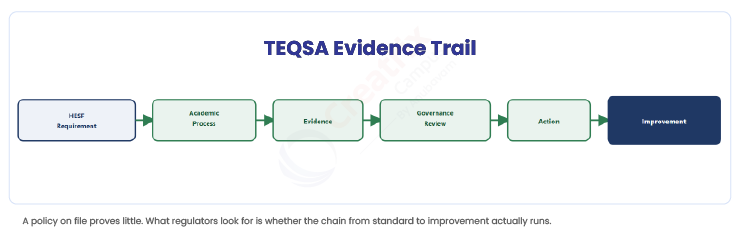
The operating chain that matters looks like this: a standard sets an expectation, an academic process is meant to satisfy it, that process generates evidence, a governance body reviews the evidence, a decision follows, and, where needed, an improvement action is taken. Storing a policy document or a committee minute is not the same as demonstrating that this chain actually runs. A provider can have a course approval policy that reads well and still struggle if it cannot show, with dates and decisions attached, that the policy was applied consistently across recent course reviews.
This is where many institutions unintentionally weaken their own position. They treat evidence collection as a documentation task, when what regulators are really testing is whether the institution's own oversight mechanisms catch problems before an external party does.
Regulatory evidence becomes stronger when the institution can show not only what its policy says, but how the policy operates and what happens when evidence identifies a problem.
From Regulatory Preparation to Continuous Self-Assurance
Institutions often wait for a course accreditation cycle, a renewal, or a scheduled review before genuinely testing whether their own evidence holds together. That timing works against them, because gaps tend to surface exactly when they are hardest to fix, under the pressure of a live regulatory process.
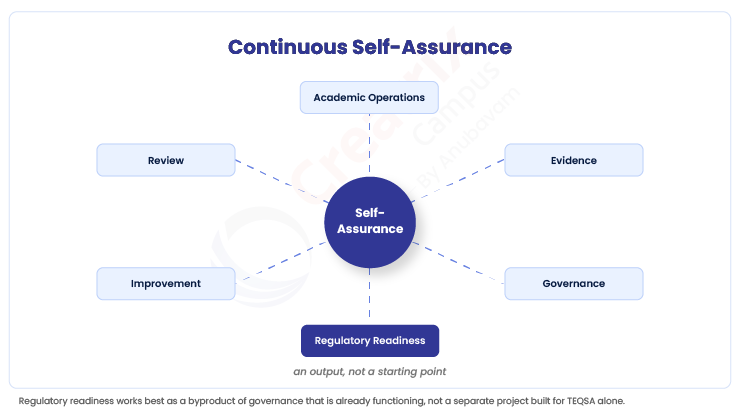
A steadier approach treats ongoing quality assurance as something the institution owes itself continuously, not something assembled for TEQSA's benefit alone. Evidence from course monitoring, assessment outcomes, and governance decisions stays connected to the processes that produced it throughout the year. Ownership of corrective actions remains visible rather than reconstructed from memory when a reviewer asks. Institutions that operate this way are simply better positioned whenever a course accreditation application, a renewal, or a regulatory assessment does come around.
This is an institutional operating comparison, not a TEQSA-prescribed model, and how it applies will still depend on a provider's registration category and accreditation pathway.
| Periodic Regulatory Preparation | Continuous Self-Assurance |
| Evidence gathered for an application | Evidence maintained through normal operations |
| Compliance checked near submission | Compliance monitored throughout the cycle |
| Ownership reconstructed | Responsibilities remain visible |
| Findings stored separately | Findings remain connected to action |
| Reports explain past activity | Evidence supports ongoing governance |
Self-assurance is difficult when the institution has to reconstruct its own evidence before it can judge whether its quality systems are working.
Where Creatrix Campus Fits
Creatrix Campus helps Australian providers keep academic governance, curriculum approval, assessment, and outcomes evidence connected to the workflows and decisions that produce them. Course review records, governance approvals, and improvement actions stay traceable rather than scattered across departmental files, giving institutions a clearer operational foundation for demonstrating that their quality systems function continuously, not just when a review is scheduled. This does not guarantee TEQSA registration, course accreditation, self-accrediting authority, or any specific regulatory outcome, all of which remain TEQSA's own determination.
Conclusion
TEQSA readiness should not begin with an application or regulatory review. It should be visible in how the institution governs academic quality every day, in whether course approvals, assessment evidence, and improvement decisions can be traced clearly at any point in the cycle, not just when someone asks for them.
If your institution's approach to TEQSA readiness still depends on assembling evidence when a review is announced, talk to Creatrix Campus about connecting academic governance and course evidence to everyday operations.
Quick recap
TEQSA regulates Australian higher education through provider registration and separately governed course accreditation, with self-accrediting authority reserved for providers with a sustained compliance record. Readiness depends less on document assembly and more on whether governance and quality processes are demonstrably functioning throughout the year, not reconstructed under regulatory pressure.
Frequently asked questions
What is TEQSA course accreditation?
What is the difference between TEQSA registration and course accreditation?
Do Australian universities need TEQSA course accreditation?
What is self-accrediting authority in Australia?
How can higher education providers maintain TEQSA compliance?
Join the conversation
Want to contribute?
We welcome thought leaders to share ideas and write for our blog.
Become a guest author