

On this page
Accreditation performance indicators, completion rates, assessment results, faculty qualifications, student feedback, are illustrative examples institutions commonly track, though specific requirements vary by accreditor and framework. Measuring them well is a data problem. Improving on them is a governance problem, and most institutions solve the first while quietly failing the second.
Quick answer
An accreditation performance indicator becomes useful only when an institution can trace it from the number itself back to the academic context that produced it, the person responsible for responding, the action that followed, and whether that action actually changed the result. Tracking the indicator alone answers "what is our completion rate." Governing improvement with it answers "what did we do about it, and did it work," which is the question accreditors and institutional leaders actually need answered.
Article summary
Problem: Institutions track accreditation indicators as isolated metrics, disconnected from the academic context, ownership, and action needed to actually improve them.
For: Quality Assurance Heads, Accreditation Leaders, Institutional Effectiveness Leaders, Provosts, Deans, and Programme Heads.
Shift: From measuring indicators to governing improvement through them, evidence connected to decision connected to result.
Outcome: An indicator that can be traced end to end during programme review, not a number sitting alone in a report.
Key takeaways
- Measuring an indicator and using it to govern improvement are different capabilities.
- A number without its academic context, owner, and resulting action isn't evidence, it's a data point.
- Useful indicators should answer six things: what changed, why, who owns it, what action followed, did it work, and can that trail be shown.
- Different accreditors use different indicators and terminology; there's no single required set.
- Closing the loop is a governance habit, not a reporting event.
The Metric Is Not the Evidence
A programme's completion rate drops five points in a single term, gets reported accurately in the next compliance cycle, and then sits there, technically documented, practically unexplained, because nobody connected it to the curriculum change that caused it, assigned a programme head to respond, or recorded what action, if any, followed, which means the same conversation happens again next cycle with no institutional memory of what was already tried.
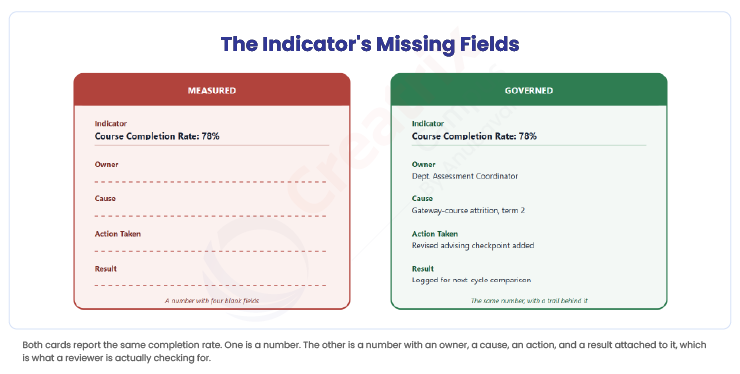
An indicator, by itself, is a number produced at a point in time. A completion rate, an assessment pass rate, a faculty qualification ratio, a student satisfaction score, each tells you something happened, but none of them, on their own, tell you why it happened, whether anyone noticed, or what the institution did in response. Treating the number as the evidence is the mistake most quality offices make without realizing it, because the number is the easiest part of the whole exercise to produce and the part every dashboard is built to show.
Real evidence, the kind a programme review or accreditation panel is actually testing for, is the connective tissue around the number: the academic context that explains the movement, the person or committee responsible for responding, the specific action taken, and whether that action produced a measurable change. A completion rate that dropped because of a curriculum sequencing issue, was caught by a programme head, addressed through a specific intervention, and recovered the following term, is a complete story. The same completion rate reported without any of that context is just a fact sitting in a spreadsheet, waiting to be asked about.
This distinction matters more once an institution is answering to more than one accreditor or framework. India's IQAC structure under NAAC, for instance, requires exactly this kind of traceability, CO-PO attainment data connected to specific courses, specific faculty, and specific improvement actions, not just a percentage submitted at year end. A recent analysis of NAAC accreditation challenges found that this kind of attainment and improvement data typically lives in individual faculty spreadsheets with no consistent structure across departments, which is precisely why closing the loop becomes so difficult when a submission deadline arrives. The problem isn't the indicator, it's that the surrounding evidence was never captured as part of producing it.
None of this means every accreditor wants the same six data points, or that completion rates and faculty qualifications are universally mandated categories. Frameworks vary, and institutions should confirm specific requirements with their own accreditor rather than assume any list is exhaustive. What doesn't vary is the underlying expectation: a reviewer wants to see that the institution noticed a change, understood it, acted on it, and can show the result, regardless of which specific indicators are in scope.
What Happens After the Indicator Moves?
Here's the test worth running on any indicator an institution currently tracks: when it moves, meaningfully, up or down, what happens in the next thirty days? For most institutions, the honest answer is that the number gets reported, possibly flagged in a meeting, and then waits for the next reporting cycle to be looked at again, because no one owns the specific responsibility of acting on that movement before the next report is due.
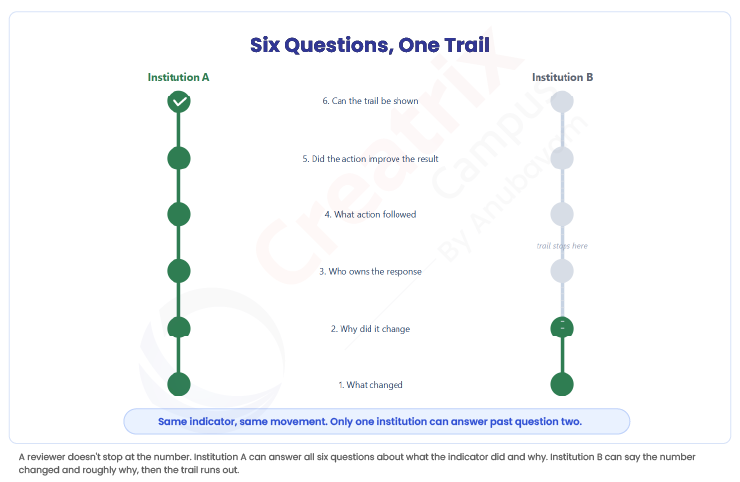
A useful accreditation performance indicator should be able to answer six connected questions, not just report a value: what changed, why it changed, who owns the response, what action followed, whether that action actually improved the result, and whether the institution can show that complete trail during programme review or accreditation, not reconstruct it under pressure. Most institutions can answer the first question easily. Fewer can answer the third and fourth without checking with someone. Almost none can answer the sixth without weeks of preparation.
This is where the connection to everyday academic operations matters more than the indicator itself. When assessment results and programme outcomes are tracked as part of how a programme runs, not compiled separately for a report, the context behind a moving indicator, which course, which cohort, which assessment, is already attached to it. And when that connects into a broader quality assurance and accreditation structure, ownership and action tracking stop being things a QA office has to chase down manually after the fact. The indicator stays governed instead of just measured.
Conclusion
An accreditation performance indicator earns its usefulness the moment it stops being a number reported in isolation and starts being something the institution can trace: from the metric, to the reason it moved, to the person who responded, to the action taken, to whether that action worked. Most institutions already collect enough data. What separates the ones that improve from the ones that keep reporting the same gaps is whether that trail exists at all, or has to be reconstructed every time someone asks.
If your institution can produce the number instantly but needs a week to explain what was done about it, that's not a data problem. It's a governance gap, and it's worth closing before the next review does it for you.
See how Creatrix Campus connects indicators to evidence and improvement. Creatrix Campus does not guarantee accreditation outcomes, compliance status, or institutional improvement; these depend on the institution's own academic and administrative decisions.
Quick recap
Accreditation performance indicators are only as useful as the trail behind them. Measuring a metric answers what happened. Governing improvement with it answers why it happened, who responded, what they did, and whether it worked, the sequence accreditors and institutional leaders actually care about. Different frameworks track different indicators and shouldn't be treated as interchangeable, but the underlying expectation, a traceable path from evidence to action to result, holds across most of them. Closing that loop consistently, not just reporting the number, is what turns data into institutional improvement.
Frequently asked questions
What are accreditation performance indicators?
Why isn't tracking indicators enough on its own?
What questions should a useful indicator be able to answer?
Does every accreditor require the same indicators?
How does IQAC-style governance relate to this?
Join the conversation
Want to contribute?
We welcome thought leaders to share ideas and write for our blog.
Become a guest author