
On this page
Ask a university whether it has a quality assurance system and the answer will almost certainly be yes.
There are programme reviews.
Student surveys.
External examiners.
Curriculum approvals.
Assessment boards.
Annual monitoring.
Committee reports.
Policies for almost everything.
Now ask a different question:
When one of those processes identifies a problem, can the institution trace what changed because of it?
That is a much harder question.
And it gets closer to the direction of the current UK Quality Code.
The 2024 UK Quality Code for Higher Education is structured around 12 Sector-Agreed Principles rather than simply prescribing one institutional process. Among them are taking a strategic approach to quality and standards, engaging students as partners, using data to inform quality, monitoring and evaluating provision, and operating partnerships effectively.
That changes the leadership conversation.
Quality assurance is not simply about whether the institution has processes.
It is about whether those processes help the institution understand itself and improve.
Quick answer
The QAA approach to quality is increasingly useful as a framework for asking whether quality is embedded across institutional operations. Strong quality assurance connects student voice, academic data, programme review, curriculum decisions and improvement actions so that leaders can see not only that review happened, but what changed afterwards.
Article summary
Problem: Universities can have mature quality processes without a clear institutional view of whether those processes are producing improvement.
For: Provosts, QA Directors, Registrars, Deans, Programme Leaders and Student Experience leaders.
Shift: From proving that quality processes exist to showing what those processes change.
Outcome: Earlier visibility into academic quality, clearer ownership of improvement and stronger evidence of enhancement.
Key takeaways
- The UK Quality Code 2024 contains 12 Sector-Agreed Principles for securing standards and assuring and enhancing quality.
- Quality cannot sit with the QA office alone.
- Student feedback becomes valuable when institutions can show what happened because of it.
- Data should inform academic judgement, not simply populate another dashboard.
- A review is more useful when its actions remain visible until the institution knows whether they worked.
Why This Matters
One of the most revealing parts of the updated Quality Code is Principle 1: Taking a strategic approach to managing quality and standards.
It asks providers to demonstrate that their approach is embedded across the organisation. QAA's supporting guidance also talks about strategy, communication, external expertise, monitoring and evaluation.
The word that matters is embedded.
Because a university can have a sophisticated QA office while quality itself remains fragmented.
The QA team may know which programmes have open actions.
The Registrar knows where regulations changed.
Programme leaders know where curriculum has been revised.
Student Experience knows what students keep raising.
Deans know where delivery is struggling.
Leadership may see only the final committee report.
Every team has part of the picture.
Who sees the institution?
Quality Does Not Live in the Quality Office
Quality assurance often becomes visible at the point of review.
But quality itself is being created much earlier.
When a programme is designed.
When an assessment is changed.
When students repeatedly raise the same issue.
When progression data begins to shift.
When an external examiner identifies a concern.
When a curriculum committee approves an intervention.
Those are quality events.
The problem is that universities rarely call them that while they are happening.
Imagine student feedback repeatedly identifies a problem with assessment timing.
The issue is discussed by the programme team.
A curriculum change is approved.
Assessment sequencing changes the following year.
The next student cohort reports a better experience.
That is quality enhancement.
But could the institution trace that complete story without asking four different teams to reconstruct it?
This is particularly relevant to Principle 2 of the 2024 Quality Code, which positions students as active partners in assuring and enhancing their learning experience. QAA's guidance goes further than simply collecting feedback. It expects institutions to consider how student engagement influences decision-making and how resulting enhancements are communicated back to students.
That last part changes everything.
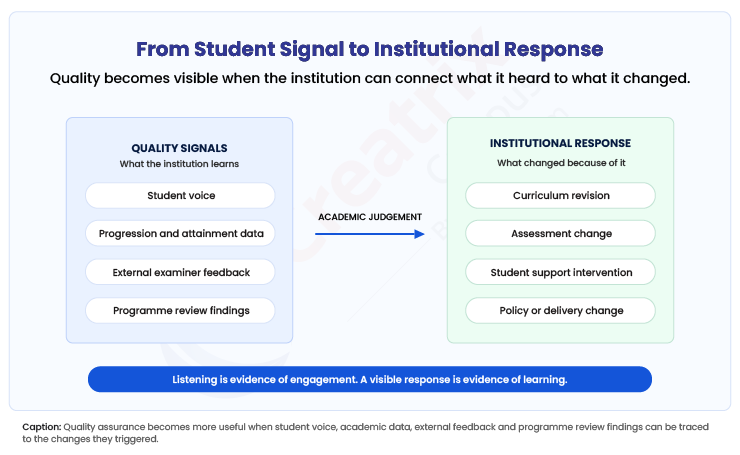
A student survey is evidence that the institution listened.
A visible academic response is evidence that the institution learned.
This is where Course Evaluation should connect naturally with programme review and Curriculum Management, rather than ending with a survey report.
The question for a Provost or QA Director should therefore not be:
“Did every programme complete its annual quality review?”
It should be:
“What did those reviews actually change?”
The Real Test Is What Happens After the Review
Most institutions know how to run a review.
The harder part is keeping the result alive afterwards.
A programme review identifies an issue. An owner is assigned. A change is approved. The committee minutes record it.
Then the academic year moves on.
Twelve months later, can the institution still see:
What raised the concern?
Who owned the response?
What changed?
Did the change work?
That is the quality memory test.
The 2024 Quality Code makes this especially relevant because several of its principles depend on institutions being able to connect evidence, monitoring, evaluation and enhancement over time.
This is where Accreditation Management becomes more useful when it sits alongside the academic work creating the evidence, rather than functioning only as a repository for review documents.
The same applies to Outcome-Based Education, programme review, curriculum change and student feedback. If each process keeps its own version of the story, quality teams are forced to reconstruct the institutional memory every time someone asks what happened.
For a Director of Quality Assurance, that creates operational strain.
For a Dean, it makes programme improvement harder to see.
For a Provost or Deputy Vice Chancellor, it creates a bigger problem:
Leadership may know that reviews happened without knowing whether the institution actually improved because of them.
That is why the strongest quality model is not the one with the most completed reviews.
It is the one where a quality issue remains visible from the first signal to the eventual result.
Conclusion
Quality assurance can easily become a collection of good processes.
Student surveys are completed.
Programme reviews are submitted.
External examiner reports arrive.
Committees meet.
Actions are logged.
Yet the most important question remains:
What became better because all of that happened?
That is where the QAA Quality Code becomes useful as more than a compliance reference.
It asks institutions to think about quality as something embedded across academic life, shaped by students, informed by evidence, owned across the institution and strengthened through continuous enhancement.
When those relationships stay visible, the QA office no longer has to rebuild the story of improvement after the fact.
Leadership can see it while it is happening.
And that changes quality assurance from a periodic review activity into something far more valuable:
an institutional ability to learn from itself.
Make Improvement Easier to See
Creatrix Campus connects student feedback, curriculum decisions, programme review, assessment evidence and quality actions across the academic lifecycle, helping institutions preserve the context behind what changed and why.
See how connected quality governance can work across your institution
Quick recap
The 2024 UK Quality Code moves the quality conversation beyond whether institutions have the right processes.
The stronger question is whether student voice, academic evidence, review findings and improvement actions remain connected long enough for the institution to understand what changed and whether it worked.
Frequently asked questions
What is the UK Quality Code for Higher Education?
Is QAA the regulator for all UK higher education?
What changed in the 2024 UK Quality Code?
Why is student voice important in QAA quality assurance?
How can institutions make quality enhancement more visible?
Can software guarantee compliance with the QAA Quality Code?
Join the conversation
Want to contribute?
We welcome thought leaders to share ideas and write for our blog.
Become a guest author