

On this page
Most programmes can produce a clean learning outcomes-based curriculum framework document: PLOs defined, CLOs mapped underneath them, a matrix showing which course covers which outcome. It looks finished. It usually isn't.
The moment a course syllabus changes, an assessment method gets swapped, or a programme committee approves a curriculum tweak, that mapping document quietly stops being true, and almost nobody goes back to update it, because the mapping was treated as a one-time deliverable, not a living part of how the curriculum actually runs.
Quick answer
A learning outcomes-based curriculum framework (LOCF) only stays useful if outcomes remain connected through curriculum design, assessment, attainment, and improvement as they change, not just at the moment they're first mapped. Most LOCF failures aren't bad outcome statements, they're good outcome statements that stopped matching the curriculum around them.
Article summary
Problem: Learning outcomes get mapped once and then drift out of sync as courses, assessments, and curriculum change around them.
For: Deans, Curriculum leaders, Programme Heads, Academic Affairs leaders, and OBE/Assessment leaders.
Shift: From LOCF as a mapping exercise completed and stored to LOCF as a living planning layer that updates with the curriculum.
Outcome: Outcomes that stay traceable from design through assessment to improvement, instead of a mapping document nobody trusts by year three.
Key takeaways
- LOCF fails most often from outcome drift, not from weak outcome statements.
- A mapping document is a snapshot. The curriculum around it keeps changing.
- Backward design and constructive alignment only hold if the alignment is maintained, not just achieved once.
- A living LOCF connects outcomes to curriculum, assessment, and improvement continuously.
Why This Matters
A programme spends real effort getting its LOCF right: PLOs written using Bloom's taxonomy, CLOs mapped to them, courses aligned through backward design, and then eighteen months later a faculty member updates a course's assessment method to something more practical, a curriculum committee approves a prerequisite change, and neither update touches the original mapping document, so when someone finally tries to trace a specific outcome from its course, through its assessment, to an attainment result, the trail breaks somewhere in the middle and nobody can say exactly when it happened.
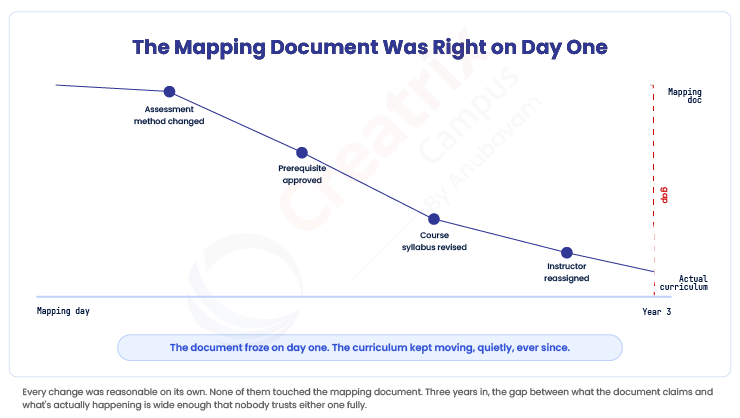
Mapping Day Isn't the Finish Line
Backward design and constructive alignment are genuinely good ideas: start from what a student should be able to do, design assessment to measure it, then build the curriculum to get them there. The theory holds up. The problem is what happens to that alignment after the mapping exercise ends and the semester actually starts.
Curricula aren't static. Courses get refreshed. Assessment methods evolve. Programme committees approve changes for good reasons, industry feedback, faculty expertise, student outcomes data, none of which wait for a convenient time to respect an existing outcome map. Every one of those changes is a small opportunity for an outcome to quietly stop being taught, or stop being assessed the way the mapping document claims it is. Multiply that across a four-year programme with dozens of courses, and the mapping document that was accurate on day one is rarely accurate by year three.
| Treated as | What exists | What breaks over time |
| A mapping exercise, done once | An accurate outcome-to-course matrix, at the moment it was built | Course and assessment changes drift away from it silently |
| An annual mapping refresh | Periodic corrections, usually before a review | Real-time accuracy between refreshes; changes still go untracked for months |
| A living planning layer | Curriculum, assessment, attainment, and improvement staying connected to outcomes as each one changes | Nothing to refresh; the mapping updates with the curriculum itself |
What Breaks the Chain Between an Outcome and an Improvement?
Here's a test worth running on any programme: pick one graduate attribute, trace it to the specific outcome that supports it, then to the course that teaches it, the assessment that measures it, and the improvement decision that responded to a gap in it. Can you actually walk that chain today, in one sitting? For most institutions, the chain exists in theory and breaks in at least one place in practice, usually where a course or assessment changed and the mapping didn't follow.
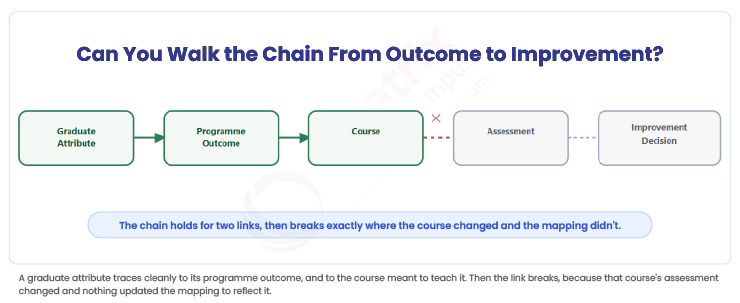
This is where LOCF has to stop being a document and start being infrastructure. Curriculum design and mapping that update together, not separately, means a course change is visible against the outcomes it affects the moment it happens, not discovered during the next accreditation cycle. Malaysia's MQA COPPA framework treats CLO-PLO mapping as a continuous institutional requirement precisely because a mapping exercise frozen at one point in time is what produces the drift reviewers eventually catch. The same connection is what makes outcome-based education function as intended: attainment data and improvement actions feeding back into a curriculum model that's still accurate, not one that was accurate once.
Conclusion
A learning outcomes-based curriculum framework isn't proven by how well it's written on mapping day. It's proven by whether it's still accurate two years and a dozen course changes later. Most LOCF problems aren't a design flaw in the original outcomes, they're the natural result of treating outcome mapping as a project with an end date instead of a layer that has to move with the curriculum it describes.
If your programme's outcome map hasn't been touched since the last review but your courses and assessments clearly have, that gap is worth closing before an accreditor finds it for you.
See how a living LOCF stays connected through curriculum, assessment, and improvement.
Quick recap
LOCF rarely fails because the outcome statements were weak. It fails because outcome mapping gets treated as a one-time deliverable while courses, assessments, and curriculum keep changing around it. Backward design and constructive alignment only hold if the alignment is maintained continuously, not just achieved once at mapping time. A living LOCF connects outcomes to curriculum, assessment, attainment, and improvement as each one evolves, so the chain from outcome to improvement stays traceable instead of breaking quietly somewhere in the middle.
Frequently asked questions
What does it mean for a learning outcomes-based curriculum framework to "drift"?
Isn't backward design supposed to prevent this?
How would we know if our LOCF has already drifted?
Does this require redoing our outcome mapping from scratch?
Who should own keeping an LOCF connected over time?
Join the conversation
Want to contribute?
We welcome thought leaders to share ideas and write for our blog.
Become a guest author