
On this page
As universities connect more academic workflows, records, and systems together, the question that matters most isn't whether each individual control is strong. It's whether security, access, and privacy operate as one connected trust foundation, or as a patchwork of separately managed safeguards with gaps between them.
Quick answer
Cloud security for university data works best when access control, encryption, hosting decisions, resilience, and privacy compliance are treated as one connected trust layer, not as ten separate technical checkboxes. As institutions link more academic and administrative systems together, a gap in any one control can undermine the whole structure. Leadership should evaluate security as a foundation question, not a features list.
Article summary
Problem: Universities often evaluate cloud security as a list of isolated technical controls, which misses whether those controls actually work together as institutional data moves across connected systems. For: CIOs, IT Directors, Information Security leaders, Registrars, Data Protection leaders, and Provosts. Shift: From reviewing individual security practices in isolation, toward asking whether the institution's trust foundation is as connected as its academic operations. Outcome: A clearer framework for what to actually verify from a cloud partner, rather than another checklist of standard security terms.
Key takeaways
- Security in higher education is not just protecting servers. It's protecting data as it moves across connected academic and administrative workflows.
- A gap in one control, access, encryption, or recovery, can undermine trust in the whole connected system.
- GDPR and FERPA are not interchangeable, and institutions should confirm which framework actually applies to their data.
- SOC 2 reports and ISO certifications describe a vendor's internal controls; they aren't automatically a legal requirement or a guarantee.
- The more connected an institution becomes, the more its security model needs to be equally connected, not more fragmented.
Security Breaks When Institutional Data Has Too Many Trust Boundaries
Every additional system an institution connects, a new integration, a new vendor, a new data-sharing arrangement, adds another boundary where trust has to be re-established. Each boundary is a place where access rules, encryption standards, or audit logging might not carry over consistently, and that inconsistency is exactly what attackers and auditors both look for.
This is different from the traditional framing of cloud security as a checklist of individual practices: data privacy, compliance audits, risk management, access management, each handled as its own workstream. Those practices still matter, but treating them as separate boxes to tick misses the more important question of whether they connect coherently as data moves from admissions, to academic records, to reporting, to a third-party integration.
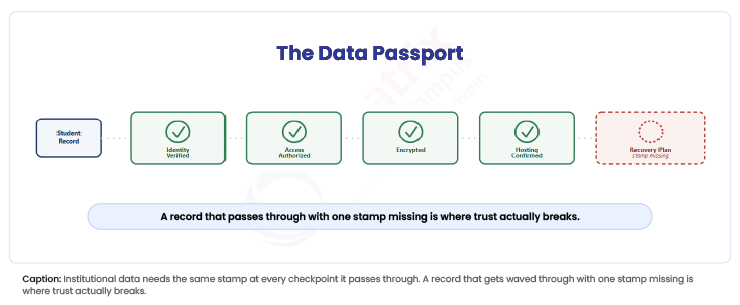
Visual Direction: A single student record shown as a travel document moving left to right through five checkpoint stations, each stamping the passport in sequence: "Identity Verified," "Access Authorized," "Encrypted," "Hosting Confirmed," and "Recovery Plan Attached." At the final station, a checkpoint is shown with a missing stamp pad, and the passport passes through without that stamp, visibly incomplete.
Caption: Institutional data needs the same stamp at every checkpoint it passes through. A record that gets waved through with one stamp missing is where trust actually breaks.
Alt Text: Diagram of a travel document representing a student record moving through five sequential checkpoint stations, each adding a stamp: Identity Verified, Access Authorized, Encrypted, Hosting Confirmed, and Recovery Plan Attached. At the final checkpoint, the stamp pad is shown missing, and the document passes through incomplete, illustrating how a gap at any single checkpoint undermines the full chain of institutional data trust.
Regulatory frameworks add another layer of boundary that's frequently mishandled. GDPR and FERPA are not interchangeable: GDPR is an EU regulation governing personal data broadly, while FERPA specifically governs the privacy of US student education records. An institution with international students or partnerships may need to satisfy both, and a cloud partner should be able to speak to each distinctly rather than offering one blended compliance answer.
What University Leaders Should Expect From a Secure Cloud Foundation
Rather than asking a vendor to walk through ten individual practices, it's more useful for leadership to ask a smaller set of pointed questions and expect specific, verifiable answers, not general assurance language.
| Security Question | Why It Matters in Higher Education | What Leadership Should Verify |
| Who can access the data? | Student and institutional records contain sensitive personal information | Role-based access controls, identity management, and audit logging |
| Where is the data hosted? | Residency and regulatory obligations can differ by jurisdiction | Specific hosting locations, residency commitments, and subprocessor disclosures |
| What happens during failure or downtime? | Academic operations can't simply pause during registration or exams | Backup frequency, recovery time objectives, and continuity commitments in writing |
| How are changes controlled? | Misconfiguration during updates is a common source of exposure | Documented change management process and review cadence |
| How are security incidents handled? | Response speed affects how much institutional risk actually materializes | Incident response process, notification timelines, and communication commitments |
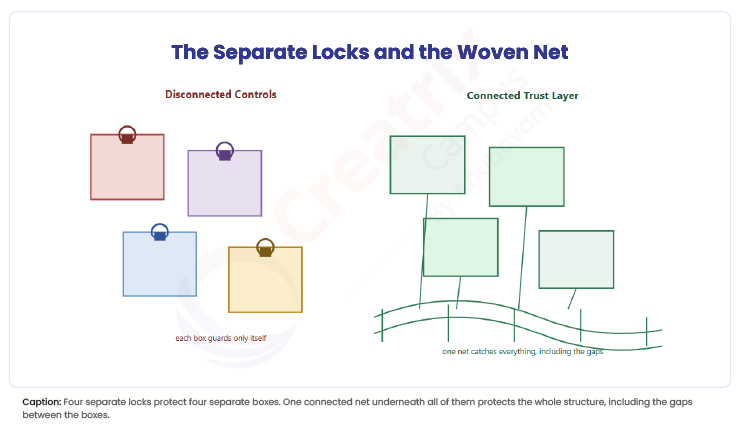
Visual Direction: Two panels. Left panel, labeled "Disconnected Controls," shows four separate boxes, each representing a different system, sitting apart with visible gaps between them, each with its own individual small padlock and no shared structure underneath. Right panel, labeled "Connected Trust Layer," shows the same four boxes sitting together on top of one continuous woven safety net that spans underneath all of them as a single connected layer.
Caption: Four separate locks protect four separate boxes. One connected net underneath all of them protects the whole structure, including the gaps between the boxes.
Alt Text: Two-panel diagram. On the left, labeled Disconnected Controls, four separate boxes sit apart with gaps between them, each secured by its own individual padlock. On the right, labeled Connected Trust Layer, the same four boxes sit together on one continuous woven safety net spanning underneath all of them, illustrating the difference between isolated security controls and one connected institutional trust foundation.
Verifying these answers matters more as institutions connect more of their platform, data, and integration architecture together, since each new connection point is where a gap in one of these five areas would surface. It's also worth checking that governance and accountability structures extend to who owns a security decision institutionally, not just who configures a setting technically. The National Institute of Standards and Technology's Cybersecurity Framework is a useful, vendor-neutral reference for structuring exactly this kind of evaluation, organized around identifying, protecting, detecting, responding to, and recovering from risk as one connected process rather than isolated practices.
Where Creatrix Campus Fits
Creatrix Campus connects academic lifecycle data, curriculum, assessment, governance, and student records, inside one governed structure with role-based access controls, so that permissions and data flow follow consistent rules as information moves between lifecycles rather than resetting at each system boundary. This is the specific gap this article points to: a security posture that stays connected as the institution connects more of its operations.
For current information on certifications, hosting infrastructure, and compliance attestations, institutions should review Creatrix Campus’s Trust and Security documentation as part of their due diligence.
Conclusion
Cloud security for university data was never really a list of ten practices to implement and move past. It's a question of whether access, encryption, hosting, resilience, and privacy compliance work together as one trust foundation, especially as institutions connect more academic operations to each other. A gap at any single boundary is where that foundation actually gives way.
If your institution is connecting more systems and workflows together and wants to evaluate whether your security model is keeping pace, that's worth a direct conversation. Talk to our team about how Creatrix Campus governs access and data across connected academic lifecycles. Results vary by institution, and no platform can guarantee specific security, compliance, or audit outcomes.
Quick recap
Cloud security for a university works best as one connected trust layer across access, encryption, hosting, resilience, and privacy, not as a list of separately managed controls.
The more systems and workflows an institution connects, the more a gap in any single control can undermine trust in the whole structure, which is why leadership should evaluate security as a foundation question rather than a checklist.
Frequently asked questions
Are GDPR and FERPA the same requirement?
Is a SOC 2 report a legal requirement for a cloud vendor?
What's the biggest security risk when universities connect more systems together?
How should a university evaluate a cloud partner's data residency commitments?
Can technology alone guarantee institutional data security?
Does Creatrix Campus provide the cloud infrastructure for a university?
Join the conversation
Want to contribute?
We welcome thought leaders to share ideas and write for our blog.
Become a guest author